Payment systems are entering one of their most important periods of development since financial services became digital. Customers expect transfers to arrive within seconds, businesses want financial functions embedded inside their products, and regulators are encouraging open banking, instant payments, richer data exchange, and stronger oversight.
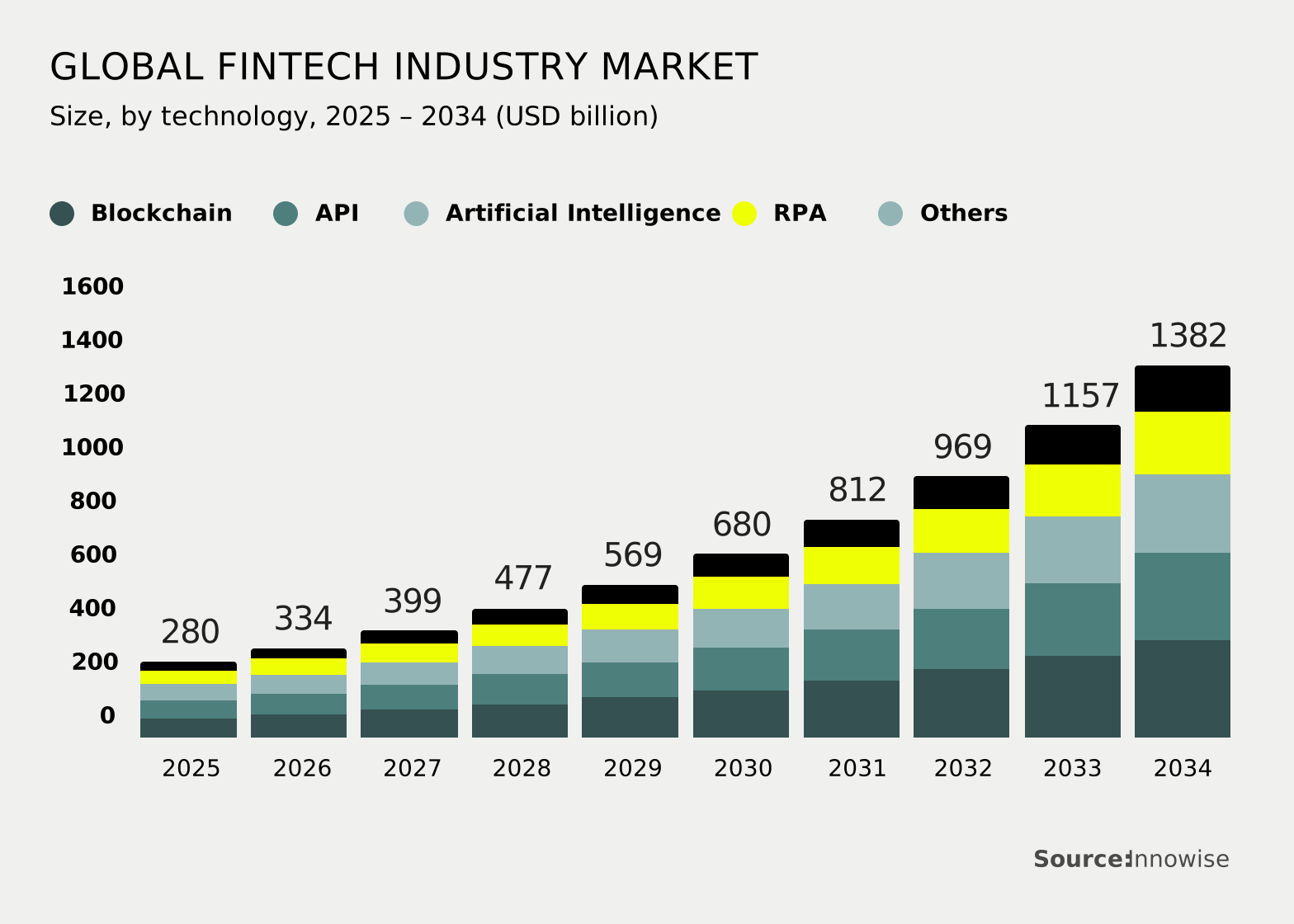
Digital assets have added another settlement option, while modern APIs allow banks, fintech companies, payment service providers, and merchants to connect services through consistent interfaces. These changes are producing payment architecture built around modular components, continuous processing, automated controls, and several settlement methods. Recent investment data shows where capital is concentrating:
- Coinspaid research found global fintech investment rising from $95.5 billion in 2024 to $116 billion across 4,719 deals in 2025. Investment in digital assets also increased from $11.2 billion to $19.1 billion during the same period. Higher investment alongside fewer deals indicates greater capital concentration among companies with established technology, regulated operations, and durable business models.
- Finch Capital describes payments and RegTech as two of Europe’s strongest fintech sectors, both requiring deep technical capability and close regulatory oversight. Its 2026 analysis found UK fintech companies accounting for 70% of European venture and growth deal value in 2025.
Why legacy payment systems struggle with modern demands
Many established payment systems were designed around closed banking networks, local clearing schedules, and end-of-day processing. New functions were often added through separate applications and custom connections, creating environments where payment initiation, account management, fraud controls, currency conversion, and reconciliation operate across different systems.
A single payment can pass through a customer application, gateway, processor, correspondent bank, and local clearing system before reaching the beneficiary. Each participant may apply separate cut-off times, data requirements, and compliance checks. Transaction status becomes harder to follow when each system stores its own record and updates information at different intervals.
Batch processing also separates customer confirmation from final settlement. A business may receive confirmation of submission while the underlying transfer remains pending until the next clearing window. Weekend schedules, time zones, and intermediary reviews can extend settlement further.
Operational costs rise when staff investigate exceptions across several interfaces. Reconciliation may depend on files exchanged at fixed intervals, while treasury teams move funds between accounts or providers by hand. Product development also slows when each new currency, market, or payment method requires several custom integrations.
Modern payment architecture addresses these constraints through defined services. Each component performs a specific function, exchanges data through consistent interfaces, and records transaction progress in near real time.
| Legacy systems | Modern payment architecture |
|---|---|
| Large applications with many internal dependencies | Modular services with defined responsibilities |
| Batch files and scheduled processing | APIs, webhooks, and event-based processing |
| Separate transaction records | Coordinated ledger and transaction data |
| Manual exception handling | Automated routing and policy execution |
| Fixed provider connections | Replaceable banking, liquidity, and settlement providers |
| Business-hours treasury management | Continuous liquidity and settlement monitoring |
| Custom data formats | Standardized data models such as ISO 20022 |
The main components of modern payment architecture
- APIs connect customer channels with account systems, payment engines, compliance services, liquidity providers, and external settlement networks. They allow institutions to exchange instructions and status updates through documented interfaces.
- Modular services separate payment initiation, transaction routing, custody, liquidity, compliance, and reconciliation. Institutions can develop or replace one component while preserving the rest of the environment.
- Real-time processing updates transaction status, balances, and internal records as a payment progresses. Operations teams gain current information, while customers receive more accurate updates.
- Multiple settlement options allow one platform to connect with bank transfers, instant payment systems, card networks, and blockchain networks. The selected route can depend on currency, market, counterparty, cost, and required completion time.
- Liquidity management keeps funds available in the right account, asset, and currency. Automated controls can monitor balances, consolidate funds, and initiate treasury movements when preset conditions are reached.
- Compliance automation embeds identity checks, transaction monitoring, sanctions screening, and approval policies inside the payment process. Instant payments create little room for manual review, so automated decisioning becomes essential.
- A common transaction record supports customer updates, accounting, reporting, and investigation. ISO 20022 provides richer payment data and can improve analytics, fraud controls, and straight-through processing. Swift reports almost 200 financial market initiatives implementing or considering ISO 20022 across payments and securities.
API-first design as the foundation of modern finance
An API-first model begins by defining how components exchange data before individual products are built around them. Each service receives a defined request, performs its function, and returns a predictable response.
This approach gives financial institutions several advantages:
- This model separates the customer experience from payment execution. A neobank, marketplace, or merchant can design its own interface while a payment platform handles processing underneath it. Mobile applications, web portals, and business software can all connect to the same processing engine.
- APIs also support modular development. A company can connect an external foreign exchange provider, add a new compliance service, or introduce another settlement route while preserving its customer product. Stable interfaces reduce dependencies between internal teams and external providers.
- Developer access improves as well. Teams can test payment functions in sandbox environments, use webhooks to receive status changes, and automate transaction handling through documented endpoints. Integration becomes easier to maintain when authentication, error codes, idempotency rules, and version control follow common standards.
These capabilities support embedded finance, where financial services appear inside software products used by merchants, marketplaces, or corporate clients. Customer-facing companies retain control over design and user experience, while licensed institutions and specialist providers operate the underlying accounts, payments, custody, or settlement functions.
API-first banking also supports open banking. The UK Open Banking Standard uses RESTful APIs to let authorised providers access account information and initiate payments with customer consent. Its specifications define common methods for identity, payment initiation, security, and data exchange.
Cross-border interoperability remains an important development area. In 2026, the Bank for International Settlements completed Project Aperta, a prototype connecting open finance networks through a neutral API translation and directory service. The project linked networks in the UK, UAE, Brazil, Hong Kong, and India, showing how common interfaces can support cross-border data portability while domestic systems retain their own standards.
Reliable payment APIs require strong operational controls. Institutions need authentication, rate limits, monitoring, version management, idempotency, and consistent error handling. Webhooks require verification, transaction requests require traceable identifiers, and failed operations require recovery procedures designed to prevent duplicate payments.
API-first design therefore combines developer access with governance. The interface becomes a control point for permissions, transaction limits, audit records, and service monitoring across the payment environment.
Blockchain as part of financial architecture
Blockchain provides another environment for recording ownership, transferring value, and completing settlement. Its relevance to financial institutions extends beyond individual cryptocurrencies because the same technology can support tokenized deposits, tokenized securities, treasury transfers, and programmable payments.
Traditional cross-border payments often require several institutions to update their records in sequence. Each participant confirms receipt, completes checks, and passes a new instruction to the next participant. Blockchain networks can give authorised participants access to a shared transaction record and allow them to verify when an asset has transferred.
The Bank for International Settlements describes tokenization as recording claims on financial or physical assets on programmable platforms. Its 2025 Annual Economic Report explains how tokenization can combine messaging, reconciliation, and asset transfer within one operation. The report also examines tokenized platforms for cross-border payments and securities settlement.
Several infrastructure functions become possible:
- Settlement. Digital assets can be transferred between wallets at any time the underlying network is available. This creates an additional route for international payments and treasury movements.
- Tokenized assets. Bank deposits, securities and other claims can be represented digitally. Payment and asset transfer can then occur within connected programmable environments.
- Transparency. Participants can inspect transaction status and settlement history through a shared ledger, subject to the network’s access controls.
- Programmability. Payment instructions can be connected to predefined conditions. Funds may be released once an asset is delivered, an approval is received or another event occurs.
- Atomic exchange. The transfer of an asset and its payment can be coordinated so both complete together. This can reduce principal risk in delivery-versus-payment and payment-versus-payment arrangements.
- Interoperability. Blockchain gateways can connect internal payment systems with several networks through one integration, reducing the need to create and maintain separate node infrastructure for every blockchain.
These capabilities come with requirements. Institutions must manage keys, transaction signing, network fees, wallet balances and blockchain reorganizations. They also need transaction monitoring, sanctions screening and procedures for handling deposits from external addresses.
Public blockchain networks and tokenized assets therefore form one component within a larger payment architecture. Banks, electronic money institutions, custodians and payment providers continue to perform essential functions around identity, safeguarding, compliance, liquidity and customer service.
Blockchain changes how some of these functions connect and how settlement can occur. It does not remove the need for regulated institutions.
Real-time settlement as a standard
Real-time settlement has become an expected part of modern payment technology. The Federal Reserve’s FedNow Service gives participating US financial institutions round-the-clock instant payment and settlement capability. In Europe, TARGET Instant Payment Settlement completes eligible payments in central bank money throughout the day.
European adoption accelerated during 2025. TIPS processed 2.47 billion transactions, an increase of 82.5% from 2024, while technical availability reached 99.99%. Euro-denominated activity also increased following implementation of the EU Instant Payments Regulation.
Since October 2025, euro-area payment service providers have been required to offer instant euro transfers around the clock. Providers must also offer payee verification by comparing the beneficiary name with the supplied IBAN before processing.
Naturally, real-time settlement changes the model around each payment. Continuous processing requires continuous fraud monitoring, current balance information, automated liquidity controls, and accounting records updated as transactions complete. Compliance checks must return decisions within the payment window, while exception handling must remain available outside normal business hours.
Settlement speed depends on the complete payment environment. A fast external network delivers limited value when internal ledgers update every few hours or withdrawals wait for manual approval. Institutions therefore need payment processing, compliance, treasury, and reconciliation to operate as one coordinated system.
Payment modernization succeeds when institutions separate the customer experience from the underlying execution. APIs provide the control plane, while instant payment systems and blockchain networks provide additional settlement options. The main challenge lies in coordinating liquidity, compliance, custody, and reconciliation as one continuous operation
Institutions also need accurate status definitions. Customer confirmation, provider acceptance, clearing, and final settlement can occur at different points. Modern systems should communicate each stage precisely and maintain one authoritative transaction record throughout the process.
Modular financial systems
Modular architecture divides the payment lifecycle into services selected according to an institution’s operating model.
| Component | Function |
|---|---|
| API gateway | Authenticates requests and manages access |
| Payment orchestration | Determines how each operation should be processed |
| Ledger | Records balances, holds, and completed movements |
| Compliance engine | Applies AML, KYT, sanctions, and transaction policies |
| Custody or key management | Secures assets and authorises transactions |
| Liquidity and exchange | Manages balances and currency conversion |
| Settlement connectors | Connect to banks, payment systems, and blockchain networks |
| Merchant management | Configures clients, pricing, and settlement terms |
| Reconciliation | Matches transactions with bank, provider, and blockchain records |
| Reporting and monitoring | Provides balances, status updates, and audit records |
Modularity gives institutions greater control over sourcing. For example:
- A bank may retain its internal ledger and compliance systems while using an external blockchain gateway;
- A payment provider may operate its merchant portal internally while connecting specialist custody and liquidity services;
- A fintech may adopt a complete enterprise platform during launch and replace selected components as requirements develop.
This model also helps institutions manage differences between markets. Compliance rules, supported assets, settlement providers, and approval policies can vary by jurisdiction while the customer interface remains consistent.
Strong governance remains essential. Components need common identifiers, consistent transaction states, and defined responsibilities. A payment should retain the same reference through screening, conversion, settlement, and accounting. The institution must also identify the authoritative balance source, approval authority, and recovery method for interrupted transactions.
How financial institutions can prepare today
Modernization begins with a full map of the payment lifecycle, covering customer initiation, internal approvals, external providers, ledger updates, compliance checks, treasury movement, settlement, and reconciliation. This review can identify duplicated records, manual handovers, and dependencies on scheduled processing.
A common data model should follow. Institutions need standard transaction identifiers, account definitions, status codes, and event records. ISO 20022 offers a useful foundation because it carries detailed information about parties, accounts, and remittance data. Richer data can improve reconciliation, compliance, analytics, and customer reporting.
An API management environment can then centralise authentication, permissions, rate limits, monitoring, and version control. Early APIs may cover payment initiation, balance queries, transaction status, and merchant configuration, with further services added as governance develops.
Operations also need preparation for continuous processing. Treasury teams require current balance data, automated alerts, and defined procedures for provider failures, compliance exceptions, and insufficient funds throughout the day.
Importantly, payment orchestration should remain separate from settlement. The orchestration service determines the provider, currency, route, and settlement method for each transaction. This design allows an institution to add instant payments or blockchain settlement while preserving the customer-facing product.
Policy execution can also become automated. Transaction limits, trusted beneficiaries, approval levels, sanctions controls, and risk rules can operate inside the platform, with audit records and exception queues preserving oversight.
A staged programme reduces operational risk. Institutions can place APIs in front of existing systems, replace selected services, and introduce new settlement connections one at a time. Each development can then be tested under production conditions before further changes follow.
Coinspaid Enterprise
Coinspaid Enterprise offers one example of how modular payment infrastructure can be delivered as a ready-made platform.
The product is intended for licensed electronic money institutions, payment service providers, banks, CASPs and regulated fintech companies adding digital asset payments or settlement under their own brand and license.
Under this model, the financial institution runs the commercial business and retains control of its license, treasury strategy and provider relationships. Coinspaid operates the technical engine behind custody, blockchain connectivity, liquidity routing, compliance execution and monitoring.
The platform divides these responsibilities into several connected components.
- Core Processing receives operations and determines which component should handle them. It coordinates deposits, withdrawals, currency exchange and settlement without requiring merchant-facing applications to interact with blockchain networks directly.
- Crypto Gate and Custody creates addresses, processes blockchain transactions and secures assets and keys in an isolated environment.
- Exchange Aggregator connects liquidity providers and identifies an appropriate execution route when a transaction requires conversion.
- Compliance Guard screens transactions, manages approvals and maintains an audit history.
- Processing and Merchant Portals allow the licensed operator to onboard and configure merchants, establish fees and manage settlement arrangements.
- The Admin Panel and FinApp support asset configuration, balance monitoring, accounting and automated settlement.
This design illustrates the difference between buying an individual payment feature and adopting an operating environment. Custody, liquidity and compliance are connected to the same processing engine, allowing transaction status and balances to remain coordinated.
The arrangement will suit institutions that want Coinspaid to operate much of the underlying technology. Businesses seeking client-controlled keys, wallets and transaction signing can use a different deployment model through Coinspaid Core. Core provides wallet infrastructure, a payment engine, liquidity tools, compliance controls and managed blockchain connectivity while keys and signing remain within the client’s environment.
The future is already being built
Modern payment architecture combines modular services, APIs, blockchain connectivity, and continuous settlement:
- APIs connect financial products with processing and external providers;
- Modular components allow institutions to add capabilities while preserving existing systems;
- Instant payment networks support round-the-clock bank settlement;
- Blockchain networks offer additional methods for transferring digital value and tokenized assets.
Successful modernization requires coordination across payment processing, compliance, liquidity, custody, and reconciliation. Faster settlement depends on automated controls, current balance data, accurate transaction records, and reliable provider connections.
Many required capabilities already exist through established payment systems, common technical standards, and enterprise platforms such as Coinspaid Enterprise and Coinspaid Core. Financial institutions can therefore begin implementation today through staged development aligned with their licensing model, technical resources, and commercial plans.
Frequently asked questions
Blockchain will become one of several settlement and asset-recording technologies used by financial institutions. Banks and other regulated providers will continue to manage customer relationships, account services, liquidity, safeguarding and compliance.
Blockchain can improve how value moves between institutions and how ownership records are updated. Its role will depend on the asset, jurisdiction, network design and regulatory model.
The main technologies include payment APIs, modular processing services, instant payment systems, blockchain connectivity, automated compliance, real-time ledgers and intelligent payment routing.
Shared data standards such as ISO 20022 will help these components exchange richer transaction information.
APIs allow customer applications, payment engines and external providers to communicate through standardized interfaces. They support faster integrations and make individual components easier to replace or extend.
APIs also enable embedded finance by allowing businesses to place financial services inside their own applications while specialist institutions operate the underlying accounts and payment functions.
Blockchain can support continuous settlement, shared transaction records and programmable transfer conditions. It can also reduce sequential reconciliation between participants when they use the same network or interoperable systems.
Financial institutions still need custody, compliance, liquidity and governance around blockchain transactions.
Institutions should begin by mapping their payment lifecycle and identifying manual steps, duplicated records and fixed provider dependencies.
They can then introduce common data standards, API management, payment orchestration and real-time monitoring. Individual components can be replaced gradually to reduce operational risk.
Preparation should cover technology and operations. Institutions need modular systems, reliable APIs and access to appropriate settlement networks. They also need continuous compliance monitoring, automated treasury controls and staff procedures for a 24/7 environment.
Ready-made enterprise platforms can shorten development time when the institution lacks the resources or specialist knowledge to build custody, blockchain connectivity and compliance technology internally.