Quick Answer
- Fintech is the use of technology to deliver financial services.
- Fintech innovation refers to the new tools, models, and infrastructure that make those services faster, cheaper, and more accessible.
- Digital payments, embedded finance, AI-driven automation, and open banking shape today’s fintech trends.
- Blockchain has transitioned from an emerging technology to a core component of this shift, providing the new infrastructure behind global payments, settlement, and digital asset operations.
Together, these forces are reshaping how money moves between consumers, businesses, and financial institutions.
What Areas Are Considered Fintech?
Fintech covers several types of financial services built around software and data:
- Payments and transfers — digital wallets, mobile payments, cross-border transfers, and stablecoin settlement.
- Lending and credit — peer-to-peer lending, buy-now-pay-later services, and AI-based underwriting.
- WealthTech — robo-advisors, retail investing apps, and automated portfolio management.
- InsurTech — usage-based insurance, claims automation, and risk modeling.
- RegTech — compliance solutions, KYC/AML automation, and fraud detection.
- Blockchain and digital assets — crypto payment infrastructure, tokenization, and decentralized finance (DeFi).
These areas increasingly overlap. A modern payment app can hold deposits, offer credit, and settle in stablecoins, all within a single product.
FinTech Transforming Everyday Life
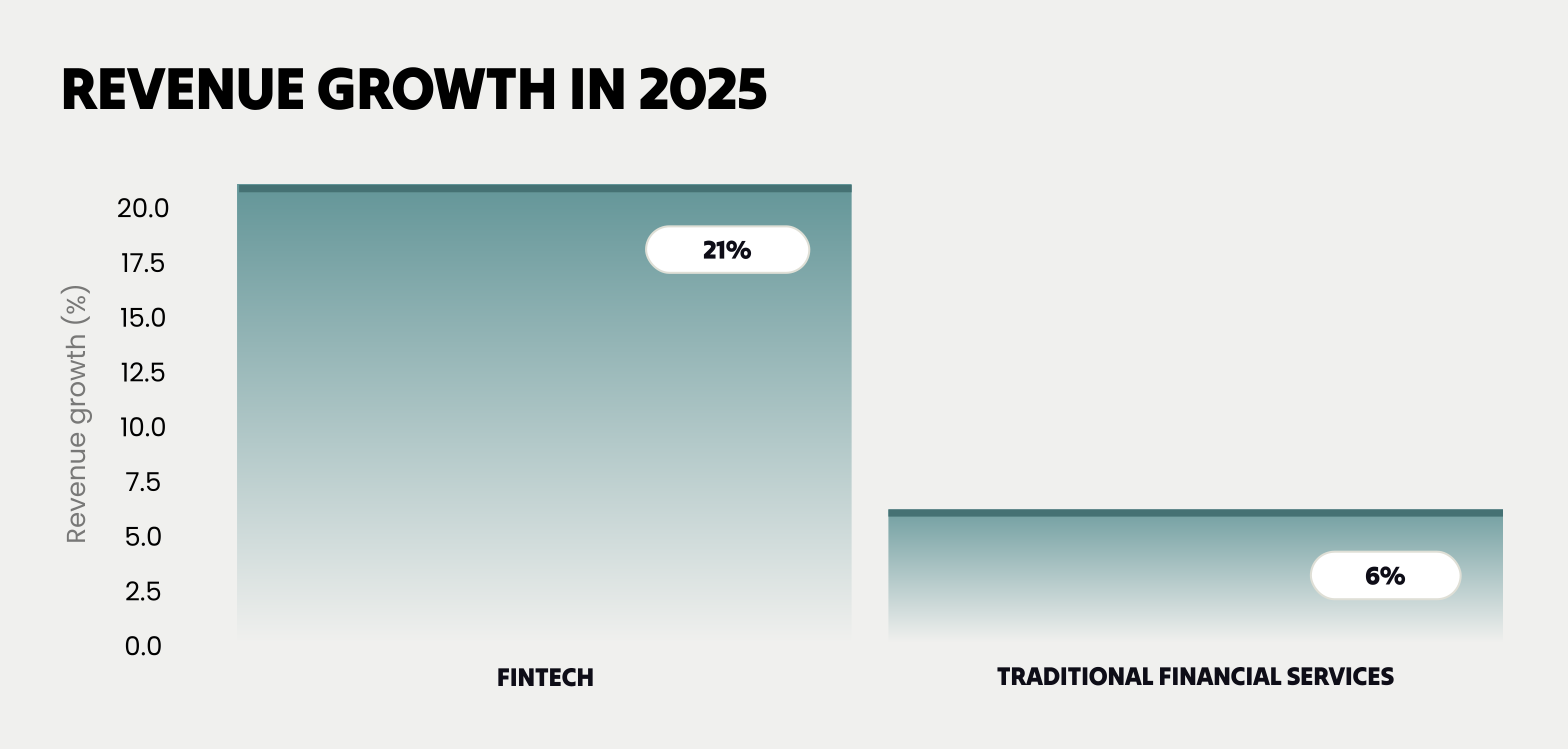
FinTech continues to grow faster than traditional financial services, becoming an integral part of how businesses and consumers manage payments, transfers, investments, and financial operations every day.
Source: McKinsey
Some fintech innovation examples are already part of daily life:
- Mobile wallets (Apple Pay, Google Pay, Revolut) — contactless payments and stored balances on a phone.
- Buy-now-pay-later (Klarna, Affirm) — short-term installment credit at checkout.
- Neobanks (N26, Monzo, Nubank) — fully digital banks with no physical branches.
- Robo-advisors (Betterment, Wealthfront) — algorithm-driven investing for retail users.
- Cross-border payment apps (Wise, Remitly) — cheaper, faster international transfers.
- Crypto on/off-ramps — services that convert between fiat and digital assets, often built into mainstream apps.
- Embedded payments — checkout, payouts, and lending built directly into non-financial platforms like marketplaces, ride-hailing, and SaaS tools.
What connects these services is simplicity. Processes that once took time, paperwork, and manual effort can now be completed in a few taps.
Key digital finance innovation and financial technology trends
Digital payments evolution
Real-time payment networks, account-to-account transfers, and stablecoin settlement are already reshaping card and bank rails. Trends in digital payments point toward instant, always-on, lower-cost flows that work across borders. Real-time payment systems now operate in over 70 countries.
Embedded finance
Financial products are expanding into non-financial platforms. A logistics company might offer working-capital loans to its drivers, a marketplace can run its own wallet, and an HR platform can handle payroll in multiple currencies. The financial layer operates in the background, which aligns with most users’ preferences.
AI and automation
Machine learning powers fraud detection, credit scoring, customer service, and personalized advice. Generative AI is now used inside banks for document processing, code review, and analyst workflows.
Open banking and open finance
Regulated APIs let third parties access account data with user consent. This has unlocked new categories of budgeting, lending, and account-aggregation products, and the model is now extending into open finance, covering pensions, investments, and insurance.
Tokenization of real-world assets.
Banks and asset managers are issuing tokenized money market funds, bonds, and deposits on blockchain rails to settle faster and reduce reconciliation costs.
| Digital payments | Embedded finance | AI & automation |
Open banking
| Stablecoins & tokenization | Blockchain infrastructure
|
The role of blockchain in fintech
Blockchain matters in fintech because it offers a shared settlement layer that doesn’t depend on any single institution. These are the main use cases:
- Settlement and clearing — moving value between parties without multi-day delays.
- Cross-border payments — bypassing correspondent banking chains and reducing fees.
- Stablecoins — fiat-pegged digital assets used for payments, payouts, and treasury management.
- Tokenized assets — securities, deposits, and funds issued on-chain.
- Programmable money — smart contracts that execute payments under defined conditions.
The role of blockchain in finance has shifted from an alternative to the banking system to a complementary infrastructure that facilitates more efficient processing. Today, it’s more about coexistence, providing high-speed rails running alongside existing ones. Stablecoin transaction volumes have crossed several trillion dollars annually, and a growing share of that activity is payment-related rather than purely speculative.
This is also where the line between crypto and fintech is fading. A retailer accepting USDC at checkout, or a bank settling Eurobonds on-chain, both rely on blockchain underneath. To the end user, it just looks like payments.
Blockchain payment infrastructure in practice
How does a business actually accept, send, or settle in digital assets without building everything from scratch?
That is the role of blockchain payment infrastructure — the set of components that sit between a business application and the underlying public networks. It typically includes:
- Wallet generation and key management.
- Transaction monitoring across multiple blockchains.
- On-chain and off-chain settlement.
- Compliance tooling (KYT, sanctions screening, audit trails).
- Reporting and reconciliation.
- Fiat and stablecoin conversion.
Most companies have no interest in maintaining nodes for 20+ blockchains, monitoring mempool conditions, or managing hot-wallet security in-house. They want their payments to clear, and a clean trail when auditors come knocking. Specialized providers fill that gap.
Coinspaid is one example of a provider delivering blockchain payments infrastructure to businesses, with a focus on processing, wallets, and settlement across multiple networks. It sits in the same broader category as other infrastructure plays: payment service providers, custodians, and stablecoin orchestration platforms. These providers handle the technical and compliance complexity, so that businesses can offer digital asset payments through familiar interfaces.
Regardless of the provider, fintech infrastructure has become its own layer of the stack, much like cloud computing did for software.
Why fintech infrastructure matters more than individual solutions
Fintech is shifting from products to ecosystems. Behind a single neobank app sit dozens of integrated services covering KYC, card issuing, ledgers, risk, and payments. A merchant accepting digital assets has its own version of the same problem, with wallets, compliance, fiat conversion, and reporting all needing to work together.
Building each component in-house is slow and expensive. Payments are now multi-currency, multi-network, and multi-jurisdiction, and the complexity is growing faster than internal teams can absorb. That is why ready-made infrastructure has become a deciding factor in whether a fintech project ships in months or years.
The companies that tend to succeed here pick the right rails first and concentrate their engineering on the product layer that customers actually see. Feature lists alone rarely decide the outcome.
Benefits for businesses
Modern fintech infrastructure offers clear, measurable advantages:
- Faster time to market — launching new payment flows in weeks rather than years.
- Lower operating costs — automation reduces manual reconciliation, settlement, and support.
- Global reach — accepting and paying out in multiple currencies and networks from day one.
- Improved cash flow — instant or near-instant settlement instead of multi-day waits.
- Better customer experience — fewer failed payments, less friction at checkout.
- Compliance by design — built-in monitoring, audit trails, and reporting.
- Scalability — infrastructure that handles growing transaction volumes without re-architecture.
The effects tend to compound over time. A business that settles faster, pays out cheaper, and works across more markets has a structural advantage over competitors stuck on legacy rails.
Challenges in fintech innovation
Fintech innovation has its own set of difficulties.
- Fragmented regulation. Rules vary widely across jurisdictions, and they change quickly. Operating in multiple markets requires constant legal and compliance work.
- Security and fraud. Faster payments attract faster fraud. Account takeover, authorized push payment scams, and on-chain exploits are all rising.
- Legacy integration. Most banks still run on decades-old core systems. Connecting modern fintech to those systems is harder than it looks.
- Talent and trust. Specialized engineering and compliance talent is scarce, and customers still rank trust above novelty when choosing a financial provider.
- Volatility and concentration risk. In digital assets specifically, exposure to a small number of stablecoins or networks creates new dependencies.
For most teams, however, these issues are not critical. They represent ongoing operational requirements for continuous management, rather than a one-time solution.
Regulation in fintech
Regulation now shapes product design directly, rather than sitting alongside it.
The European Union’s MiCA framework now governs crypto-asset issuers and service providers across member states. PSD3 is updating the open banking and payment services rules. The UK and Singapore have published detailed regimes for stablecoins. The US continues to develop its approach through a mix of state and federal action, with stablecoin-specific legislation under active discussion.
For businesses, the practical implications are consistent: stronger KYC and AML obligations, clearer rules for stablecoin issuance and custody, transaction-level monitoring, and detailed reporting. Looking at the future of fintech, companies that build compliance into the product tend to scale more reliably than those that bolt it on as an afterthought.
The future of fintech and digital payments innovation
Several themes will shape the next phase of digital payments innovation and the broader fintech sector.
- Stablecoins as mainstream payment infrastructure. Expect more merchants, payroll providers, and B2B platforms to settle in stablecoins as a normal option alongside cards and bank transfers.
- AI agents transacting on behalf of users. Autonomous software will make payments, subscriptions, and financial decisions within set guardrails.
- Tokenized deposits and money market funds. Banks will move everyday balance sheets onto programmable rails.
- Convergence of fintech and crypto infrastructure. The two stacks will increasingly look like one.
- More embedded, less visible. Financial services will keep moving into the background of the apps people already use.
Speaking at Stablecon USA in Washington, DC, on September 9, Pavel Kashuba, Strategic Leader at Coinspaid Solutions, outlined a future in which users interact with an AI agent while payment systems communicate behind the scenes through APIs.
“For us, the only interface is going to be our AI agent,” he said.
His prediction points to a change in the role of payment interfaces: users could delegate transactions to an agent instead of navigating separate payment pages. In this model, the systems processing the transaction become less visible to the person making it.
Pavel also sees blockchain as complementary infrastructure for interactions between AI agents. His perspective connects two developments in fintech innovation: simpler user interfaces and greater connectivity between the systems moving money.
Watch the full interview where Pavel discusses how agentic AI could reshape payment interfaces and the role blockchain could play.
Success in this environment belongs to companies that treat infrastructure as a strategic priority, and choose partners capable of managing the technical and compliance burden.