Why Agentic Commerce Matters for Financial Institutions
Table of contents:
AI agents are moving from product discovery toward transaction execution. For Pavel Kashuba, the payments question begins when one AI agent has to transact with another: which infrastructure can move value at software speed, across borders, and without the friction built into legacy payment chains?

Pavel Kashuba, Strategic Leader at Coinspaid, explored this question at the Payments Leaders’ Summit in London on 28–29 April, 2026. Drawing on his experience with modular payment, custody, exchange, finance, and audit infrastructure for merchants and financial institutions, he explained that choosing the right payments partner increasingly depends on two areas where proven expertise is essential: security and regulation.
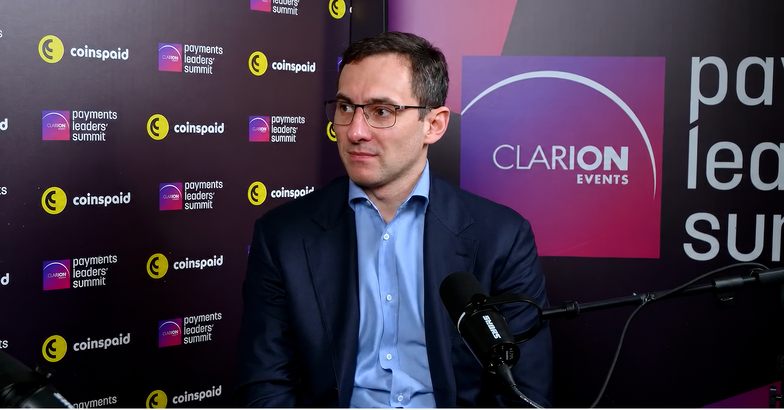
His view was pragmatic: traditional and blockchain payment rails will coexist for a long time because businesses have built complete customer journeys around legacy infrastructure. However, technologies that are faster, more cost-efficient, and easier to integrate will continue to gain ground
What agentic commerce means in business terms
What is agentic commerce?
Agentic commerce is a model in which an AI agent can discover products or services, evaluate options, make a decision, and complete a purchase within rules set by a person or business. The agent moves beyond advice and becomes an authorized participant in the transaction.
Pavel Kashuba illustrated the model with a simple request: “Alexa, I’m having a party for 40 people. You already have the guest list. Please order everything we need and pay using the money in my bank account.” The example captures the shift from recommendation to execution. From a business perspective, the agent would need to coordinate product selection, checkout, payment, delivery, and any later exception without returning to the user for approval at every step.
The business version is similar. An enterprise agent could reorder approved inventory, buy cloud capacity, renew software licenses, pay a data provider per query, or move funds between operating entities under a treasury policy. In each case, the economic action is delegated, bounded, and recorded.
Why has agentic commerce become a payments issue now?
Agentic commerce has become a payments issue because the technology needed for agents to execute multi-step tasks is moving into live commerce. Kashuba’s point is that “the technology is already here”; payment infrastructure now has to catch up with software that can make and execute decisions without a person present at checkout.
He linked these changes to the rapid evolution of business demand. When the company began operating as a licensed entity in Estonia in 2019, clients mainly asked for Bitcoin. Ethereum followed, and stablecoins then opened a new phase. He also mentioned that major changes can now occur within a single quarter. For financial institutions, that pace shortens the time available to build expertise, controls, and integration capacity.
The argument applies across protocols. When one AI agent communicates with another, the underlying rail has to support fast execution, low unit costs, global reach, and straightforward integration. Kashuba expects that requirement to favor blockchain-based infrastructure in selected use cases.
How is the market responding?
Industry developments show how the market is responding. Google introduced the Agent Payments Protocol, or AP2, to carry verifiable evidence of user intent and authorization, and the Universal Commerce Protocol, or UCP, to connect consumer surfaces, merchants, and payment providers. OpenAI and Stripe developed the Agentic Commerce Protocol for agent-led merchant checkout. Visa and Mastercard introduced network capabilities for recognized, controlled agent-initiated payments.
Machine-native payments developed in parallel. Coinbase’s x402 protocol lets software pay for an online resource through the HTTP 402 “Payment Required” response. Visa and Artemis reported that x402 processed about $15.0 million in adjusted volume across 109.6 million transactions from its May 2025 launch through 21 April 2026. The value remained modest, but the transaction count showed demand for high-frequency flows that don’t resemble a standard checkout.
The payment problem behind autonomous decisions
Why can existing payment systems become a bottleneck?
Existing payment systems can become a bottleneck when agent activity is continuous, cross-border, or high-frequency. Kashuba’s concern is practical: agents will gravitate toward infrastructure that is faster, cheaper, and easier to integrate than long legacy payment chains.
Cards and bank rails remain deeply embedded because retailers, financial institutions, and enterprises have built complete customer journeys around them. That installed base explains why coexistence will last. Yet that installed base must increasingly support software-led transactions outside banking hours and across multiple jurisdictions.
Alongside the rail itself, the operating model must express the agent’s authority, spending limits, permitted counterparties, and revocation status. Industry protocols are beginning to address these controls.
Will blockchain replace cards and bank rails?
Pavel expects stronger technologies eventually to replace older ones, although cards, bank rails, and blockchain will coexist for a prolonged transition period.
He compared this tendency with the move from horses to cars: legacy infrastructure doesn’t disappear immediately, particularly when retailers, banks, payment providers, and enterprises have built entire customer journeys around it. The coexistence phase can therefore last for years, but Kashuba’s direction of travel is clear. Where blockchain delivers a faster, cheaper, and easier-to-integrate route, he expects it to take a growing share of the underlying payment function.
The transition will be gradual and function-specific. Cards can continue to serve established merchant acceptance, bank rails can remain central to regulated account-based payments, and blockchain can expand in selected cross-border and machine-native flows. In Kashuba’s argument, the hybrid period represents a transitional stage.
Why do stablecoins fit some agentic payment flows?
Stablecoins fit some agentic flows because they combine a familiar unit of account with 24/7 blockchain settlement. Kashuba pointed specifically to USDC as a possible alternative for global companies that need to move value between headquarters and regional operations.
He used PepsiCo, Coca-Cola, and Nike as hypothetical examples of multinationals with constant cross-border treasury needs and a reason to examine a more direct settlement route.
The wider operating model still requires custody, sanctions screening, wallet-risk controls, liquidity, accounting, redemption access, and fiat conversion. Policy-controlled wallets, machine-readable payment requests, and nanopayment infrastructure show how the industry is building around that settlement layer.
What the shift means for financial institutions
How does delegated authority change payment authorization and accountability?
Delegated authority means institutions may need to validate the limits under which an agent acts, as well as the payment credential itself. Kashuba focused on the infrastructure choice; the authorization model is a practical implication for the industry.
A valid card token or funded wallet proves access to value, but it doesn’t establish the task, spending limit, approved merchant or category, expiry, or revocation status. Protocols such as AP2 and network agent-token initiatives are emerging responses to that gap.
They point toward a record that connects the original instruction, the agent’s mandate, the order, the approval, the payment message, and any later change. That evidence will matter for audit and disputes, while liability across the customer, agent provider, merchant, issuer, and processor is still being defined.
What operational capabilities will banks and payment providers need?
Financial institutions will need to combine reliable payment execution with enterprise-grade security, regulation, finance, and audit. Kashuba emphasized reliable payment execution, enterprise-grade security, regulatory experience, finance, and audit. A detailed agent-control architecture remains an industry design question.
A possible operating model would add agent registration and revocation, scoped permissions, policy limits, credential isolation, transaction monitoring, and routing across cards, bank payments, stablecoins, and internal ledgers. The exact design will vary by institution.
Operations teams will also need to map the agent action to the order, invoice, ledger entry, settlement event, fee, refund, and audit record. Failed, duplicated, delayed, or partially completed tasks will require defined exception handling.
Why is transaction volume a stronger test than a feature list?
Transaction volume is a practical test of whether infrastructure can remain reliable under real operating conditions. Kashuba’s answer was direct: volume is the metric enterprise clients examine most closely because “it demonstrates resilience” and “it demonstrates scalability.”
Sustained activity exposes peak load, chain congestion, provider outages, liquidity shortfalls, delayed confirmations, and manual exceptions in ways that a feature list can’t. For institutional due diligence, the principle can be translated into transaction count, processed value, authorization and settlement success, latency, uptime, recovery time, false-positive rates, manual-review rates, and reconciliation breaks.
Machine-native commerce may generate large transaction counts with low average values. Throughput and unit economics may therefore matter more than headline payment value.
Where business value is likely to appear first
Which agentic commerce use cases are likely to arrive first?
Early use cases will be bounded, repeatable, and easy to verify. Businesses will adopt agentic payment flows where the agent can operate within narrow rules and the cost of a wrong decision remains manageable.
Consumer examples include household replenishment, travel planning with a defined budget, subscription management, event purchasing, and comparison-led e-commerce. Kashuba’s party example offers a bounded consumer scenario. In an operational implementation, the mandate could also specify a budget, preferred retailers, dietary rules, a delivery time, and human approval for exceptions.
Business use cases may move faster because companies already use approval matrices and procurement policies. An agent can reorder approved inventory, purchase cloud resources, pay for verified data, adjust software capacity, or execute supplier payments after matching an invoice. Higher-value and regulated purchases will retain more human confirmation until identity, fraud, returns, and source-of-funds controls mature.
Kashuba’s experience with crypto payments offers a useful adoption analogue. For example POS terminals that let customers pay directly from crypto wallets, and he said the terminals were already operating in stores across Europe. He also identified luxury goods as one of the largest customer segments and expected the market to move from e-commerce and digital assets toward broader mass-market use. Agentic commerce may follow a similar path, starting with bounded digital use cases before moving into physical and higher-value commerce.
Where can agent-to-agent payments create business value?
Agent-to-agent payments can automate selected treasury, procurement, and digital-service flows across entities, currencies, and time zones. The strongest cases reduce manual coordination or make low-value transactions viable where current fee structures are uneconomic.
One practical application for financial institutions is multinational treasury automation. Agents could execute approved transfers between headquarters and regional entities under predefined liquidity, currency, and counterparty rules. Stablecoin-based settlement could provide a more direct route for selected flows, while the agents handle timing, routing, and reconciliation.
At the infrastructure level, he also asked the audience to imagine Amazon, Microsoft, or Google running crypto nodes inside their cloud environments. He presented this as a possible future deployment rather than a description of current infrastructure.
At the micro level, software can buy a specific API call, dataset, model inference, storage unit, or second of compute. A service can publish a machine-readable price, receive payment, and release the result in one interaction. Financial institutions can provide credentials, limits, screening, liquidity, multi-rail settlement, and audit records. The commercial opportunity may sit in orchestration and risk management as much as in the payment fee.
How do tokenized assets extend agentic commerce beyond payments?
Tokenized assets allow an agent to exchange value and acquire a digitally represented right within the same programmable environment. This expands agentic commerce from paying invoices to transacting in assets, licenses, claims, and contractual entitlements.
Kashuba used tokenized cocoa futures as an example and argued that simply moving tokenized assets can create substantial opportunities even before advanced smart contracts are involved. An agent could identify an approved asset, confirm eligibility and limits, transfer payment, and receive the asset into a controlled wallet.
Financial institutions must still determine the asset’s legal nature, custody model, transfer restrictions, valuation, accounting treatment, and settlement finality. The technology can reduce coordination between separate records, but governance determines whether the digital representation is enforceable.
How financial institutions can prepare
Should institutions build the infrastructure in-house or use partners?
Kashuba’s position was pragmatic: companies shouldn’t reinvent the wheel when reliable infrastructure already exists. He connected the partner decision to two areas where practical experience matters most: security and regulation.
A practical institutional interpretation is to retain ownership of risk appetite, customer policies, and differentiating controls while using specialists for custody, blockchain integration, payment connectivity, screening, liquidity, or other capabilities that require continuous technical and regulatory maintenance.
Provider due diligence can then cover security architecture, key management, regulatory permissions, transaction volume, uptime, recovery, reconciliation accuracy, audit rights, data ownership, business continuity, and exit portability.
What could a first implementation look like?
One possible first implementation would be narrow, low-risk, and fully observable. A financial institution could begin with known merchants or service providers, limited transaction values, and human approval for exceptions.
A practical pilot could let an agent buy from an allowlist of digital services within a daily budget. The institution would issue a scoped credential or wallet, require a signed mandate, enforce per-transaction and aggregate limits, screen every counterparty, and store the complete decision and payment record. A kill switch and immediate revocation should be available to the customer and operations team.
Human-present flows are a useful starting point. The agent can search, compare, and assemble a cart, while the customer confirms the final amount. Delegated execution can follow after the institution collects evidence on fraud, errors, disputes, customer behavior, and operational workload. Success metrics should cover task completion, authorization, settlement, false declines, manual reviews, refunds, reconciliation, and cost per completed task.
Which risks must institutions design for before scale?
A broader industry risk assessment includes model, identity, payment, and operational risks. Controls must assume that agents will receive misleading data, make errors, and face deliberate manipulation.
Prompt injection can redirect an agent toward an attacker-controlled merchant. Agent impersonation can present unauthorized software as trusted. Credential theft can turn a bounded mandate into access to funds, while repeated small payments can evade thresholds focused on single high-value transactions. Institutions should isolate signing from the language model, validate merchant identity outside generated output, apply cumulative limits, require step-up approval for changed conditions, and make mandates time-bounded and revocable.
When could agentic commerce adoption accelerate?
Adoption could accelerate once standards, merchant integration, regulated settlement, and liability rules become consistent enough to reduce implementation costs. Kashuba described this as a breaking point: “the fire is burning” slowly at first, but once the tipping point arrives, development can move very quickly.
The practical priority is to make existing payment infrastructure adaptable enough to support new rails, maintain institutional controls, and handle reconciliation as agent-led transactions become more common. As Kashuba put it, “the technology is already here.”
Key Takeaways
- Agentic commerce changes how payments are initiated. Financial institutions will need to verify the scope of an agent’s authority and preserve the context behind each transaction.
- Traditional and blockchain rails are likely to coexist during a prolonged transition. Adoption will shift toward infrastructure that offers lower costs, faster settlement, and easier integration.
- Stablecoins may support selected cross-border treasury and machine-led payment flows. Their strongest use cases are likely to involve 24/7 settlement and more direct movement of value between operating entities.
- Infrastructure quality becomes visible under sustained transaction volume. Resilience, scalability, uptime, reconciliation, and operational performance matter more than a broad feature list.
- Early implementations should remain bounded and observable. Narrow use cases, limited values, human approval for exceptions, and complete audit records can reduce implementation risk.
- The opportunity extends beyond checkout. Agentic commerce may support treasury automation, usage-based digital services, machine-to-machine transactions, and tokenized assets.
- Adoption may accelerate once standards, merchant integration, and institutional readiness align.