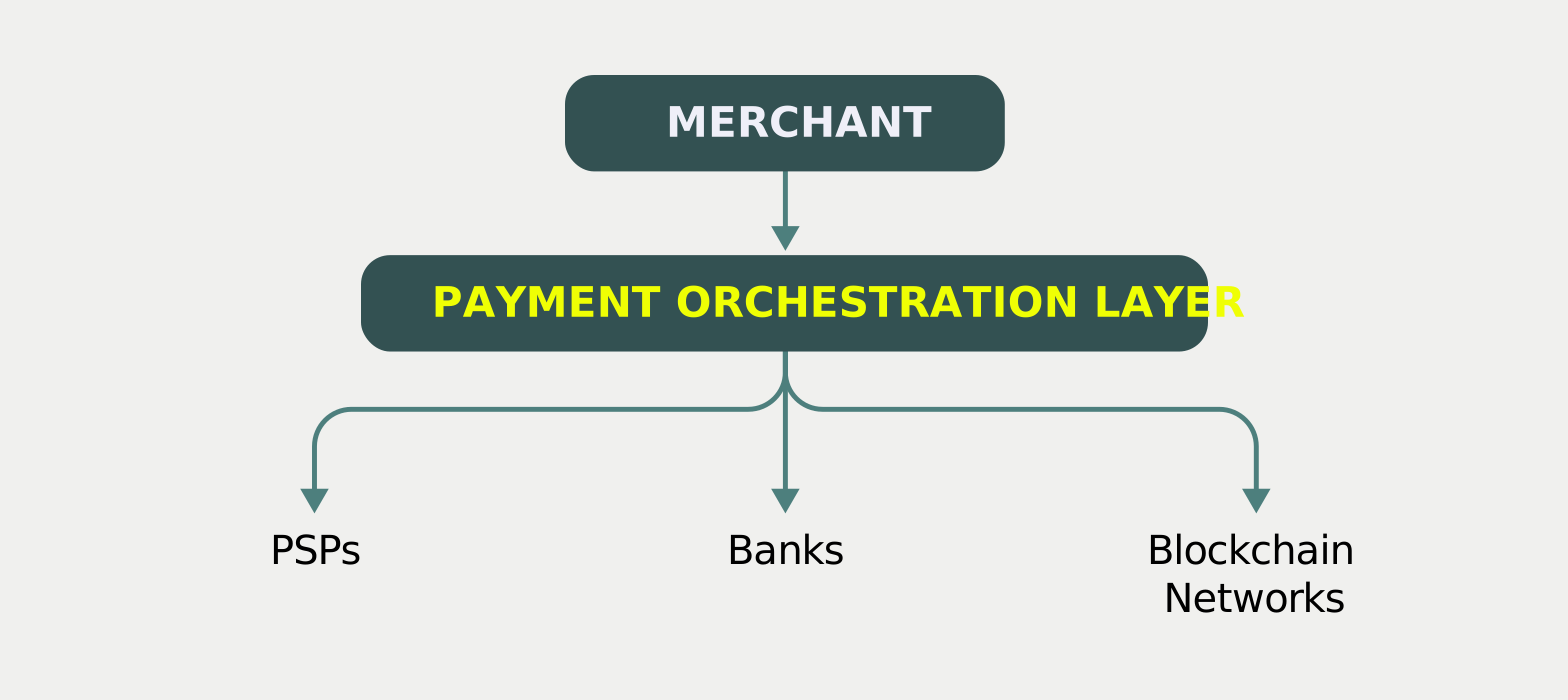
Payment orchestration is a software layer that sits between a merchant and its payment service providers (PSPs), acquiring banks, and payment networks. It routes each transaction to the provider best suited to handle it.
If a payment fails, it automatically retries through a backup provider. It also pulls reporting from every connected provider into one dashboard. Instead of building a separate integration for each PSP, a business connects once to the orchestration platform and manages the entire provider network from there.
The concept exists because no single PSP performs equally well everywhere. A gateway that authorizes 92% of US card transactions might authorize only 70% of transactions in Brazil or the Philippines. There can be different reasons: it may lack a local acquiring relationship, not support the right alternative payment methods, or get flagged by issuers as a foreign processor. Payment orchestration platforms close that gap. They give merchants access to many providers at once and pick the right one for each transaction, without merchants having to negotiate or maintain each relationship manually.
Payment stacks have grown to include card networks, bank transfers, wallets, buy-now-pay-later providers, and blockchain rails. Orchestration has become the control layer that keeps the whole payment ecosystem manageable from a single point. The category is also sold as payment orchestration software, delivered through an API rather than hardware or a fixed checkout page.
How does payment orchestration work?
A payment orchestration platform sits above the provider layer and coordinates four things: routing, authorization, settlement, and reporting.
1. Routing
When a customer submits a payment, the platform’s routing engine evaluates it against a set of rules and real-time data.
That includes:
- Card’s country of issue
- Transaction currency
- Payment method
- Historical success rates by provider and corridor
- Cost
The engine sends the transaction to the PSP most likely to approve it at the best available price.
If that provider declines the transaction or times out, the platform retries automatically through a second or third provider within milliseconds. This is usually called cascading, or intelligent fallback.
2. Authorization
The selected PSP or acquirer then handles the actual authorization request with the card network or payment method provider, applying its own fraud screening and risk checks. The orchestration layer doesn’t perform that step itself, but it decides which provider does.
3. Settlement
Once a transaction is authorized, funds move from the customer’s bank or wallet to the merchant. That happens through the acquirer’s normal settlement cycle, or increasingly, through blockchain rails that settle in stablecoins within seconds rather than days. Orchestration platforms track this across every provider, so finance teams don’t have to reconcile settlement timing one PSP at a time.
4. Reporting
Every transaction (regardless of the provider) lands in a single reporting layer, broken down by provider, corridor, and payment method. That layer covers the following:
- Authorization rates
- Decline reasons
- Fees
- Chargebacks
- Settlement status
It replaces the old practice of manually pulling numbers from five or six separate PSP dashboards.
Payment orchestration vs. Payment gateway
A payment gateway and a payment orchestration platform solve different problems, and businesses often need both.
The gateway captures and encrypts payment data at checkout and passes it to a single processor. Orchestration sits a layer above. It decides which processor, among several, should handle each transaction.
| Dimension | Payment gateway | Payment orchestration platform |
|---|---|---|
| Purpose | Captures and transmits transaction data to one processor | Routes transactions across multiple providers to optimize approval and cost |
| Flexibility | Fixed to one PSP relationship per integration | Provider-agnostic; new PSPs are added through configuration |
| Routing | None — every transaction follows the same path | Rule-based and real-time, with automatic fallback on decline |
| Integrations | One PSP, one set of payment methods | Dozens of PSPs, acquirers, wallets, and blockchain networks through a single API |
| Scalability | Requires new engineering work for each new market or provider | New markets and methods are enabled without rebuilding checkout |
| Business use case | Single-market businesses with simple payment needs | Multi-market, multi-provider businesses managing risk and cost across corridors |
What business problems does it solve? Three come up most often:
- A business is losing revenue to declined payments a second provider would have approved.
- A business depends on one PSP and has no fallback if that relationship fails.
- A business is spending engineering time integrating new payment methods one at a time, instead of once.
Orchestration addresses all three by centralizing provider management behind a single interface.
How does blockchain fit in? Blockchain networks are increasingly treated as just another rail inside the orchestration layer, alongside card networks and bank transfers. They’re used for stablecoin settlement, cross-border payouts, and programmable payment logic. Section 6 covers this in detail.
Why businesses need payment orchestration
The case for orchestration gets stronger as a business adds markets, providers, or payment methods, and the operational gains are measurable.
Platform data published by Solidgate and Yuno puts the typical lift in authorization rates from smart routing and fallback logic at 2 to 8 percentage points.
The exact number depends on how fragmented the business’s markets are. For a business processing $200 million a year, even a 2% improvement is roughly $4 million in transactions that would otherwise have failed.
Costs tend to fall too. Different providers price differently by region, method, and risk profile. Routing based on cost and approval likelihood lets finance teams negotiate with full visibility, rather than accepting whatever a single PSP charges. Gr4vy has reported platform businesses cutting payment costs by more than half after consolidating collections across multiple acquirers this way.
Relying on one PSP also means an outage, a policy change, or an account suspension can stop revenue entirely. Multiple connected providers give a business a working fallback the moment one path degrades.
That same connectivity speeds up global expansion. Entering a new country traditionally meant a new contract, a new integration, and a new compliance review. With an orchestration platform’s pre-built connections, adding a local payment method or acquirer becomes a configuration change instead of an engineering project.
The customer-facing effect follows from the same mechanics. Fewer declines at checkout means fewer abandoned carts and failed subscription renewals. Local routing also lets customers pay the way they already do, e.g., bank transfers in Brazil, e-wallets in Southeast Asia.
The business doesn’t have to rebuild checkout for each market. Automatic retries and fallback routing absorb PSP outages and temporary spikes in decline rates, without anyone on the finance or engineering team having to step in manually.
Key components of a payment orchestration platform
A payment orchestration platform is a set of connected systems working together, instead of a single tool.
At the center is the routing engine, the decision layer that matches each transaction to a provider based on configurable rules and live performance data.
Behind it sits the provider network: the collection of PSPs, acquirers, wallets, and blockchain rails the platform has already integrated. This determines how much reach a business gets without building new connections on its own.
Reporting and analytics unify transaction data across every provider into one consistent dashboard. A finance team can compare authorization rates or fees without exporting from six separate portals.
Compliance tooling handles PCI DSS scope reduction, KYC and AML checks, and region-specific licensing that would otherwise need to be managed separately with each provider.
Fraud management applies risk scoring and rules across the whole provider network, rather than relying on each PSP’s own, inconsistent tools.
Reconciliation matches settlements, fees, and chargebacks against expected transaction data automatically, which is one of the most time-consuming manual tasks in payments operations before orchestration takes it over.
A set of APIs and SDKs ties all of this together, giving developers one integration point instead of one per provider.
Payment orchestration and blockchain infrastructure
Blockchain payment orchestration is the extension of this same routing logic to a new class of rail.
Blockchain networks have moved from a peripheral experiment to a functioning settlement option inside modern payment orchestration. It’s not just a matter of novelty: the shift is driven by cost and speed.
Traditional cross-border wires carry a true all-in cost, once FX spreads and correspondent banking fees are counted, that can run 2 to 7% of the transaction. Blockchain-based settlement can bring that down to a fraction of a percent, with finality measured in seconds instead of the multi-day chain a wire transfer travels through.
Four capabilities explain why orchestration platforms are building blockchain support directly into their routing and settlement layers:
- Stablecoins pegged to fiat currencies let platforms settle merchant payouts near-instantly, avoiding the multi-day settlement cycles typical of card acquiring. This matters most for marketplaces and platforms that need to pay sellers or contractors quickly.
- That speed shows up most in cross-border payments. Research from AlphaPoint and Tazapay shows B2B stablecoin payment volume has grown sharply over the past two years. Adoption is concentrated in corridors where correspondent banking is slow or expensive, particularly Latin America, parts of Asia, and emerging-market supplier payments.
- Some orchestration platforms now let merchants accept digital asset payments directly at checkout, routed and reconciled through the same reporting layer as card and bank transactions, rather than a separate crypto stack.
- Smart contracts add programmable payment flows to the settlement layer itself: releasing funds only when a delivery condition is met, splitting a payment automatically across multiple parties, or triggering a payout on a schedule.
Coinspaid is one example of a provider of blockchain solutions for the global economy. It enables businesses to integrate blockchain payment infrastructure into modern payment operations, alongside the traditional PSPs and acquirers already in a merchant’s orchestration stack.
Businesses getting the most value from orchestration right now treat blockchain rails just like they would treat any other provider. They evaluate it on cost, speed, and reliability, instead of adopting it for its own sake.

Use cases
Global e-commerce retailers use orchestration to accept local payment methods in every market they sell into, and to recover revenue lost to declines during high-traffic periods like holiday sales.
SaaS and subscription businesses face a narrower but costly problem: recurring billing depends on minimizing involuntary churn from failed card renewals. Orchestration platforms apply retry logic and card-updater services across providers to keep subscriptions active without manual follow-up.
Fintechs and marketplaces that pay out to sellers, drivers, or freelancers use orchestration to route payouts through whichever provider is fastest or cheapest in a given country. Increasingly, that means stablecoin rails for cross-border contractor payments.
Large multinational businesses use it for enterprise payments and treasury work: managing settlement across dozens of currencies and banking relationships. More and more, blockchain rails are used for transfers between entities in different jurisdictions.
Challenges of payment orchestration
Orchestration solves real problems. However, it isn’t free of trade-offs.
Integration complexity doesn’t disappear so much as it moves. A single API to the orchestration platform replaces dozens of direct PSP integrations. But each underlying provider still needs its own commercial contract, KYB review, and acquiring setup before traffic can route to it.
The technical work does get simpler — unlike the commercial relationships. More routing options also mean more contracts, fee schedules, and vendor performance to monitor. That shifts work from engineering to payments operations rather than removing it.
Compliance still varies by market, too. Orchestration centralizes reporting, but PCI DSS scope, KYC and AML obligations, and local licensing requirements differ by country and provider. The platform doesn’t remove the need for legal review in each new market.
Pulling data from many providers into one dashboard is a real improvement over checking six PSP portals separately. But providers don’t all report fees, decline reasons, or settlement timing in the same format, so some manual reconciliation work typically remains.
Expanding into new markets through orchestration is faster than doing it one PSP at a time. It still requires navigating local payment regulation, data residency rules, and, in some cases, local entity requirements that a routing platform can’t abstract away.
Future of payment orchestration
Two trends are shaping where orchestration goes next.
The first is AI-driven routing. Machine learning models continuously adjust routing decisions based on real-time success rates, latency, and fraud signals, rather than relying on static rules that need manual updates.
The second is the growing share of transactions initiated by autonomous or agentic systems, unlike a person clicking checkout. That’s pushing orchestration platforms to handle payment decisions at machine speed, without a human in the loop for routine cases.
Rather than staying a separate category, blockchain settlement is likely to keep expanding inside orchestration. Regulatory frameworks around stablecoins are maturing in the US, EU, and major Asian markets. As they do, more orchestration platforms are expected to treat blockchain rails as a standard routing option alongside cards and bank transfers. That’s especially true for cross-border and payout use cases, where speed and cost make the strongest case.
Payment orchestration flow at a glance
FAQ
Mainly to stop losing revenue to declined payments that a second provider would have approved. It also removes the risk of being locked into one PSP relationship with no fallback if it fails or underperforms in a given market.
Higher authorization rates, lower processing costs through provider-level cost routing, faster expansion into new markets, unified reporting across providers, and resilience against any single provider’s outages or policy changes.
Typically once a business is processing in multiple markets, managing two or more providers, or losing a measurable share of revenue to declines. Smaller, single-market businesses with one reliable PSP often don’t need it yet.
More and more so, yes. Many platforms now route to blockchain rails for stablecoin settlement and digital asset payments alongside traditional card and bank methods, particularly for cross-border and payout use cases.
Yes. Local acquiring relationships reduce the cross-border decline rates that occur when a foreign processor triggers stricter issuer risk checks. Blockchain settlement can also cut both cost and settlement time on international payouts.
Breadth of pre-built provider connections in the markets that matter, transparent and configurable routing logic, unified reporting, compliance support for the relevant jurisdictions, and (if relevant) native blockchain settlement options.
Yes, and it’s often where the value is clearest. Enterprise businesses have the transaction volume and multi-market complexity where authorization-rate improvements and cost routing translate into the largest absolute savings.