
In production payment systems, blockchain connectivity solves only part of the problem. Financial institutions also need to control signing, compliance, transaction states, liquidity, settlement, and reconciliation while keeping network-specific logic away from core banking and customer-facing systems.
How does blockchain payment infrastructure work?
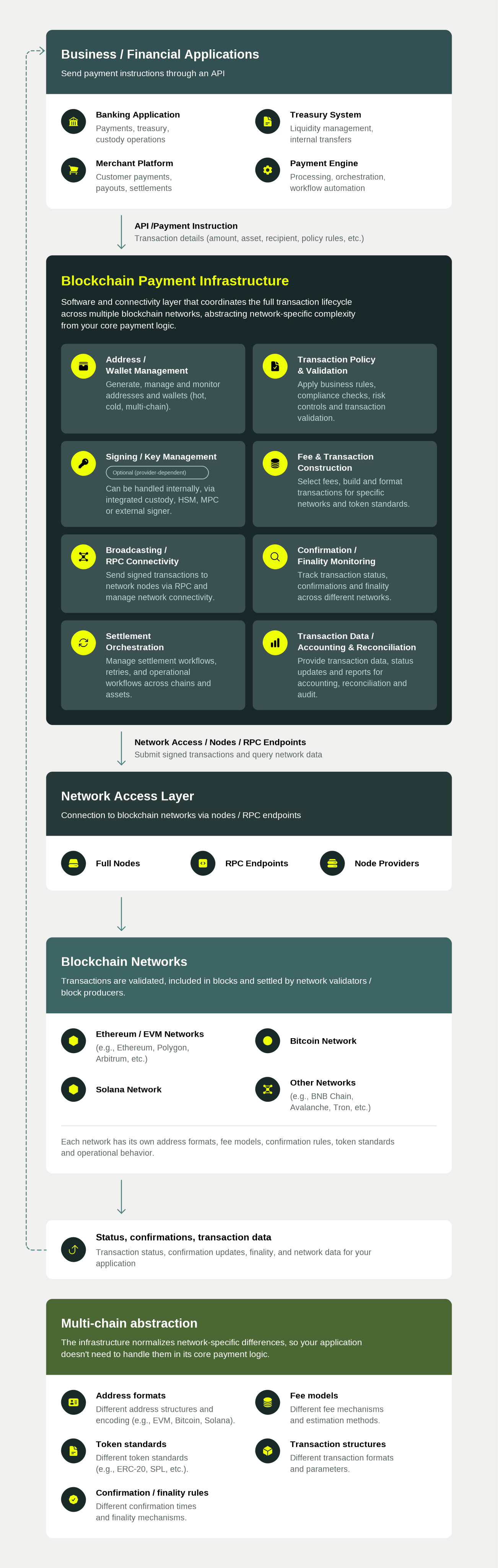
Blockchain payment infrastructure is the software and connectivity layer that allows financial institutions and businesses to initiate, process, monitor, and settle digital-asset transactions across blockchain networks.
It sits between a financial application and the underlying networks. A banking application, treasury system, merchant platform, or payment engine sends an instruction through an API. The infrastructure can coordinate address management, transaction policies, transaction construction, signing or integration with external signing systems, broadcasting, confirmation monitoring, settlement workflows, and transaction data for accounting and reconciliation.
This abstraction becomes particularly important in multi-chain environments. Blockchain networks use different address formats, fee models, confirmation rules, token standards, transaction structures, and operational behavior. A dedicated infrastructure layer keeps those differences out of the institution’s core payment logic.
Key Takeaways
- Blockchain payment infrastructure connects financial applications with blockchain networks and manages the transaction lifecycle between instruction and reconciliation.
- A typical transaction passes through policy checks, preparation, signing, broadcasting, confirmation monitoring, settlement, and financial recording.
- Enterprise blockchain infrastructure includes more than blockchain connectivity. It can also coordinate wallets, compliance controls, liquidity, settlement, reporting, and integrations.
- End-to-end infrastructure refers to integrated lifecycle coverage. Several software and financial service providers can participate in the same workflow.
- Regulated institutions need explicit control over keys, permissions, policies, audit records, reporting, resilience, and the division of responsibilities between participants.
- Blockchain infrastructure can operate as an additional layer alongside core banking, treasury, accounting, and conventional payment systems.
- Blockchain payment infrastructure providers should be evaluated on lifecycle coverage, control boundaries, integration quality, portability, operational resilience, and supported asset coverage.
What is blockchain payment infrastructure?
Digital asset payment infrastructure can be separated into 3 layers:
| Layer | Primary role |
|---|---|
| Blockchain network | Validates and records on-chain transactions |
| Blockchain payment infrastructure | Manages connectivity, wallets, transaction execution, policies, monitoring, settlement workflows, and integrations |
| Business application | Provides payment functionality to customers, merchants, treasury teams, or internal users |
The distinction matters because a blockchain network does not understand the institution’s business context. It can validate an on-chain transaction, but it does not know whether the payment was approved internally, whether a destination address passed compliance checks, which customer or internal account should be associated with the transfer, or how the event should appear in financial records.
The business application should not have to manage network mechanics either. Gas fees, UTXOs, RPC endpoints, token contracts, confirmation thresholds, and blockchain reorganizations belong in the infrastructure layer.
The infrastructure converts business instructions into network-specific operations and returns transaction events in a format banking, treasury, compliance, and accounting systems can process.
Stablecoin payment infrastructure sits within this broader category, alongside infrastructure for other digital assets and tokenized instruments, with additional requirements around network support, liquidity, conversion, and settlement.
How does a blockchain payment work?
An institutional blockchain payment typically follows a controlled sequence between the business application and the blockchain.
1. The payment instruction is created
A banking application, treasury platform, merchant system, or payment engine sends the asset, amount, destination, and relevant account information to the infrastructure.
The system can assign an internal transaction reference at this stage. That reference lets the institution track the same payment through compliance, blockchain execution, settlement, and reconciliation without relying only on a network transaction hash.
2. The wallet and address are determined
For an outbound transaction, the infrastructure identifies the appropriate sending wallet. For an incoming flow, it may select or generate the address associated with the relevant customer, account, merchant, or transaction.
Institutional wallet structures can separate assets according to customer, business function, legal entity, product, or security policy.
3. Compliance and transaction policies are checked
Before execution, the payment can pass through institutional rules such as:
- Sanctions and address screening
- AML and KYT controls
- Transaction limits
- Allowlists
- Customer risk rules
- Permitted assets or networks
- Approval requirements
The institution determines which policies apply and which conditions should block, escalate, or approve a transaction.
These controls need to operate before the network transfer becomes irreversible or operationally difficult to recover.
4. The transaction is prepared and signed
The infrastructure converts the payment instruction into the format required by the selected blockchain.
Depending on the network, this may include fee calculation, UTXO selection, nonce management, token contract identification, destination validation, and other network-specific logic.
The transaction then moves through the institution’s signing model. Private keys may remain under institutional control or operate through another approved signing architecture. The important architectural question is where signing authority sits and which systems can request, approve, and release a transaction.
5. The transaction is broadcast
Once signed, the transaction is submitted to the blockchain through node or API connectivity.
6. Confirmation and finality are monitored
After broadcast, the infrastructure monitors the transaction until it meets the institution’s confirmation or finality policy. Thresholds can vary by network, asset, transaction value, and internal risk policy. Customer and banking systems can receive normalized states such as pending, confirmed, failed, or settled while the infrastructure interprets the underlying blockchain events.
7. Settlement or conversion follows
Funds may remain in the received asset, move to another wallet, enter a conversion process, support a treasury transfer, or form part of merchant or customer settlement.
Stablecoin payments provide a simple example. A business may choose to retain the stablecoin or convert it according to its treasury and settlement model. The infrastructure needs to connect the blockchain event with the relevant liquidity, exchange, or settlement workflow.
8. The transaction is reconciled
The final stage connects blockchain activity with the institution’s own books and operational records.
Transaction IDs, amounts, fees, timestamps, assets, conversions, and settlement data need to move into reporting and accounting systems. Exceptions also need to remain visible when the blockchain record and internal payment state do not align.
What components make up blockchain payment infrastructure?
A complete architecture usually combines several specialist functions.
| Component | Function |
|---|---|
| Wallet and key infrastructure | Addresses, keys, signing, and wallet policies |
| Blockchain connectivity | Node access, transaction broadcasting, balance data, and network events |
| Payment orchestration | Routing, transaction states, retries, fees, and business logic |
| Transaction monitoring | Confirmation status, failures, and operational alerts |
| Compliance and policy controls | AML, KYT, sanctions screening, risk rules, and approvals |
| Liquidity and conversion | Asset and currency conversion and liquidity-provider integration |
| Settlement | Distribution or final movement of funds and assets |
| Reporting and reconciliation | Financial records, transaction matching, and exception management |
| APIs and integrations | Connections with banking, treasury, compliance, and accounting systems |
These components do not have to come from a single vendor. An institution can combine specialist systems as long as the resulting architecture preserves a coherent transaction lifecycle and clearly defined control boundaries.
What does end-to-end blockchain payment infrastructure mean?
In enterprise architecture, end-to-end refers to lifecycle coverage across an integrated workflow. An end-to-end blockchain payment infrastructure should allow a financial institution to manage a transaction from the original instruction through authorization, blockchain execution, monitoring, settlement, and reporting, even when custody, banking, liquidity, or compliance data come from separate providers. The software layer coordinates those components through APIs, transaction states, and workflows.
A practical end-to-end environment should maintain continuity across those handoffs. The same payment should remain identifiable from the point at which an application creates the instruction through the final accounting and settlement records. A change of network or external provider should not force the institution to redesign the entire customer or core banking flow.
Orchestration can direct a transaction to a specific wallet configuration, compliance integration, liquidity source, blockchain connection, or settlement process according to institutional policy.
A practical test is whether the institution can create, authorize, execute, monitor, settle, and reconcile a payment without engineering every blockchain-specific component independently.
What do regulated financial institutions need beyond blockchain connectivity?
Basic network access is insufficient for a bank, EMI, regulated fintech, or other financial institution. Blockchain infrastructure for regulated financial institutions also needs an operating control framework.
Important requirements include:
- Security architecture. Systems need controls around access, transaction initiation, signing, key material, operational changes, and privileged actions.
- Key governance. The institution needs clear rules for key generation, storage, signing, recovery, and authorization. It should also understand exactly which participant can initiate or approve a transaction.
- Role-based access. Permissions should separate transaction creation, approval, policy administration, technical administration, and other sensitive functions.
- Transaction policies. Limits, permitted assets, destination rules, approval thresholds, and other conditions should be enforced before execution.
- AML and KYT integration. On-chain risk information needs to connect with customer data, sanctions controls, and case-management processes. FATF’s risk-based guidance for virtual assets and VASPs treats virtual-asset activity as part of the broader AML/CFT control framework, so blockchain screening should feed into the institution’s customer and transaction controls.
- Audit trails. Systems should record who created, approved, changed, and released a transaction, together with the relevant policy and settlement information.
- Reconciliation. On-chain balances, internal ledgers, fees, conversions, and settlement records need consistent matching. Exceptions should be visible to finance and operations teams.
- Operational resilience. Procedures need to cover network congestion, endpoint failures, provider outages, blockchain changes, upgrades, and delayed confirmations.
- System integration. Controls and transaction states need to move between blockchain infrastructure and existing banking, treasury, compliance, and accounting systems without creating a separate operational silo.
- Reporting. Institutions need structured records covering transaction status, approvals, fees, blockchain identifiers, conversions, and final settlement so finance, risk, compliance, and audit teams can reconstruct the complete event.
- Separation of responsibilities. The architecture should define which functions remain with the institution and which sit with software providers, custodians, liquidity providers, banks, or other counterparties.
How does blockchain infrastructure integrate with existing banking systems?
Blockchain payment infrastructure does not need to replace core banking. It can operate as an additional modular infrastructure layer.
A simplified architecture looks like this:
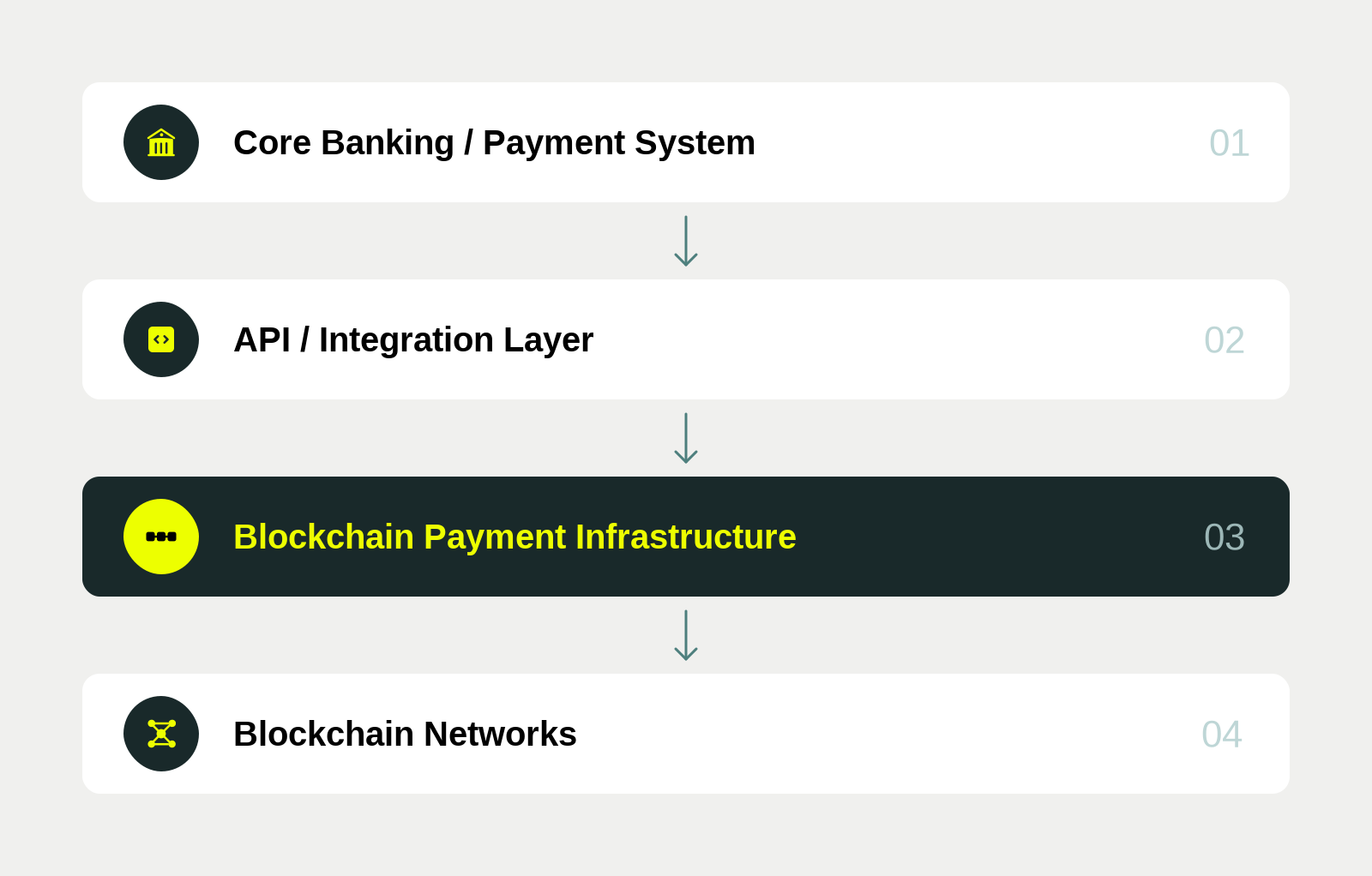
The core platform can continue to manage customer accounts, internal balances, product logic, and existing financial records. The blockchain layer handles the network-specific functions required for digital-asset transactions.
For an outbound payment, the banking system sends an instruction through an API. The blockchain infrastructure applies the relevant policies, prepares and executes the network transaction, monitors confirmation, and returns status information.
For an incoming transaction, the direction is reversed. Monitoring detects the blockchain event, associates it with the appropriate address or internal reference, and sends the resulting transaction information into the institution’s payment, treasury, or ledger environment.
The integration layer therefore carries more than transaction instructions. It also needs to move statuses, compliance results, fees, settlement information, and reconciliation data between systems.
Banks can integrate blockchain payments into selected products while keeping network-specific logic out of unrelated core systems.
Blockchain payment infrastructure vs. crypto payment gateway
A crypto payment gateway and a blockchain payment platform can overlap, but their typical scope is different.
| Capability | Crypto payment gateway | Blockchain payment infrastructure |
|---|---|---|
| Payment acceptance | Core use case | Supported |
| Address generation | Common | Common |
| Blockchain connectivity | Usually abstracted | Core capability |
| Payout and treasury workflows | Varies | Common |
| Institutional policy controls | Varies | Important |
| Key-management options | Provider-specific | Major architectural consideration |
| Back-office integration | Usually limited | Broad |
| Reconciliation | Payment-focused | Financial and operational |
| Modular architecture | Optional | Often important |
A gateway can be sufficient for a business that primarily wants to accept digital-asset payments through a packaged merchant workflow.
A financial institution may need more. Wallet operations, payouts, treasury activity, multiple networks, approval rules, signing models, settlement, and ledger reconciliation create requirements that extend beyond checkout or payment acceptance.
A gateway can be sufficient for a business focused on digital-asset payment acceptance. Financial institutions with broader requirements may also need wallet operations, treasury workflows, signing controls, settlement, and ledger reconciliation. Product labels vary, so buyers should evaluate lifecycle coverage directly.
Build vs. buy blockchain payment infrastructure
Financial institutions generally choose among 3 infrastructure models: build, integrate, or hybrid.
1. Build
Internal development provides the highest level of architectural control. It also makes the institution responsible for blockchain integrations, transaction logic, network upgrades, security, monitoring, incident handling, and ongoing specialist engineering.
Building can make sense when blockchain technology creates strategic differentiation or when institutional requirements demand direct ownership of specific components.
2. Integrate
External software can shorten implementation time and reduce the internal infrastructure burden. Specialist providers can maintain blockchain connectivity, wallet technology, transaction orchestration, or other components across several networks.
This model introduces provider dependencies. The institution therefore needs to understand resilience, data access, migration options, control of keys, and the consequences of an external outage.
3. Hybrid
A hybrid model keeps strategically important functions inside the institution while integrating specialist technology elsewhere.
For example, an institution may retain keys, approval policies, customer data, risk rules, or ledgering while using external software for multi-chain connectivity and transaction orchestration.
Internal ownership makes sense where control or differentiation justifies permanent engineering; specialist functions can be integrated where continuous technical maintenance adds little product differentiation.
Build vs buy vs hybrid blockchain infrastructure
| Decision Factor | Build In‑House | Integrate Infrastructure | Hybrid |
|---|---|---|---|
| Time to market | Usually longest | Usually shortest | Moderate |
| Upfront investment | High | Lower | Moderate |
| Ongoing maintenance | Primarily internal | Primarily provider‑led | Shared |
| Control | Highest | Depends on architecture | High over selected systems |
| Security responsibility | Primarily internal | Shared with provider | Divided by component |
| Multi‑chain expansion | Requires additional engineering | Usually easier | Selective |
| Compliance integration | Highly customisable | Depends on APIs | Custom policy with integrated tools |
| Vendor dependency | Low | Highest | Reduced through modular design |
| Internal expertise required | Extensive | Lower | Targeted |
| Best suited for | Strategically differentiated technology | Faster deployment and standard capabilities | Banks balancing control with specialisation |
How should financial institutions choose a blockchain payment infrastructure provider?
A buyer checklist should cover the following questions:
- Does the platform cover the full payment lifecycle? Evaluate initiation, policy checks, execution, monitoring, settlement, and reconciliation.
- Is the architecture API-first? APIs, webhooks, documentation, and test environments need to support production integration with existing systems.
- Which networks and stablecoins are supported? Coverage should match the institution’s current use cases while leaving room for expansion.
- Who controls private keys and transaction signing? The institution needs to understand the available control models and where authority ultimately sits.
- How are transaction states and failures monitored? Confirmations, failed broadcasts, network changes, delayed transactions, and operational exceptions should remain visible.
- Can existing compliance tools be integrated? AML, KYT, sanctions, customer risk, and internal approval systems should fit into the transaction flow.
- How are liquidity and conversion workflows handled? The platform should make clear how digital assets interact with treasury, conversion, and settlement processes.
- Can the infrastructure connect with existing banking systems? Treasury, core banking, payment, compliance, accounting, and reporting environments should receive usable transaction data.
- Is reporting and reconciliation complete enough for institutional operations? The institution should be able to connect blockchain events with internal balances, fees, approvals, conversions, and settlement.
- Can individual components or providers be replaced? Portability matters if the institution wants to change a network provider, liquidity source, or other dependency without rebuilding the surrounding architecture.
- Which responsibilities remain under institutional control? The operating model should define responsibility for keys, policies, assets, data, settlement, and regulated activities.
Due diligence should also examine how those claims appear in practice. API documentation, sandbox behavior, reporting outputs, failure handling, reconciliation flows, migration arrangements, and the division of responsibilities reveal more about production suitability than a feature list alone.
Compare the internal engineering a platform still requires with the provider dependence it introduces.
Which providers offer end-to-end blockchain payment infrastructure for regulated financial institutions?
Blockchain payment infrastructure providers operate across several categories, and the categories should not be treated as interchangeable.
Blockchain networks
Blockchain networks provide the underlying transaction environment. They validate and record transactions but do not supply the institution with the complete payment, wallet, compliance, treasury, or reconciliation stack.
Stablecoin infrastructure providers
Stablecoin infrastructure providers can cover different parts of the payment stack. Circle Payments Network focuses on institutional stablecoin payment coordination and blockchain settlement. Merge represents a different model, connecting fiat rails with stablecoin settlement through API infrastructure.
Payment and settlement networks
Payment and settlement networks concentrate on moving value through a defined network or settlement environment.
They may provide important transaction and settlement capabilities, but an institution can still require separate wallet, compliance, treasury, accounting, and orchestration systems around that network.
Blockchain payment software platforms
These platforms provide a broader operating environment for digital-asset payments, treasury functions, settlement workflows, integrations, and transaction management.
Coinspaid belongs to this software and infrastructure category.
Its product model includes 2 software approaches:
- Coinspaid Enterprise provides a SaaS environment for operating a digital-asset payment business.
- Coinspaid Console provides modular infrastructure through Treasury Management, Core Custody software, Core Exchange, and Compliance components.
Against the lifecycle criteria outlined above, Enterprise represents the broader SaaS model. It brings payment, settlement, reconciliation, liquidity, compliance, and related workflows into a more complete software environment.
Console follows a modular model. Institutions can integrate treasury, custody software, exchange, and compliance components around their existing architecture according to the functions they need.
Coinspaid’s role in this architecture is software infrastructure, including orchestration, integrations, workflows, and blockchain connectivity. Regulated processing, custody, banking, and other financial activities remain separate from that software role and may sit with the institution or other relevant providers.
Specialized infrastructure providers
Specialized providers cover narrower functions such as blockchain connectivity, custody technology, liquidity infrastructure, compliance analytics, or monitoring.
These services can still participate in an end-to-end architecture when an orchestration layer connects them into a consistent transaction lifecycle.
Conclusion
Blockchain payment infrastructure becomes useful when a financial institution can add blockchain as another financial rail without spreading network-specific logic across its core systems. A strong architecture preserves institutional control over policy, data, permissions, and financial records while keeping networks and external infrastructure components replaceable.