
Key takeaways
- Blockchain infrastructure has the strongest business case when it addresses an identifiable cost, operational bottleneck or revenue opportunity.
- Cross-border payments, stablecoin settlement and treasury operations offer relatively straightforward financial metrics.
- Faster blockchain transfers do not necessarily mean faster access to usable funds.
- Digital asset accounts and new financial products depend on customer demand, rather than technical capabilities alone.
- Return on investment must account for integration, compliance, liquidity, security and ongoing operations.
- The appropriate infrastructure model depends on transaction volumes, regulatory requirements and the degree of operational control an institution needs.
A payment service provider is considering a new stablecoin settlement system. The proposal promises near-instant transfers, around-the-clock availability and lower transaction fees. On paper, the case looks convincing.
Then the CFO starts asking questions:
- How much will the integration cost?
- Will it reduce the amount of capital sitting in correspondent accounts?
- What happens when a recipient needs local currency rather than stablecoins?
- And, perhaps most importantly, how many customers will actually use it?
These questions are harder to answer than how quickly a blockchain can process a transaction. They’re also considerably more important.
Financial institutions evaluating blockchain infrastructure face a growing selection of technologies and providers. Some can reduce payment costs or improve treasury operations. Others make it possible to launch financial products that would be expensive to develop internally.
But the commercial value varies substantially between institutions, markets and use cases. A technology that makes sense for a PSP processing thousands of international payments may offer little advantage to a regional bank whose customers primarily make domestic transfers.
This article examines where blockchain infrastructure creates measurable business value, how institutions can calculate its return on investment, and what to consider before committing capital.
Which blockchain infrastructure solutions deliver measurable business value?
For financial institutions, the strongest business cases for blockchain infrastructure generally fall into six categories.
- Stablecoin payment and settlement infrastructure can support 24/7 transfers and potentially lower payment costs.
- Cross-border infrastructure may reduce intermediary fees, settlement delays and prefunding requirements.
- Digital asset account and wallet infrastructure allows institutions to introduce new customer products and revenue streams.
- Treasury and liquidity infrastructure can automate fund movements and improve balance visibility.
- Transaction processing and reconciliation systems can reduce manual work and operational exceptions.
- Finally, enterprise digital asset platforms allow banks and fintechs to launch new services without developing every technical component internally.
Each has a different measure of success. Payment infrastructure should be judged on the cost and completion time of usable payments. Treasury infrastructure should reduce operational expense or capital requirements. Customer-facing products must ultimately demonstrate adoption, revenue and profitability.
Where blockchain infrastructure creates the most business value
The following table summarizes the main blockchain use cases in financial services and the metrics that can establish whether an investment is worthwhile.
| Use case | Infrastructure solution | Potential business value | Primary KPIs |
|---|---|---|---|
| Cross-border B2B payments | Blockchain settlement and payment routing | Lower costs, faster delivery, reduced prefunding | Cost per payment, settlement time, liquidity tied up |
| Stablecoin settlement | Stablecoin payment rails and conversion | 24/7 transfers and flexible settlement | Time to usable funds, conversion costs, payment success rate |
| Digital asset accounts | Wallet and custody infrastructure | New products and fee revenue | Active accounts, revenue per user, retention |
| Treasury management | Wallet consolidation and liquidity automation | Less manual work and improved capital allocation | Treasury costs, liquidity utilization, processing hours |
| Transaction processing | Payment orchestration and reconciliation software | Fewer exceptions and lower operating costs | Cost per transaction, exception rate, reconciliation time |
| New financial services | Enterprise digital asset platforms | Faster product launches and additional revenue | Time to market, acquisition costs, product profitability |
Of course, whether these potential benefits materialize depends on the institution’s existing infrastructure and the economics of its transaction flows.
1. Cross-border B2B payments
International payments remain one of the more credible applications for blockchain infrastructure.
A PSP making frequent payments to overseas merchants may face intermediary charges, FX spreads, different banking cut-off times and capital tied up in prefunded accounts.
Blockchain-based settlement can potentially reduce some of these costs. Stablecoins, for example, allow value to move between supported wallets without relying on conventional interbank operating hours.
The important distinction is between completing an on-chain transfer and completing a business payment.
According to Swift, 75% of payments on its network already reach the beneficiary bank within ten minutes, while more than 90% arrive within an hour. Much of the remaining delay occurs after the receiving bank gets the payment.
An October 2026 Bank for International Settlements study also found that stablecoin conversions, FX pricing and withdrawal costs can materially affect the economics of cross-border transfers.
For a financial institution, the relevant KPIs are therefore total cost per completed payment, time until the recipient can use the funds, failure rates and reductions in prefunded liquidity.
The strongest opportunities are likely to be corridors where existing payment costs are relatively high, or where customers and counterparties can receive and use digital assets directly.
2. Stablecoin payments and settlement
Stablecoin settlement has a different business case.
Consider a fintech that serves international trading firms. Its customers may need to transfer collateral or settle obligations during weekends, when ordinary banking arrangements can be unavailable or restricted.
Stablecoin infrastructure may give those customers another settlement option, provided they can hold, receive and use the relevant assets.
For the fintech, this could mean better service availability, stronger customer retention and additional payment volume.
But around-the-clock access requires more than a blockchain connection. The institution also needs transaction screening, liquidity arrangements, wallet security, monitoring and procedures for handling failed or suspicious transfers outside normal working hours.
Performance should be measured through the percentage of payments completed within a specified timeframe, effective settlement costs, reconciliation accuracy and the number of transactions requiring manual intervention.
Stablecoins are most useful when customers have a genuine need for their particular settlement characteristics. Where reliable, inexpensive domestic instant-payment systems already exist, there may be little reason to replace them.
3. Digital asset accounts and wallets
For banks and fintechs with established customer bases, digital asset accounts present an opportunity to generate revenue from existing relationships.
A neobank, for example, might introduce stablecoin balances, digital asset transfers or custody-related functionality alongside conventional accounts.
Rather than building wallet infrastructure, key management, blockchain connectivity and transaction monitoring internally, it could integrate specialist software.
The financial rationale comes from customer adoption and product economics.
Relevant KPIs include monthly active digital asset accounts, revenue per active customer, cost of servicing an account, retention and contribution margin.
A new product can look attractive when measured by registrations alone. Its economics may change considerably once security, customer support, compliance and maintenance are included.
Institutions should establish whether customers actually want digital asset functionality before making a substantial infrastructure investment.
4. Treasury and liquidity management
Treasury operations can provide a more immediate business case because institutions already know what they spend managing funds.
A company operating across several blockchain networks may maintain numerous wallets, manually consolidate balances and transfer assets between accounts to meet payment obligations.
Treasury infrastructure can automate some of these activities, centralize balance visibility and apply rules to fund movement.
The benefits may include lower operational costs, fewer settlement delays and reduced excess liquidity.
A treasury department should measure staff hours spent on processing, settlement exceptions, average idle balances and the amount of working capital required to maintain operations.
There is an important qualification here. Faster fund movement only produces a financing benefit if the institution can actually reduce the balances it needs to hold or otherwise use the released capital productively.
Moving money more quickly is useful. Releasing $1 million from unnecessary prefunding is something a CFO can quantify.
5. Transaction processing and reconciliation
Reconciliation is an expensive part of financial operations, particularly when payment data is spread across banks, exchanges, blockchain networks and internal accounting systems.
Blockchain infrastructure software can connect transaction records with payment instructions, wallet activity, settlement information and reporting tools.
Automated reconciliation may reduce manual data entry, improve visibility and help operations teams identify exceptions earlier.
However, blockchain records alone are insufficient. An institution still needs to match transactions to customers, invoices, fees, conversions and internal ledger entries.
The KPIs are relatively simple: manual processing hours, reconciliation exceptions per thousand transactions, cost per transaction and the frequency of operational incidents.
Institutions with high transaction volumes and fragmented systems are more likely to see meaningful savings. A small organization handling a few transactions per day may find implementation costs difficult to justify.
6. Launching new digital asset financial services
Blockchain infrastructure can also help institutions enter markets that previously required substantial specialist engineering.
A licensed PSP might want to introduce merchant stablecoin acceptance. An EMI could develop digital asset payment accounts. A regulated fintech might add international stablecoin payouts to its existing service.
Enterprise infrastructure platforms can supply transaction processing, wallets, liquidity connectivity, compliance tooling and operational applications.
This reduces the amount of technology the institution must develop independently, although it does not remove regulatory or commercial responsibilities.
The business case should consider development expenditure avoided, time to market, customer acquisition and the projected contribution from the new service.
For example, launching six months earlier has measurable value only if there is sufficient customer demand to generate profitable revenue during those six months.
Considering a digital asset product? Coinspaid can help financial institutions assess the infrastructure requirements for payments, custody, treasury and settlement before committing to a particular deployment model.
Blockchain vs. traditional infrastructure: When does it make financial sense?
Comparisons between blockchain and traditional financial infrastructure often focus too heavily on transaction speed.
Speed matters, but it is only one part of the economics.
| Consideration | Traditional infrastructure | Blockchain infrastructure | What determines the better option? |
|---|---|---|---|
| Transaction cost | Bank, scheme and intermediary fees | Network, provider, conversion and liquidity costs | All-in cost per completed payment |
| Settlement speed | Varies by payment system and corridor | Potentially rapid on-chain settlement | Time until the recipient can use funds |
| Availability | Domestic instant rails may operate 24/7; some international services remain restricted | Supported networks operate continuously | Customer need for out-of-hours payments |
| Integration | Often established within existing systems | May require wallets, APIs and new controls | Implementation and maintenance expense |
| Liquidity | Bank accounts and correspondent arrangements | Digital asset balances, conversion and redemption arrangements | Capital tied up and liquidity availability |
| Security | Mature institutional controls and established processes | Additional signing, wallet and key-management risks | Total security obligations and resilience |
| Compliance | Established regulatory and reporting processes | Additional asset, transfer and jurisdictional considerations | Permitted activities and control requirements |
A domestic bank whose customers already use inexpensive real-time transfers may gain little from introducing stablecoin settlement.
An international PSP facing expensive correspondent arrangements and high prefunding requirements could reach a different conclusion.
In both cases, the correct comparison is against the institution’s existing costs and the best available alternative.
How can financial institutions measure blockchain infrastructure ROI?
A useful blockchain infrastructure ROI framework has to capture benefits and costs across the entire operating model.
The starting point is a financial baseline. Before launching a pilot, an institution should know what its existing payment or operational process costs, how long it takes, and what resources it consumes.
Calculating business value
Each component of value needs a defensible calculation.
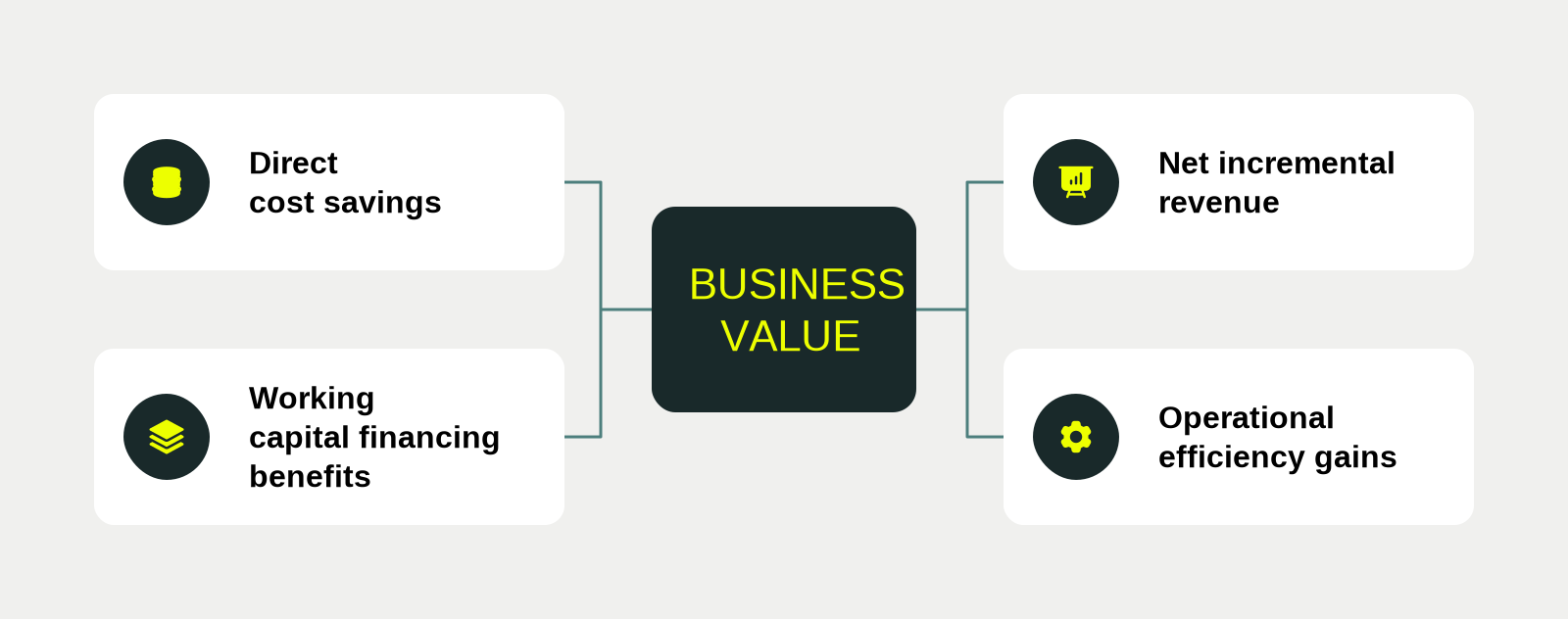
Direct savings might include lower payment fees or FX costs. Incremental revenue should be measured after variable costs, rather than counting gross customer fees as profit. Operational savings should reflect costs genuinely avoided or capacity that can be productively redeployed.
Working capital requires particular care.
If faster settlement releases $1 million from prefunded accounts, that does not automatically create $1 million in profit. The financial benefit is the cost of financing that capital, or the return the institution can earn by using it elsewhere.
At an assumed 8% annual cost of capital, releasing $1 million would generate an annual financing benefit of $80,000.
Calculating total cost of ownership
Blockchain infrastructure total cost of ownership includes considerably more than a software subscription.
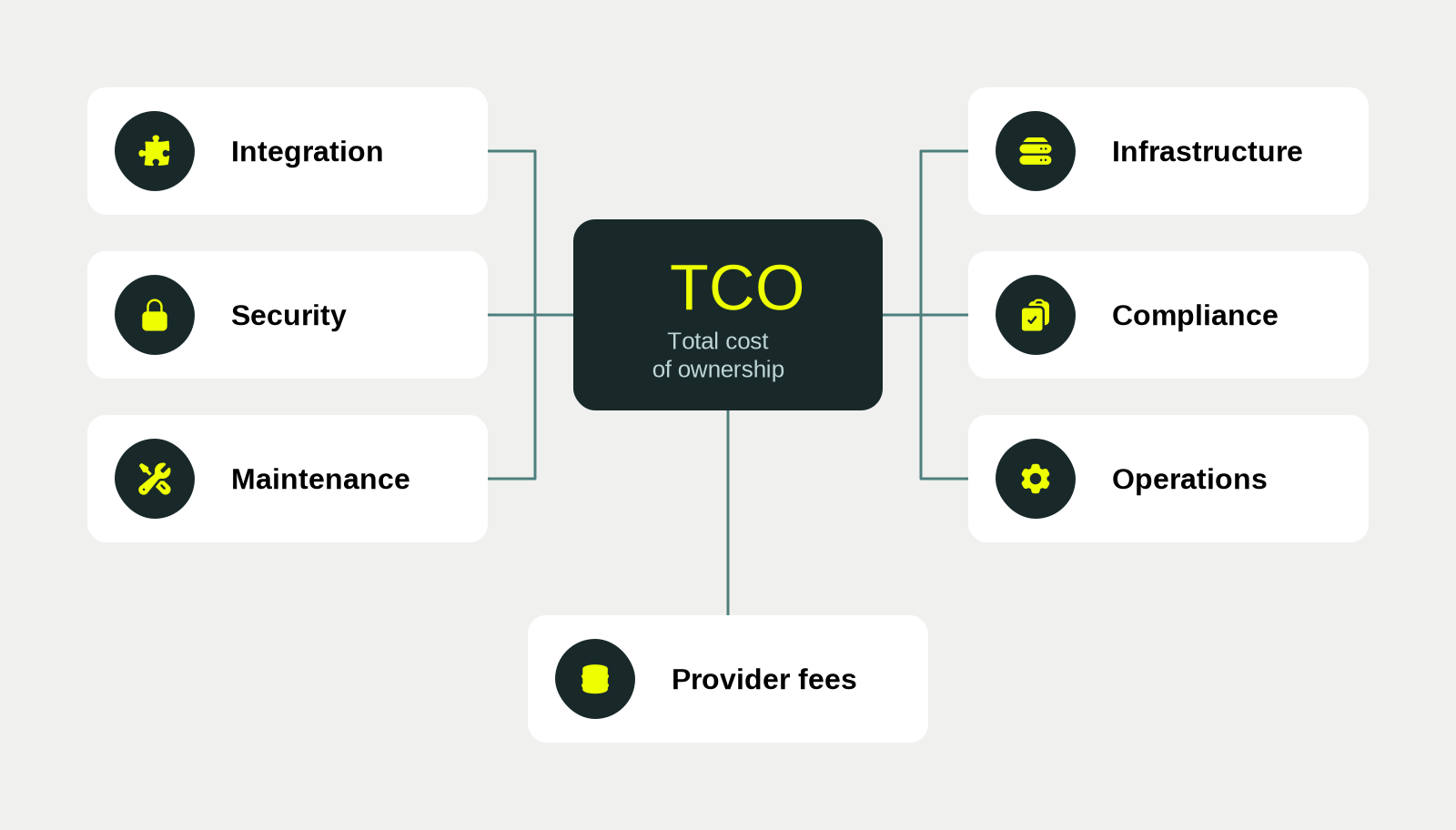
Institutions should also include training, reconciliation changes, vendor management and contingency arrangements where material.
A low transaction fee can be misleading when introducing the payment rail requires significant ongoing operational expenditure.
Two useful calculations follow:
- ROI = (Total quantified benefits − Total cost of ownership) ÷ Total cost of ownership × 100
- Payback period = Initial investment ÷ Annual net recurring benefit
The second formula assumes that recurring net benefits are sufficiently stable. For uneven adoption or significant future investment, a discounted cash-flow model is more appropriate.
Case study: An international PSP
Consider a hypothetical PSP evaluating blockchain settlement for part of its B2B payments business.
It processes 120,000 international payments annually and expects 15% of that volume, or 18,000 payments, to move to the new infrastructure.
The following figures are illustrative assumptions, not reported industry averages or Coinspaid customer results.
| Assumption | Value |
|---|---|
| Annual payments moved to blockchain | 18,000 |
| Existing all-in cost per payment | $22 |
| New all-in variable cost per payment | $13 |
| Manual processing hours saved annually | 600 |
| Fully loaded hourly staff cost | $50 |
| Average prefunded capital released | $1,000,000 |
| Annual financing cost | 8% |
| Initial implementation cost | $200,000 |
| Additional annual platform and operating costs | $130,000 |
The annual benefits would be:
| Source | Annual benefit |
|---|---|
| Payment savings: 18,000 × $9 | $162,000 |
| Operational savings: 600 × $50 | $30,000 |
| Financing benefit: $1m × 8% | $80,000 |
| Total annual benefit | $272,000 |
| Less recurring platform and operating costs | −$130,000 |
| Annual net benefit | $142,000 |
The resulting investment case is:
- Initial investment: $200,000
- Simple payback period: Approximately 17 months
- Three-year quantified benefits: $816,000
- Three-year total cost of ownership: $590,000
- Three-year net benefit: $226,000
- Three-year ROI: Approximately 38.3%
This example assumes that the payment-cost comparison includes all variable transfer and conversion charges, while the $130,000 covers separate recurring expenses. It also assumes the PSP genuinely reduces its prefunded balances and realizes the labor savings.
Those assumptions must be tested. Lower adoption, unfavorable FX spreads or higher compliance costs could materially weaken the investment case.
The same applies to operational risks. Any material expected losses from incidents or interruptions should be included in the financial analysis rather than treated as an afterthought.
An infrastructure investment only creates value when its benefits survive the full cost calculation. A cheaper transaction is of limited use if it becomes more expensive to operate the business around it.

What determines whether blockchain infrastructure delivers positive ROI?
The most influential variables are transaction volume, transaction value, existing costs and customer demand.
High transaction volumes can make relatively small unit savings commercially significant. Saving $2 per transfer is worth $20,000 annually at 10,000 transactions, but $2 million at one million transactions.
The picture changes if the system carries substantial fixed costs.
Average transaction size also matters. Network fees may be relatively immaterial for large B2B transfers, while percentage-based conversion spreads can become expensive.
Institutions must also assess how much of their payment activity is genuinely cross-border, whether customers need to convert into fiat, and how much liquidity is required at each stage.
Customer demand determines the economics of new financial products. A digital asset account with low adoption can remain unprofitable regardless of how efficiently its infrastructure operates.
Finally, engineering, security and compliance requirements affect the cost base. A business with an experienced digital asset operations team may implement a new payment capability relatively easily. A bank starting from scratch faces a different undertaking.
There is no universal transaction volume at which blockchain becomes economical. Each institution has to identify its own break-even point.
Which blockchain infrastructure providers support these use cases?
The enterprise market includes infrastructure software companies, regulated service providers and platforms combining several functions.
They should be compared by the business problem they address, rather than placed into a single ranking.
| Provider | Infrastructure focus | Relevant use cases | Evaluation considerations |
|---|---|---|---|
| Coinspaid | Modular infrastructure and enterprise digital asset payment software | Payments, treasury, wallets, settlement, merchant services | Deployment model, operational control, licensing responsibilities and TCO |
| Fireblocks | Wallet infrastructure, security, treasury and payment orchestration | Institutional wallets, treasury automation, stablecoin operations | Key-management architecture, integrations and commercial terms |
| BVNK | Stablecoin payment infrastructure and fiat conversion | Merchant acceptance, payouts, embedded payments | Corridor coverage, conversion costs, service model and regulatory scope |
| Zero Hash | Embedded digital asset and stablecoin infrastructure | Account funding, on/off ramps, trading and payouts | Geographic eligibility, provider dependencies and integration costs |
| Ripple | Cross-border payments and fiat/stablecoin settlement | International B2B payments, payouts and liquidity movement | Payout markets, settlement currencies and total conversion costs |
| BitGo | Institutional custody, wallets and settlement | Custody, digital asset accounts and institutional settlement | Custody arrangements, legal entity coverage and operational integration |
These providers are not interchangeable. An institution primarily concerned with custody and wallet governance may approach procurement differently from one launching a merchant payment service.
Similarly, a provider’s regulatory permissions do not necessarily cover every country, product or customer relationship. Institutions need to establish which legal entity delivers each service and where their own obligations begin.
Commercial comparisons should request equivalent pricing assumptions, implementation requirements, service-level commitments and evidence of operational performance.
The Basel Committee’s December 2025 principles for third-party risk management also provide a useful reference for banks assessing external technology relationships.
Where Coinspaid Console and Enterprise fit
Coinspaid provides blockchain infrastructure software for financial institutions, payment providers and fintech companies.
Its products address different operating requirements.
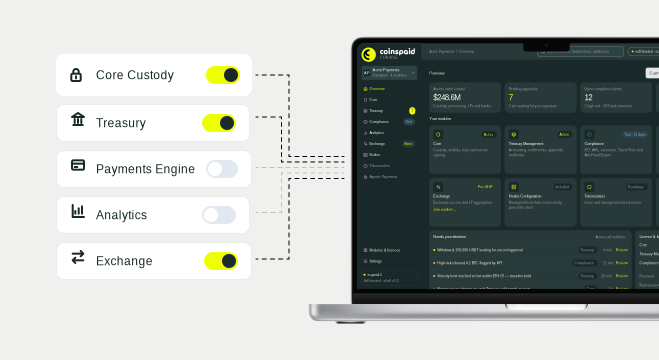
Coinspaid Console: Modular infrastructure with greater control
Coinspaid Console is designed for organizations that want to operate digital asset infrastructure within their own environment.
It provides modular capabilities covering wallet and key management, treasury, compliance, analytics and exchange connectivity.
The institution can retain control over private keys, wallets and transaction signing while using Coinspaid software for specialist infrastructure functions.
This may appeal to organizations that already have established financial operations and want to add specific digital asset capabilities.
For example, a fintech could use Console to manage wallet infrastructure and treasury operations without replacing its existing customer-facing systems.
The business value would be assessed through operating costs, engineering resources, reconciliation performance and the cost of supporting additional transaction volume.
Console’s Payments Engine is currently listed as a forthcoming module, so institutions should confirm its availability before including it in a deployment plan.
Coinspaid Enterprise: A more complete payment operating environment
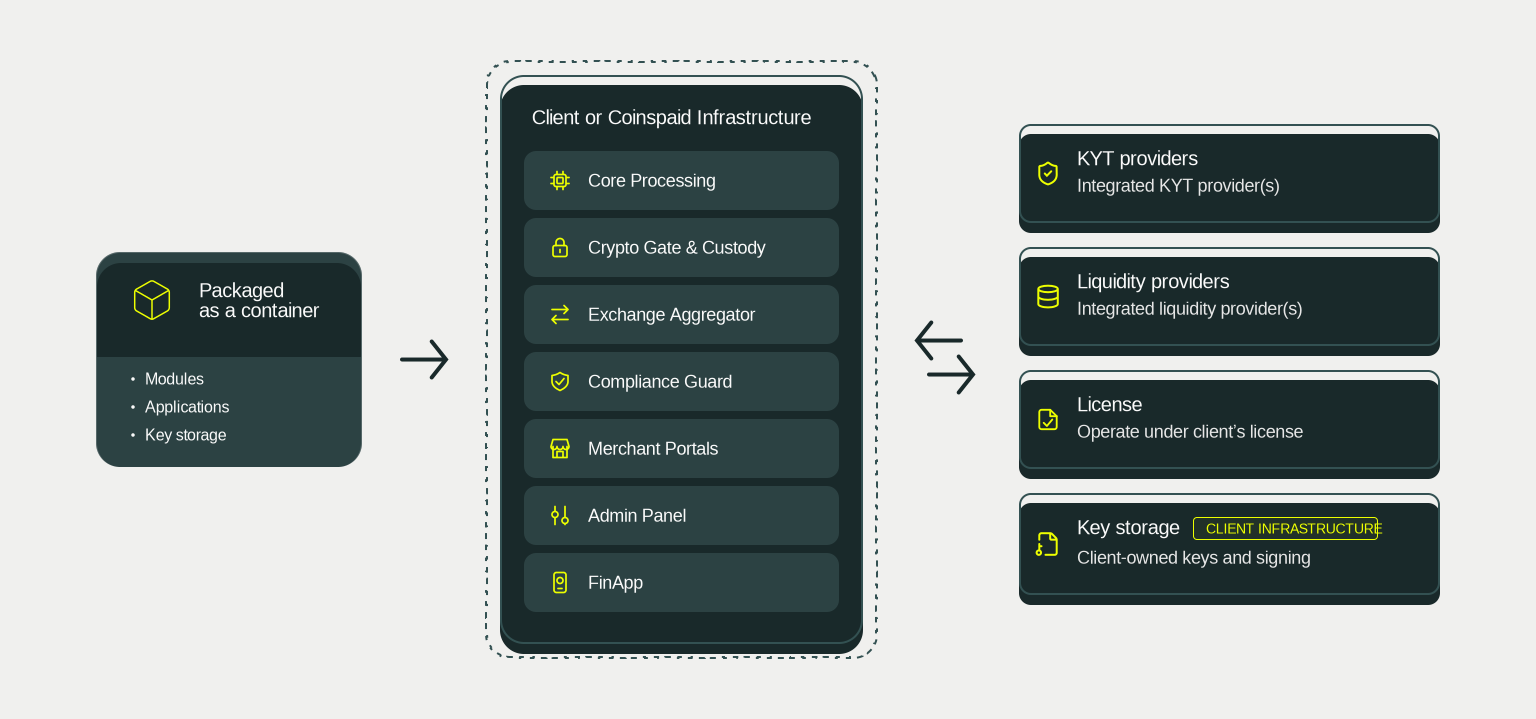
Coinspaid Enterprise provides a broader software environment for institutions looking to launch digital asset payment services under their own brand.
The platform includes payment processing, wallet and custody infrastructure, liquidity connectivity, merchant management, settlement, compliance workflows and operational applications.
Rather than integrating each component independently, a PSP or regulated fintech can use a more complete environment to operate its payment business.
The institution retains responsibility for its business, applicable licensing, customer relationships and regulatory obligations. Coinspaid supplies the underlying technology and associated infrastructure operations.
Matching Coinspaid infrastructure to business requirements
| Business requirement | Relevant product | Potential value | KPI |
|---|---|---|---|
| Operate wallets and signing within the institution’s environment | Console | Greater operational control | Cost per active wallet |
| Automate treasury and balance management | Console | Lower manual workload | Treasury operating hours |
| Add compliance and transaction analytics capabilities | Console | Improved monitoring and visibility | Exceptions handled per employee |
| Launch a branded digital asset payment service | Enterprise | Reduced product development requirements | Time to market |
| Manage merchants and payment workflows | Enterprise | More efficient commercial operations | Cost per merchant and transaction |
| Automate settlement and reconciliation | Enterprise | Reduced operational effort | Reconciliation time and exception rate |
Coinspaid reports that its infrastructure has supported more than €100 billion in client processing volume and 200 million transactions, providing evidence of production-scale usage.
Ultimately, the choice between Console and Enterprise depends on what the institution wants to operate itself, which capabilities it needs, and the total cost of achieving the desired outcome.
For a more detailed discussion of the underlying architectural decision, see Should Banks Build Their Own Blockchain Infrastructure?.
How should financial institutions prioritize blockchain investments?
A useful investment assessment begins with the existing business problem.
Before approving a project, a financial institution should be able to answer the following questions.
- What problem is being solved? Identify the payment cost, operational limitation or missing customer service.
- What is the current financial baseline? Establish costs, transaction volumes, delays and operational resources.
- Who will use the new capability? Confirm demand through customer data or a limited commercial pilot.
- What infrastructure is necessary? Distinguish essential functionality from features that add complexity without clear value.
- Can the institution operate it compliantly? Assess licensing, financial crime controls, custody, reporting and jurisdictional restrictions.
- What is the full implementation cost? Include integration, security, training and maintenance.
- What are the ongoing dependencies? Evaluate providers, liquidity arrangements, banking partners and exit options.
- When will the investment pay back? Model realistic, conservative and adverse adoption scenarios.
- What could go wrong? Consider security failures, liquidity disruptions, network outages and operational errors.
- Will the economics improve at scale? Evaluate whether growth lowers unit costs or creates additional infrastructure requirements.
A pilot should test more than whether transactions can be completed successfully.
Ideally, it should establish the actual cost of moving funds, the time until recipients can use them, the workload imposed on operations and compliance teams, and whether customers are willing to adopt the service.
The most useful blockchain pilot is one that gives management enough evidence to say no. If the economics do not work at realistic volumes, discovering that early is a successful outcome.

Blockchain infrastructure value must be measured, not assumed
Blockchain has credible applications in financial services, particularly where cross-border settlement, liquidity management and digital asset products create problems that existing infrastructure cannot address economically.
Yet technological improvements do not automatically produce financial returns.
A faster transaction may still carry expensive conversion costs. A new digital asset account may attract little customer demand. Treasury automation may improve visibility without meaningfully reducing the capital required to operate.
The institutions most likely to benefit are those that begin with a specific commercial problem, establish measurable performance targets and compare the complete economics against existing alternatives.
Ultimately, a CFO needs to ask: Will this investment make the business more profitable, more efficient or better able to serve its customers?
If the answer can be demonstrated through credible figures, the technology deserves consideration.
If it cannot, a faster blockchain is unlikely to change the investment case.
Explore blockchain infrastructure for your institution. Contact Coinspaid to discuss how Console or Enterprise could support your payment, treasury or digital asset requirements and evaluate the relevant integration costs and operating model.
FAQ
Cross-border payment infrastructure, stablecoin settlement, treasury automation and transaction processing can create measurable savings where existing costs or delays are significant. Wallet infrastructure and enterprise digital asset platforms may also generate value by enabling profitable new products. The strongest use case depends on customer demand, transaction volumes and total operating costs.
Banks can calculate ROI by comparing quantified cost savings, incremental contribution, operational efficiencies and financing benefits against the total cost of ownership. This should include implementation, provider fees, compliance, security, maintenance and operations. A realistic assessment should also test different transaction volumes and adverse scenarios.
Automated cross-border settlement, wallet consolidation, treasury operations and transaction reconciliation are among the most measurable opportunities. Cost reductions depend on existing processes, automation levels and whether the institution can actually eliminate expenditure or redeploy resources productively.
Yes. Blockchain infrastructure software can support products such as digital asset accounts, stablecoin payments, merchant processing and custody-related services. Commercial success depends on customer adoption, regulatory permissions, pricing and ongoing operating costs. The availability of technology alone does not establish a profitable market.
Providers include Coinspaid, Fireblocks, BVNK, Zero Hash, Ripple and BitGo. Their respective strengths differ across payments, custody, wallets, treasury, digital asset integration and settlement. Institutions should assess product coverage, regulatory responsibilities, deployment options, integration requirements and total cost rather than relying on general provider rankings.
Coinspaid Console provides modular digital asset infrastructure for businesses seeking greater control over wallets, keys, treasury and operational systems. Coinspaid Enterprise offers a more complete environment for licensed institutions launching digital asset payment services under their own brand. The appropriate choice depends on the institution’s technical resources, operating model and business objectives.