Key takeaways
- Building blockchain infrastructure in-house requires ongoing engineering, security and network maintenance.
- Blockchain SaaS can provide wallets, transactions, stablecoins and other capabilities through APIs.
- SaaS, hybrid and internal deployments offer different levels of control, flexibility and responsibility.
- Fintechs should assess key ownership, compliance, reconciliation, security and provider portability before integrating.
What is blockchain infrastructure for fintech?
Blockchain infrastructure for fintech is the technical foundation that allows a financial platform to interact with blockchain networks, create and manage wallets, process transactions, exchange digital assets and connect on-chain activity with existing financial systems.
Fintechs can build these capabilities internally or integrate blockchain SaaS and modular software through APIs. The second approach allows the company to retain its customer experience, business rules and internal systems while specialist software handles components such as blockchain connectivity, wallet technology, transaction processing and monitoring.
The result is closer to adding a new financial technology capability than building an entire blockchain engineering department.
What would a fintech have to build in-house?
A blockchain integration can initially appear straightforward. Connect to a node, generate an address and submit a transaction.
Production systems require considerably more.
A fintech may need reliable blockchain or node connectivity across every supported network, wallet provisioning, secure key management and a transaction engine capable of handling deposits, withdrawals, confirmations, fees and failed transactions.
Then, there are the operational requirements:
- Monitoring systems must identify delayed or anomalous transactions;
- Compliance tools may need blockchain transaction screening and customer controls;
- Liquidity workflows have to support conversion between digital assets, stablecoins and fiat currencies.
Finance teams need reporting and reconciliation that can connect blockchain transactions with the company’s internal ledger.
Multi-chain support adds further engineering work because networks differ in address formats, confirmation rules, fees, token standards and upgrade schedules. Engineers also have to respond to forks, protocol changes, outages and security incidents.
Building fintech blockchain infrastructure internally therefore means accepting an ongoing operating responsibility, rather than completing a one-off integration project.
How can fintechs integrate blockchain infrastructure through SaaS?
Blockchain SaaS moves selected blockchain functions behind software interfaces.
The fintech integrates APIs, SDKs and webhooks into its existing product while the provider supplies some or all of the underlying blockchain technology.
Circle provides a good example. Its Wallets product allows developers to create wallets and execute transactions using APIs and SDKs while Circle handles broadcasting, indexing and blockchain data for supported networks.
A fintech can, indeed, choose its level of abstraction.
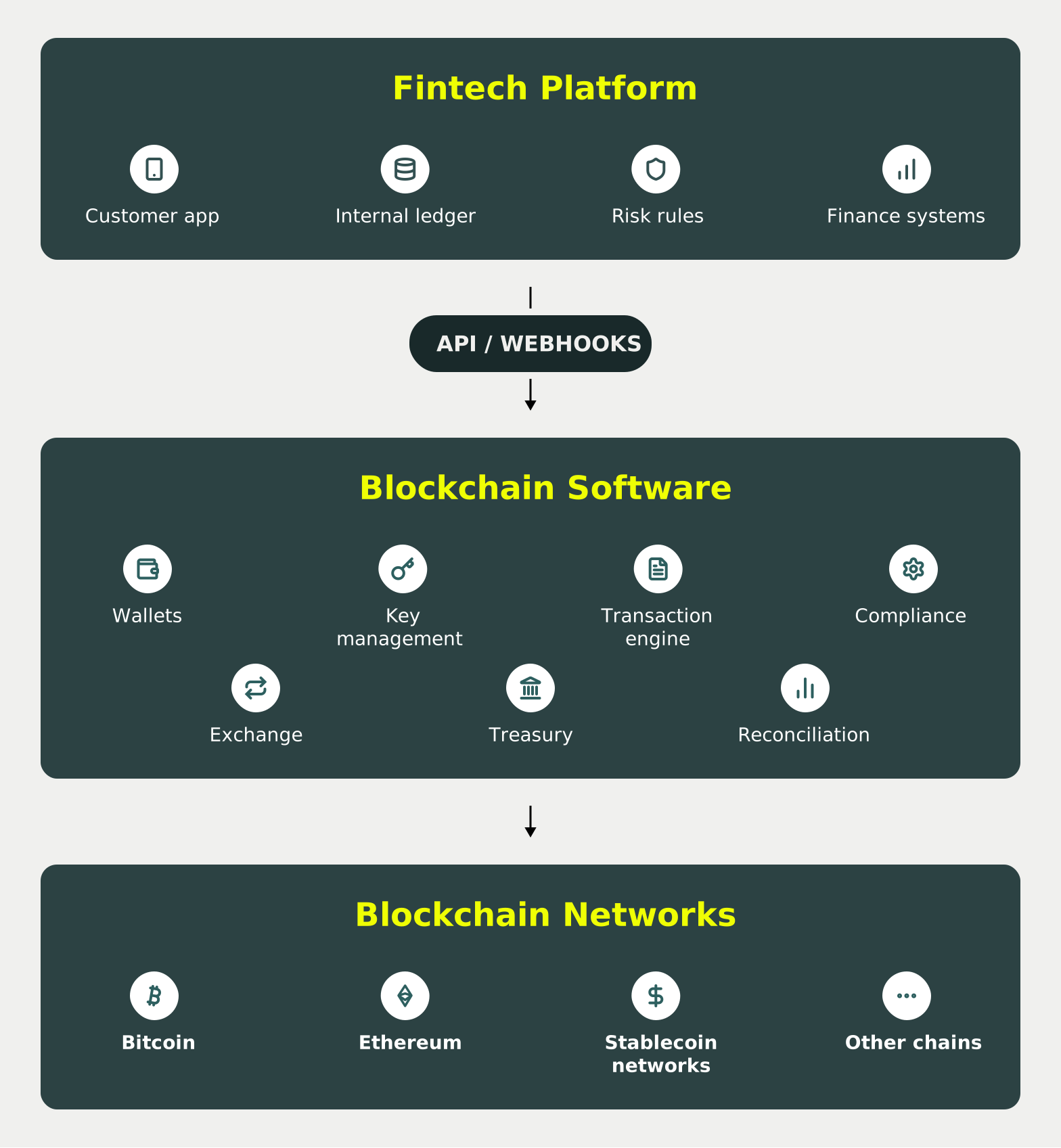
The boundary can also move. One company may outsource node connectivity while retaining its own signing environment. Another may integrate wallet and transaction technology while using external liquidity providers. A third may deploy a more complete enterprise platform.
That flexibility is largely what defines blockchain infrastructure as a service.
What blockchain capabilities can be integrated?
Ready-made blockchain infrastructure can cover several functions.
- Wallet and custody technology can create addresses, manage wallet policies and secure transaction signing.
- Blockchain connectivity abstracts individual nodes and network-specific transaction handling behind APIs.
- Payment processing can manage deposits, withdrawals, confirmations, fees and merchant settlement workflows.
- Stablecoin capabilities can support assets such as USDC or USDT for payments, payouts and treasury activity.
- Exchange and liquidity technology can connect digital asset transactions with conversion workflows.
- Compliance components can integrate transaction monitoring, address screening and internal approval rules.
- Treasury software can automate movements between operational wallets and other accounts.
- Reporting and reconciliation can translate blockchain events into records that existing finance systems can consume.
A fintech company rarely needs every capability from the same supplier. Architecture should follow the product being built and the responsibilities the company wants to retain.
Build vs SaaS vs hybrid
| Factor | Build In-House | SaaS Infrastructure | Hybrid |
|---|---|---|---|
| Time to market | Usually longest | Usually shortest | Moderate |
| Initial investment | High | Lower upfront | Moderate |
| Maintenance | Internal | Provider handles substantial portion | Shared |
| Control | Highest | Depends on architecture | High in selected areas |
| Multi-chain scaling | Requires internal development | Provider abstracts much of the work | Shared |
| Internal expertise | Extensive | Smaller specialist team | Specialist expertise in chosen areas |
| Security responsibility | Primarily internal | Shared according to service | Deliberately divided |
| Flexibility | Maximum engineering freedom | Defined by provider capabilities | High |
| Best suited for | Firms requiring deep proprietary control | Faster product launches | Firms seeking control over selected components |
When does building blockchain infrastructure in-house make sense?
Internal development can make sense when blockchain technology forms a significant part of a company’s proprietary advantage.
A large institution may want complete control over signing, network connectivity or transaction policies. Very high transaction volumes can also change the long-term cost calculation. Unusual blockchain requirements may exceed the capabilities of commercial platforms.
Internal development may also suit organizations that already employ experienced blockchain security, DevOps and protocol engineering teams.
The deciding question is whether ownership creates enough strategic value to justify permanent engineering and security responsibility.
For many fintechs, the answer differs by component. That is where hybrid architecture becomes useful.
How to choose blockchain infrastructure for a fintech platform
A blockchain infrastructure RFP should begin with architecture and responsibility.
- API design. Are core functions accessible through documented REST APIs, SDKs and webhooks? How are retries, transaction states and failures handled?
- Security and key management. Who controls signing authority, where are keys or key shares stored, and what security controls protect transactions?
- Multi-chain and stablecoin support. Which networks and assets are supported, and how does the provider handle network upgrades and new integrations?
- Modularity and control. Can wallet, custody, exchange, compliance and treasury components be adopted separately, and which policies remain under the fintech’s control?
- Compliance and monitoring. Can KYT, blockchain analytics and other compliance systems connect with transaction workflows?
- Reporting, scalability and portability. How does data feed existing finance systems, what transaction volumes can the platform support, and how easily can wallets and records be migrated to another provider?
These questions may come in handy when comparing blockchain infrastructure providers on production readiness.
Which SaaS platforms allow fintechs to integrate blockchain without building it in-house?
There are a number of platforms to keep in mind:
- Circle offers developer infrastructure including wallets and APIs. Its developer-controlled wallets allow applications to create wallets and submit transactions without low-level signing or node setup on supported chains.
- Fireblocks operates across wallet, custody, treasury and digital asset control use cases. Its platform provides APIs, wallet technology, policy controls and multi-chain connectivity, illustrating a more extensive institutional digital asset platform.
- BVNK concentrates heavily on stablecoin payments. It describes its offering as modular technology for liquidity, wallets and payments, with major chains and stablecoins accessible through a single API platform.
Coinspaid is a standout example, as it can support financial institutions and fintech companies under different deployment arrangements:
- Coinspaid Enterprise provides a more complete SaaS approach for companies that want to launch a digital asset business under their own brand. The current platform covers digital asset transactions, payments and exchange alongside merchant management, settlement, reconciliation, liquidity and compliance tooling.
- Coinspaid Console takes a modular approach for businesses that want greater control over individual components in their own operating environment. Its product structure includes Treasury Management, Core Custody, Core Exchange and Compliance capabilities.
Indeed, some fintechs need infrastructure building blocks that their engineering teams assemble. Others want a more complete business-ready software environment.
The appropriate provider category depends on where the fintech wants its own technology and operational responsibility to begin.
Provider evaluation matrix
| Capability | Why Fintechs Need It | What to Ask |
|---|---|---|
| APIs | Faster integration | REST, SDKs and webhooks? |
| Multi-chain | Expansion across networks | Which networks and tokens? |
| Wallet infrastructure | Hold and move digital assets | Who controls keys and signing? |
| Stablecoins | Payments and settlement | Which assets and chains? |
| Monitoring | Transaction risk controls | Which KYT integrations exist? |
| Modularity | Architectural flexibility | Can components be replaced? |
| Reconciliation | Finance operations | Can data feed existing systems? |
| Security | Production deployment | Architecture, audits and certifications? |
What does a typical integration look like?
Consider a US fintech that wants to add stablecoin business accounts.
Its existing application already handles customer onboarding, permissions and an internal ledger. Rather than creating its own wallet system and operating blockchain nodes, it integrates a blockchain infrastructure provider.
When an approved customer requests a deposit address, the fintech’s backend calls the provider’s API. The blockchain software provisions the wallet and monitors the relevant network.
A USDC deposit is detected and screened according to the configured transaction controls. Confirmation data returns through a webhook, allowing the fintech to update its internal ledger. Treasury rules can then determine whether funds remain in the operational wallet, move elsewhere or enter a conversion workflow.
The customer continues interacting with the fintech’s interface throughout.
The blockchain provider supplies the technical capabilities underneath that experience, while the fintech retains responsibility for its product, customers and the regulatory obligations applicable to its business.
Should fintechs build blockchain infrastructure in-house?
The build-versus-integrate decision ultimately comes down to ownership:
- Building internally offers maximum control, but it also makes blockchain connectivity, wallet technology, security, monitoring and network maintenance permanent internal responsibilities.
- Blockchain SaaS can reduce that engineering burden by exposing production capabilities through APIs or ready-made software.
- Hybrid deployments divide responsibility according to where the fintech needs greater control.
CTOs should therefore map every required blockchain function, decide which capabilities genuinely create proprietary value, and source the remainder according to security, control, portability and operational requirements.
A blockchain integration should never be seen as a single technical purchase.
FAQ – how fintechs integrate blockchain
Yes. Blockchain SaaS providers can supply wallet technology, blockchain connectivity, transaction processing, stablecoin functionality, treasury tools and other capabilities through APIs or deployable software.
No. Managed blockchain infrastructure can provide network connectivity without requiring the fintech to operate nodes itself. Whether this is appropriate depends on the level of control and resilience the company requires. Circle, for example, handles broadcasting, indexing and blockchain data for supported chains within its Wallets product.
Yes. APIs can allow fintech applications to create wallets, query balances, initiate transactions and receive transaction updates while keeping blockchain-specific functionality behind the provider interface.
There is no universal timeframe. Integration depends on the required networks, custody arrangement, compliance requirements, internal ledger design, testing and scope. API-based SaaS can remove substantial low-level development, but production deployment still requires security, operational and compliance work.
Providers address different requirements. Circle offers developer and wallet infrastructure, Fireblocks provides institutional wallet and digital asset technology, BVNK focuses heavily on stablecoin payment infrastructure, while Coinspaid offers both a more complete Enterprise platform and modular Console products. The appropriate shortlist depends on whether the fintech needs wallets, stablecoins, payments, custody technology, treasury capabilities or a more comprehensive enterprise software environment.