
About the expert
Hanna Drabysheuskaya is Chief Financial Officer at Coinspaid. Her work covers the financial and operational side of payments and digital assets, including the decisions institutions face when introducing blockchain-based payment services.
Quick answer
A crypto processing platform can cost anywhere from tens of thousands of dollars for a tightly scoped MVP to several hundred thousand dollars or more than $1 million for an enterprise deployment.
The range is wide because a crypto payment gateway can cover very different levels of functionality. A smaller product may process payments through third-party services. A larger platform may also cover wallets, key management, transaction monitoring, liquidity, settlement, reconciliation, compliance controls and round-the-clock operations.
For example:
- Merehead places a focused single-chain MVP at about $40,000 and enterprise implementations at $250,000 or more.
- GoodFirms gives a $40,000 to $300,000-plus development range.
- Gizmolab estimates $70,000 to $180,000 for an MVP, $220,000 to $650,000 for production-ready systems and more than $1 million for some enterprise builds.
For a financial institution, it starts with establishing which capabilities the company plans to build, own and operate over several years.
What are you actually building?
A crypto processing platform can support far more than checkout. It needs reliable blockchain connectivity, transaction broadcasting and confirmation monitoring. It can also include wallets, signing systems, compliance tools, conversion, settlement, reporting and customer administration.
Components tend to include blockchain connectivity, node services, wallet creation, key management, transaction processing and finality monitoring. Larger deployments can also require multi-chain support, KYC and KYT integrations, liquidity connections, settlement tools, APIs, webhooks, reporting, reconciliation and system monitoring.
Coinspaid’s five-level analysis illustrates how blockchain services can range from basic network access through developer tools and business-ready products. Each additional level can reduce the amount of technology a company needs to develop and maintain internally.
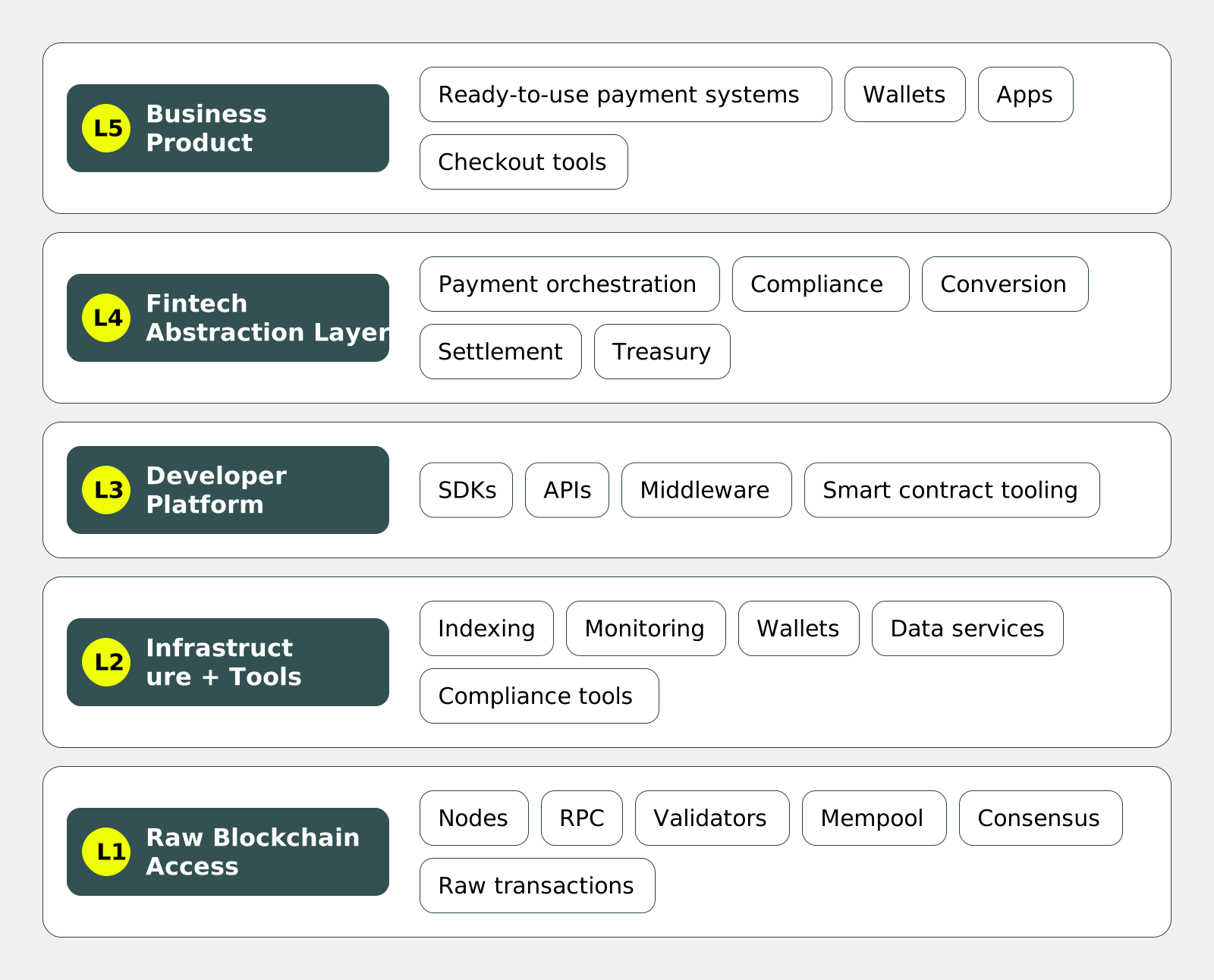
The crypto payment gateway development cost therefore depends heavily on how much technology the company wants to own. A fintech using managed blockchain APIs, external custody and third-party transaction monitoring has a different engineering requirement from a bank running its own nodes, controlling signing and developing its own ledger and reconciliation systems.
Cost breakdown and where the budget goes
| Cost category | Initial cost | Ongoing cost | Main cost drivers |
|---|---|---|---|
| Engineering | High | High | Backend systems, APIs, ledger, workflows, admin tools |
| Blockchain connectivity | Low to high | Medium | RPC providers, nodes, indexing, number of networks |
| Wallet and key systems | Medium to high | Medium to high | Custody design, HSM or MPC, signing policies |
| Security | High | High | Architecture, monitoring, access controls, incident response |
| Compliance | Medium to high | High | KYC, KYT, Travel Rule, jurisdictions, regulatory updates |
| Payment engine | High | Medium to high | Deposits, withdrawals, fees, refunds, settlement |
| Liquidity integrations | Medium | Medium | Exchanges, OTC, stablecoins, fiat partners |
| Reporting and reconciliation | Medium to high | Medium | Ledger, ERP, accounting and audit requirements |
| DevOps and monitoring | Medium | High | Availability, logs, alerts, backups, on-call coverage |
| QA and audits | Medium to high | Recurring | Penetration tests, security reviews, release testing |
Many costs begin after launch. Protocol upgrades, forks, changing network fees and new token standards all create recurring engineering work. The same applies to node maintenance, security patches and new blockchain integrations.
Round-the-clock monitoring adds another permanent expense. Teams also need incident response procedures, scaling capacity and engineers available when production issues occur.
MVP vs production vs enterprise
A narrow MVP usually limits the number of chains, assets and workflows. It may rely heavily on third-party RPC services, custody providers, KYC vendors and liquidity partners. Administration may also remain fairly basic. This is where estimates in the tens of thousands of dollars become plausible.
A production platform requires additional work around redundancy, access controls, ledger integrity, reconciliation, monitoring and recovery procedures. Multiple chains and tokens add more testing because networks differ in confirmation behaviour, fees and upgrade cycles.
An enterprise blockchain payment platform introduces further requirements. Banks, payment institutions and regulated fintechs may need internal approval policies, segmented custody, extensive audit records and configurable compliance controls.
ERP integration, complex settlement flows and support for several legal entities can add further cost. These requirements help explain why published enterprise estimates can reach the high six figures or exceed $1 million.
How long does it take to build?
Timelines tend to rise alongside scope. A narrow MVP can sometimes be delivered within a few months. Production systems require additional time for security work, testing, operational tooling and external integrations.
Enterprise projects can extend toward nine to twelve months. Licensing requirements, banking integrations, custody architecture and multi-jurisdiction operations can extend development further.
Published estimates vary here as well. GoodFirms puts many projects at roughly four to nine months, while another 2026 development analysis places larger enterprise implementations at approximately nine to twelve months.
Procurement, compliance review, vendor onboarding and the experience of the existing engineering team can all affect the final schedule.
Calculate total cost of ownership
Total cost of ownership captures what happens across the full life of the product, in addition to the development costs covering the first release.
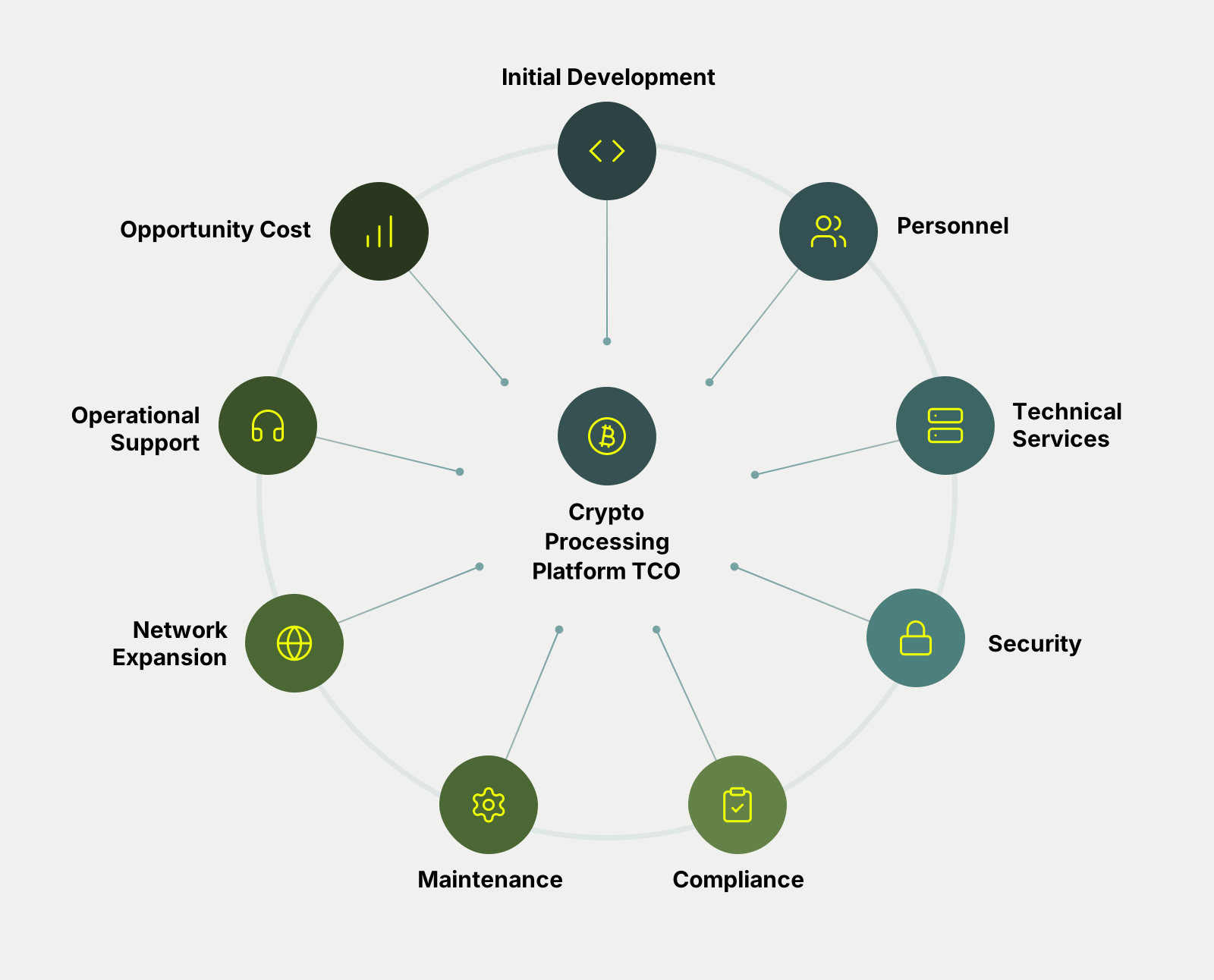
- Personnel can include blockchain engineers, backend developers, security specialists, DevOps staff, QA specialists, compliance teams and product owners.
- Technical expenditure can include RPC access, cloud services, databases, monitoring and backups. Security and compliance costs continue through audits, transaction monitoring, policy updates and incident preparation.
- Each additional blockchain, token and settlement route brings further integration and maintenance requirements.
- Opportunity cost also belongs in the calculation. Engineers maintaining wallet operations, blockchain connectivity and protocol upgrades have less time available for customer-facing products. A delayed launch can also carry a commercial cost when the service supports a new payments, treasury or digital asset revenue stream.
- Institutional preferences support an integration-led approach. In EY-Parthenon’s survey of 250 corporate decision-makers, 56% preferred embedded APIs within existing treasury or payment platforms. Another 24% preferred APIs connected to a new third-party provider, while 2% selected a self-hosted or on-premises wallet. Around 70% said ERP integration would make their organization more willing to use stablecoins.
- Liquidity design can influence TCO (Total Cost of Ownership) beyond software spend. Circle’s case study on Arf describes a USDC-based liquidity service that allows cross-border payment companies to settle with international partners while reducing the need to maintain prefunded balances in each destination market.
Build in-house vs enterprise software
| Factor | Build in-house | Enterprise software |
|---|---|---|
| Upfront investment | High | Integration-led |
| Time to market | Longer | Shorter |
| Engineering team | Specialist team | Smaller integration and product team |
| Maintenance | Internal | Provider handles much of the underlying technology |
| Multi-chain expansion | Additional development and testing | Depends on provider coverage |
| Control | Maximum | Depends on deployment approach |
| Cost predictability | Harder during development | Often higher |
| Vendor dependency | Lower | Higher |
| Best suited for | Firms treating processing technology as strategic IP | Firms prioritising launch speed and lower operating burden |
When does building make financial sense?
Building can make sense when the processing technology itself represents strategic intellectual property or when transaction scale significantly improves internal unit costs.
It can also suit organizations with highly specific architecture requirements, established blockchain and security teams, or governance requirements that justify permanent ownership of the full system.
The company should still calculate costs across several years. Internal ownership brings continued responsibility for upgrades, patches, integrations, testing and production incidents.
When does enterprise software make more sense?
Enterprise software can suit companies seeking faster market validation and lower initial CAPEX. It can also reduce the need to recruit a large specialist engineering team.
Multi-chain requirements strengthen the case further because every additional network brings development, monitoring and maintenance work.
EY found that 79% of financial institutions surveyed planned to use third parties when building stablecoin capabilities. Many expected to combine internal systems with vendor components.
Coinspaid solutions
Coinspaid Solutions offers several ways for financial institutions and fintechs to reduce the amount of blockchain technology they develop internally while retaining control over selected parts of their operation.
Coinspaid Console is designed for businesses that want digital asset capabilities within their own environment and under their own licence. Coinspaid states that keys, signing and assets can remain within the customer’s environment, while individual modules can be introduced gradually.
This approach can suit institutions seeking substantial operational control while reducing the amount of blockchain software they need to develop internally.
Coinspaid Enterprise provides a ready-to-launch platform for digital asset transactions, payments and exchange. Its capabilities cover merchant management, settlement, reconciliation, liquidity, compliance and transaction monitoring.
It is designed for financial institutions launching digital asset processing and custody services under their own brand.
CryptoProcessing by Coinspaid provides an example at the finished-product end of the market. It focuses on merchant stablecoin and cryptocurrency payments.
Coinspaid Solutions and CryptoProcessing operate as independent companies with shared brand heritage, serving the enterprise software and merchant payment markets respectively.
Businesses can therefore choose how much of the technology they want to own.
A financial institution might retain its licence, treasury policies, customer relationships, approval rules and signing environment while sourcing blockchain connectivity, wallet technology, processing software or operational components from a specialist provider.
Final thoughts
Published estimates place the cost to build crypto processing software anywhere from tens of thousands of dollars for a focused MVP to high six figures or more than $1 million for complex enterprise deployments.
The final figure depends on what the company chooses to build and operate. Multi-chain support, custody, security, compliance, settlement and reconciliation can all increase development requirements.
Importantly, personnel, technical services, security, compliance, maintenance, network expansion, operational support and opportunity cost all continue after launch.
Banks, fintechs and digital asset businesses can then decide which capabilities create enough strategic value to justify internal development and which can be supplied through enterprise software.
FAQ – crypto processing platform cost
Published 2026 estimates range from roughly $40,000 for focused builds to several hundred thousand dollars. Some enterprise implementations exceed $1 million. Scope, security, compliance, custody, settlement and blockchain coverage account for much of the difference.
A narrow MVP may take a few months. Production deployments often require several months, while larger enterprise projects can extend toward nine to twelve months when security, compliance and institutional integrations are extensive.
The continuing engineering function can become one of the largest costs. Wallet security, transaction processing, compliance, reconciliation, DevOps and multi-chain maintenance require specialist personnel throughout the life of the platform.
The answer depends on multi-year TCO and transaction scale. Building carries higher fixed development and staffing costs while providing greater ownership. Enterprise software converts much of that initial build spend into integration work and recurring commercial costs.
A crypto payment gateway focuses primarily on accepting and processing payments. An enterprise blockchain platform can also cover custody, treasury, exchange, settlement, compliance, reporting, reconciliation and internal financial workflows.
Yes. Deployment approaches vary. Some providers allow customers to retain their licences, keys, signing environments, permissions and financial policies while using externally supplied software components.
Businesses should compare initial development, specialist staffing, technical services, security, compliance and maintenance. They should also account for network expansion, operational support, time to market, control requirements, vendor dependency and the opportunity cost of allocating internal engineers to blockchain processing.