
Key takeaways
- Banks can modernize payments while keeping the existing core ledger.
- Real-time payments, compliance and blockchain functions can run around the core.
- Incremental deployment reduces migration risk and supports gradual upgrades.
- Coinspaid can add digital-asset payments, custody, exchange and treasury capabilities.
About the expert
Hanna Drabysheuskaya is Chief Financial Officer at Coinspaid, where her responsibilities span finance, accounting, legal affairs and operational processes. Her career includes international accounting, financial analysis and enterprise finance, followed by several years working inside a blockchain payments business.
At Coinspaid, she has worked across financial reporting, audits, licensing, business analysis and the financial requirements of payment software. This gives her experience at the point where financial operations, technology and regulated payment services meet.
Quick answer
Banks can modernize payments while keeping their existing core banking system by connecting modular payment technology through APIs. This allows them to add real-time processing, new payment networks, compliance controls, reconciliation and digital-asset capabilities while the core continues to serve as the system of record.
The core can continue to own balances, account records and ledger entries, while specialist systems handle payment processing and newer services around it.
Why core replacement is sometimes the wrong modernization strategy
The core banking system carries some of the most sensitive responsibilities inside a financial institution. It maintains customer accounts and balances, records ledger entries and supplies authoritative financial data to other systems. Replacing it, therefore, is a momentous task.
A full migration can involve data conversion, parallel systems, regression testing, accounting validation, staff retraining and changes to many downstream integrations.
Budget pressure adds another consideration. Accenture estimates that roughly 70% of bank IT budgets are consumed by maintaining technical debt, leaving technology leaders to decide how much capital should go into the core itself and how much should fund faster payments, compliance automation and new customer services.
| ~70% | of IT budget are being consumed just by maintenance of technical debt. |
| 8% | average growth in software costs a year since 2017, outpacing banking revenue growth. |
| ~1/3 | efficiency gains expected across key software development life cycle activities in the next three years. |
Core replacement still has a place when resilience requirements have outgrown the existing system, vendor support is approaching its end, or years of customization have made ongoing integration too costly to maintain. In those cases, the core itself becomes part of the modernization program.
When banks have a dependable ledger, payment infrastructure modernization can focus on the systems around it. The bank can improve processing speed, API access, settlement connectivity and digital-asset capabilities while keeping the accounting foundation that already supports day-to-day operations.
What payment infrastructure can be modernized without replacing the core?
Responsibilities ought to be separated carefully. The core retains ownership of balances, account records and ledger postings, while specialist technology handles payment functions that change more frequently.
1. Payment routing
Routing technology can decide how a transaction should be processed and which provider or payment network should receive it. This gives the bank room to adjust payment methods and fallback providers without rebuilding accounting functions inside the core.
2. New payment networks
Connections to FedNow, RTP, ACH, card networks and cross-border payment systems can be introduced through dedicated connectors or specialist platforms. Banks can then add new payment options according to customer demand while keeping the same central account record.
3. APIs and core banking integration
An API-based integration environment gives newer applications controlled access to the core. Legacy interfaces can connect with modern services while account and payment functions remain governed by the bank’s existing systems and permissions.
4. Real-time processing
A dedicated payment engine can manage transaction status, acknowledgements and exceptions in real time. The core then receives the accounting events required for ledger posting, while the payment engine handles the customer-facing transaction flow.
5. Compliance and transaction monitoring
Sanctions screening, fraud controls, transaction monitoring and digital-asset KYT can be integrated into the payment flow. Specialist systems return screening results while the bank retains ownership of policy, approval rules and transaction controls.
6. Reconciliation and reporting
A dedicated reconciliation system can compare payment transactions with network confirmations, provider balances and core ledger entries. This gives operations teams a more consistent way to identify mismatches and resolve exceptions.
7. Blockchain and digital-asset systems
Wallet management, custody technology, key controls, blockchain connectivity, asset conversion, stablecoin payments and on-chain monitoring can operate alongside traditional banking systems. The core records the financial outcome, while specialist blockchain software handles the technical requirements of digital assets.
What does payment infrastructure for banks look like?
A modular design separates payment activity into defined areas of responsibility. Customer channels connect through APIs to payment processing, compliance and authorization services, which then connect to payment networks and settlement systems. Reconciliation and accounting data return to the existing core banking system.
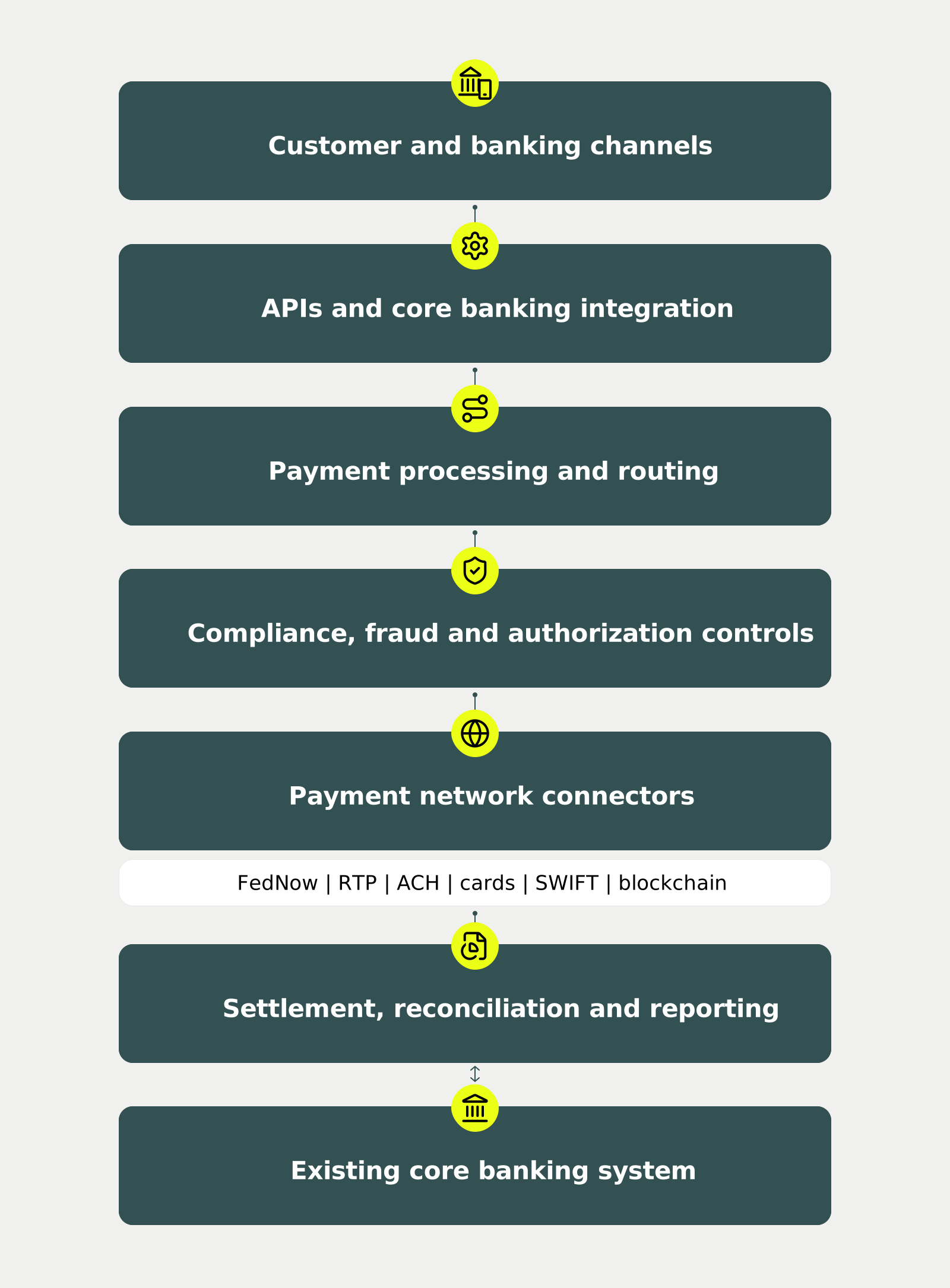
The payment platform can hold the operational status of a transaction as it passes through screening, submission and confirmation. The core keeps the authoritative account balance and ledger posting, giving each system a defined responsibility.
Three ways banks can modernize payment infrastructure
Banks usually choose between full core replacement, hybrid modernization and adding specialist payment systems around the existing core. The right option depends on the condition of the current system, the scope of change and the bank’s tolerance for migration risk.
| Factor | Core replacement | Hybrid | Specialist Payment Systems |
|---|---|---|---|
| Time | Often multiyear | Phased | Usually faster per capability |
| Cost | Highest upfront | Medium to high | Lower initial commitment |
| Risk | Concentrated migration risk | Coexistence complexity | Lower core change risk with added vendor dependency |
| Flexibility | High after migration | High | High |
| New payment networks | Added through the new core environment | Added progressively | Added independently |
| Best suited for | Core itself constrains the bank | Gradual core transition | Existing core remains dependable |
- Full core replacement suits institutions where the ledger and underlying banking architecture have become a constraint on resilience, product development or long-term maintenance. It also carries the heaviest migration workload and the largest upfront commitment.
- Hybrid modernization introduces modern systems alongside the existing core and gradually transfers selected products, customer groups or capabilities. This gives the bank more time to validate each stage while old and new systems operate in parallel.
- Specialist payment systems around the core suit institutions that mainly need new payment capabilities while their existing ledger and account systems remain dependable. This route can also make it easier to add services one at a time.
How to modernize payments step by step
1. Map the current payment infrastructure
Document every system a payment touches between initiation, authorization, settlement and reconciliation. Include the core, processors, compliance systems, correspondent banks, clearing connections and reporting tools, then identify where delays and manual work enter the process.
2. Identify the actual constraint
Start with the business and operational problem. It may involve batch processing, slow integrations, limited payment connectivity, manual reconciliation, fragmented data or digital-asset requirements. Provider selection becomes more precise once the bank can define the capability it needs to improve.
3. Decide what the core should continue owning
Define the responsibilities that remain authoritative within the core, which will usually include balances, account records and ledger postings. Document those responsibilities so connected systems always know which source governs each financial record.
4. Separate capabilities that can be externalized
Identify payment functions that can operate as independent services, such as routing, blockchain connectivity, transaction monitoring, exchange, custody or reconciliation. Assess each one according to integration effort, risk and expected commercial value.
5. Define APIs and data flows
For every component, document the data entering the service, the information returned to the bank and the point at which ledger entries are created. Retry controls, duplicate-payment protection and failure handling should also be designed before production use.
6. Select payment technology providers
Evaluate providers against the bank’s chosen architecture. Ask them to show how their technology connects with the existing core, how individual modules are deployed and how transaction data can be monitored, exported and reconciled.
7. Launch one capability first
Begin with a defined payment product, customer group or payment network. This gives the bank a contained environment for testing integration quality, compliance controls, operational processes and reconciliation before expanding further.
8. Expand gradually
Once the first implementation is stable, additional payment methods, markets and digital-asset capabilities can use the same integration pattern. The bank can then modernize through a series of controlled releases.
Where blockchain fits into payment modernization
Blockchain can sit alongside traditional payment systems as an additional settlement and digital-asset capability. It can use the same modular architecture that connects other specialist payment services to the core banking environment.
Stablecoins can support 24/7 transfer and settlement, while blockchain connectivity can support cross-border payments, digital-asset custody and treasury operations. These services require wallet management, key controls, transaction signing, network connectivity and on-chain screening, which are well suited to specialist software connected to the bank’s existing systems.
For U.S. institutions, the regulatory foundation for these activities became more established in 2025, when the OCC reaffirmed that national banks and federal savings associations may conduct certain crypto custody, stablecoin and distributed-ledger payment activities under applicable law and appropriate risk management. Permissible crypto activities may also be outsourced to third parties where suitable controls are maintained.
A bank can therefore add stablecoin settlement or digital-asset services through specialist blockchain software. The existing core can continue to record customer balances and accounting entries, while the connected platform manages blockchain-specific functions and returns the relevant transaction data.
How should banks choose a payment infrastructure platform?
Ultimately, the strongest provider will fit the institution’s existing systems, control framework and roadmap while giving technology teams enough freedom to add or replace capabilities over time.
- Core integration should cover documented APIs, webhooks, event interfaces and the way transaction data returns to the core. Reconciliation and ledger posting deserve particular attention.
- API-first design should give the bank programmatic access to payment actions, transaction status, balances and administrative functions. Internal systems should be able to use the service with limited manual handling.
- Incremental deployment gives institutions the option to launch individual capabilities in stages. This can reduce migration risk and help technology teams prove operational performance before expanding usage.
- Control should remain with the bank across customer relationships, product configuration, policy settings and relevant financial records.
- Compliance integration should work with the institution’s AML, sanctions, fraud and approval processes.
- Portability and exit should cover transaction-data export, documentation quality and the process for replacing individual components. Long-term flexibility depends on the bank being able to change providers without another major migration.
- Operational resilience should cover uptime commitments, redundancy, incident handling, monitoring, audit records and recovery objectives. Responsibilities should be documented across the bank and provider so operational teams know how incidents will be handled.
Which payment infrastructure platforms integrate with existing core banking systems?
Payment infrastructure platforms that integrate with existing core banking systems tend to specialize in different parts of the payment process. Some focus on payment hubs or API connectivity, while others cover real-time payments, compliance services or blockchain software. Banks should compare providers according to the capability they actually need to add.
One institution may use one provider for instant payments, another for fraud screening and another for digital assets. The core banking system can continue to provide the accounting record and customer-account foundation across all three.
Blockchain and digital asset systems
Coinspaid Enterprise is a solution for financial institutions that want a ready-to-run environment for building and operating a crypto payment business. It offers digital-asset transaction processing, payments and exchange with merchant management, settlement, reconciliation, liquidity and compliance.
For institutions that prefer to assemble selected capabilities around their existing systems, Coinspaid Console provides modular blockchain software that can be configured according to the bank’s requirements. Customers can choose the products that fit their architecture and operating plans.
Console can include:
- Treasury Management with four treasury modules;
- Core Custody for custody and digital-asset management;
- Core Exchange for digital-asset exchange functionality;
- Compliance for controls supporting compliant digital-asset operations.
A financial institution can deploy one, two, three or all four products according to the capabilities it already has internally and the functions it wants Coinspaid to provide.
Coinspaid can complement existing banking infrastructure with its specialized blockchain software. The bank’s core can continue managing traditional accounts and ledger records, while Coinspaid handles selected digital-asset functions.
Provider evaluation matrix
| Requirement | Why Banks Need It | What to Ask a Provider |
|---|---|---|
| Core integration | Preserves the existing core | Which APIs, webhooks and event interfaces are available? |
| Modular deployment | Reduces migration risk | Can individual modules launch independently? |
| Payment-network support | Supports future payment options | Which payment networks are supported? |
| Blockchain readiness | Enables digital assets | Which stablecoins, networks and custody approaches are supported? |
| Compliance | Connects regulatory controls | How are screening, monitoring and approvals integrated? |
| Monitoring | Supports operational resilience | Which real-time alerts and audit records are available? |
| Exit strategy | Reduces provider lock-in | How can data and components be migrated elsewhere? |
Banks can turn these requirements into pass-or-fail criteria before comparing commercial proposals.
Rounding up on payment orchestration for banks
Bank payment modernization can begin around the existing core. APIs, real-time processing, new payment networks, transaction monitoring, reconciliation and blockchain capabilities can be added through modular payment infrastructure while the core continues to hold the authoritative financial record.
This gives banks more control over modernization spending because each provider can be selected according to the function it performs and the degree of control the institution wants to retain. It also makes future expansion or replacement easier to plan.
For digital assets, Coinspaid provides blockchain software that can operate alongside existing banking technology. Banks and other financial institutions can add payments, custody, exchange, treasury and compliance capabilities while their core continues to perform its established accounting role.
FAQ – payment infrastructure modernization
Yes. Banks can connect payment engines, APIs, compliance systems, reconciliation tools and digital-asset software to an existing core. The core can remain responsible for balances and ledger records while specialist systems handle additional payment functions.
Bank payment modernization is the process of upgrading how an institution receives, processes, routes, settles, monitors and reconciles payments. Common areas of investment include real-time processing, APIs, ISO 20022, automation and blockchain technology.
Payment routing, payment-network connectivity, transaction monitoring, compliance screening, reconciliation, reporting, custody technology, exchange systems and blockchain connectivity can operate alongside the core when responsibilities and data flows are defined carefully.
Modern platforms commonly use APIs, webhooks, event streams, message queues or standardized financial messages to exchange instructions and transaction information with the core. The design should define which system owns each record and when accounting entries are posted.
Banks can use a central payment service to apply routing rules, select providers, handle failures and return transaction status through a common interface. This allows payment decisions to change while core accounting functions remain stable.
Yes. Blockchain technology can operate as an additional payment and settlement capability. Specialist software can provide wallets, custody, stablecoin support, blockchain connectivity and transaction monitoring while the existing banking system continues to record customer balances and accounting entries.
Implementation time varies according to scope, internal architecture, regulatory requirements and integration complexity. A single payment capability can be added far faster than a core migration, while hybrid modernization may progress through several stages and complete core replacement can take several years.
Banks should examine core integration, APIs, modularity, payment-network support, compliance integration, resilience, monitoring, control over customer and business rules, data portability and exit terms. Digital-asset support should also form part of the assessment where blockchain is included in the bank’s roadmap.
Several categories can integrate with existing cores, including payment hubs, API platforms, real-time payment connectors, compliance technologies and blockchain software providers. The appropriate choice depends on the function the bank wants to modernize. For banks adding digital-asset payments, custody, exchange or blockchain connectivity, Coinspaid Enterprise and Coinspaid Console can operate alongside existing financial systems while the core remains responsible for established account and ledger functions.