Key takeaways
- Crypto payment security covers technology, people, governance and operational processes, not blockchain code alone.
- Financial institutions should verify who controls keys, privileged access and transaction approvals.
- Providers need continuous monitoring, clear audit trails, tested recovery procedures and strong incident response.
- Certifications such as ISO/IEC 27001 and SOC 2 support due diligence, but should sit alongside technical and third-party risk assessment.
For banks, electronic money institutions (EMIs), payment service providers (PSPs) and regulated fintechs, a code audit is only one part of evaluating crypto payment infrastructure.
A blockchain transaction can be technically valid while the systems around it remain vulnerable:
- Credentials can be stolen;
- Signing permissions can be abused;
- An employee can approve the wrong transaction;
- A third-party service can fail;
- Monitoring can miss an anomaly until assets have already moved.
A useful assessment must cover technology, people and operational processes.
Crypto payment infrastructure security: quick answer
Crypto payment infrastructure security protects the systems and processes used to create, approve, sign and record digital-asset transactions. Financial institutions should require clear ownership of risks, protected keys, restricted access, continuous monitoring and tested recovery procedures.
A code or smart contract audit examines part of that environment. Due diligence must also establish how controls work in daily operations, who maintains them and what happens when they fail.
The NIST Cybersecurity Framework 2.0 provides a useful structure for this review through six functions: Govern, Identify, Protect, Detect, Respond and Recover.
What does institutional-grade crypto security mean?
Institutional security is ultimately about controlled risk.
A financial institution needs to understand who owns each risk, who can access critical systems, who can authorize transfers, how activity is monitored and how responsibility is divided between the institution and its provider.
Those responsibilities need supporting evidence:
- Policies should be documented;
- Privileged actions should be traceable;
- Security events should generate records;
- Recovery arrangements should be tested;
- Management should understand which third parties support critical functions.
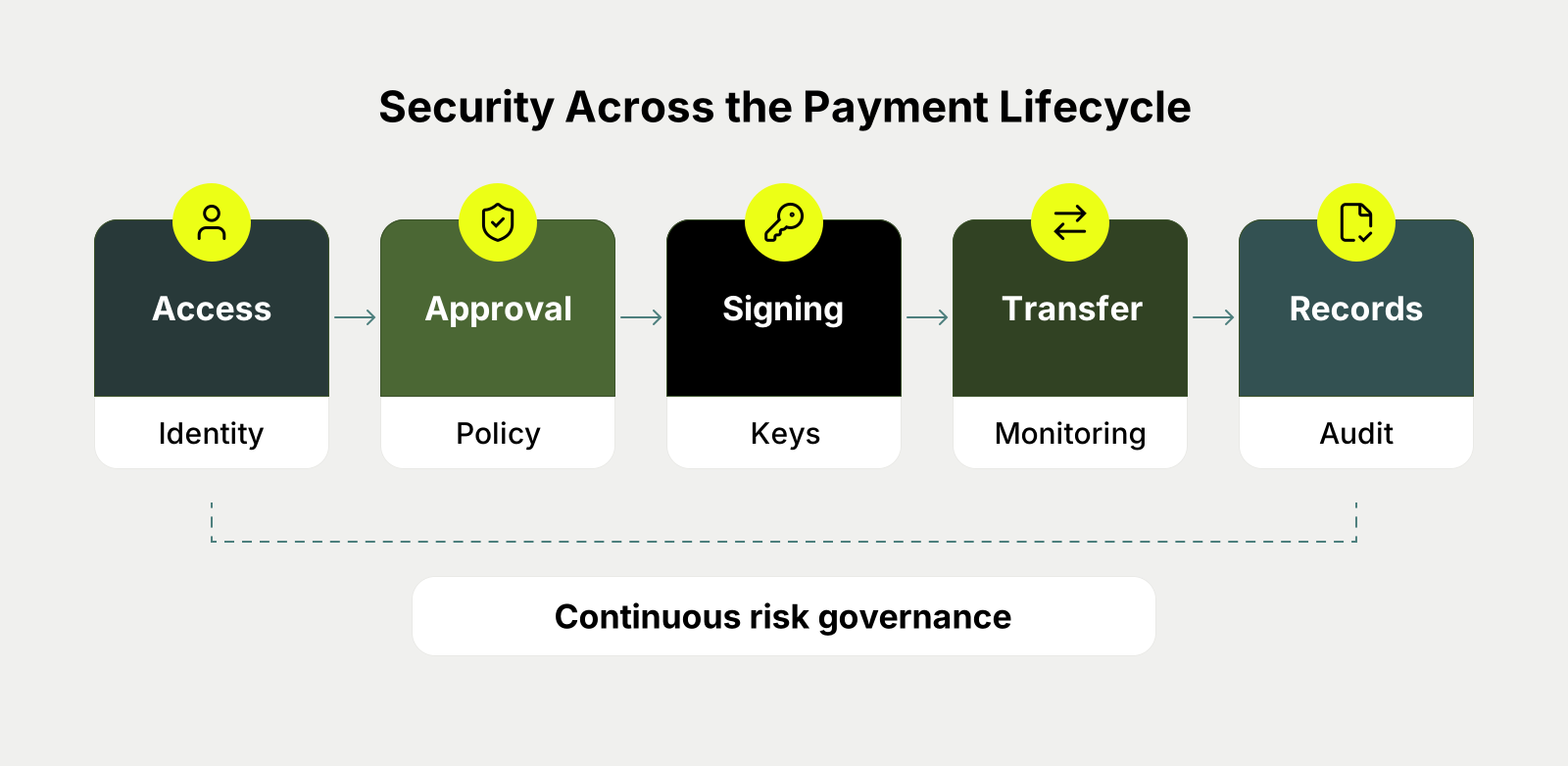
For EU financial entities within its scope, the EU’s Digital Operational Resilience Act (DORA) requires ICT risk management, monitoring, continuity and recovery arrangements, and oversight of ICT third-party risk. Outsourcing does not transfer the institution’s responsibility for meeting its regulatory obligations.
Due diligence should establish whether the technology can process transactions securely and whether the provider can maintain that security over time.
What are the main security risks in blockchain payments?
Blockchain payment security involves both on-chain and off-chain threats.
Key compromise can give an attacker authority to move assets. Weak access controls can expose administrative functions or transaction approval systems. Infrastructure vulnerabilities can affect servers, APIs, databases or employee devices.
Human behaviour also creates risk. Phishing and social engineering can bypass technically strong systems by targeting people with privileged access. Configuration mistakes, incorrect wallet addresses and poorly designed approval processes can result in irreversible transfers.
External dependencies add worries. A payment provider may depend on cloud platforms, blockchain nodes, custody technology, liquidity providers or transaction-monitoring vendors.
Smart contract vulnerabilities, of course, remain relevant wherever contracts form part of the payment flow, but they represent one category within a much larger environment.
The lesson is that a blockchain payment incident does not have to begin on the blockchain.
The security controls financial institutions should expect
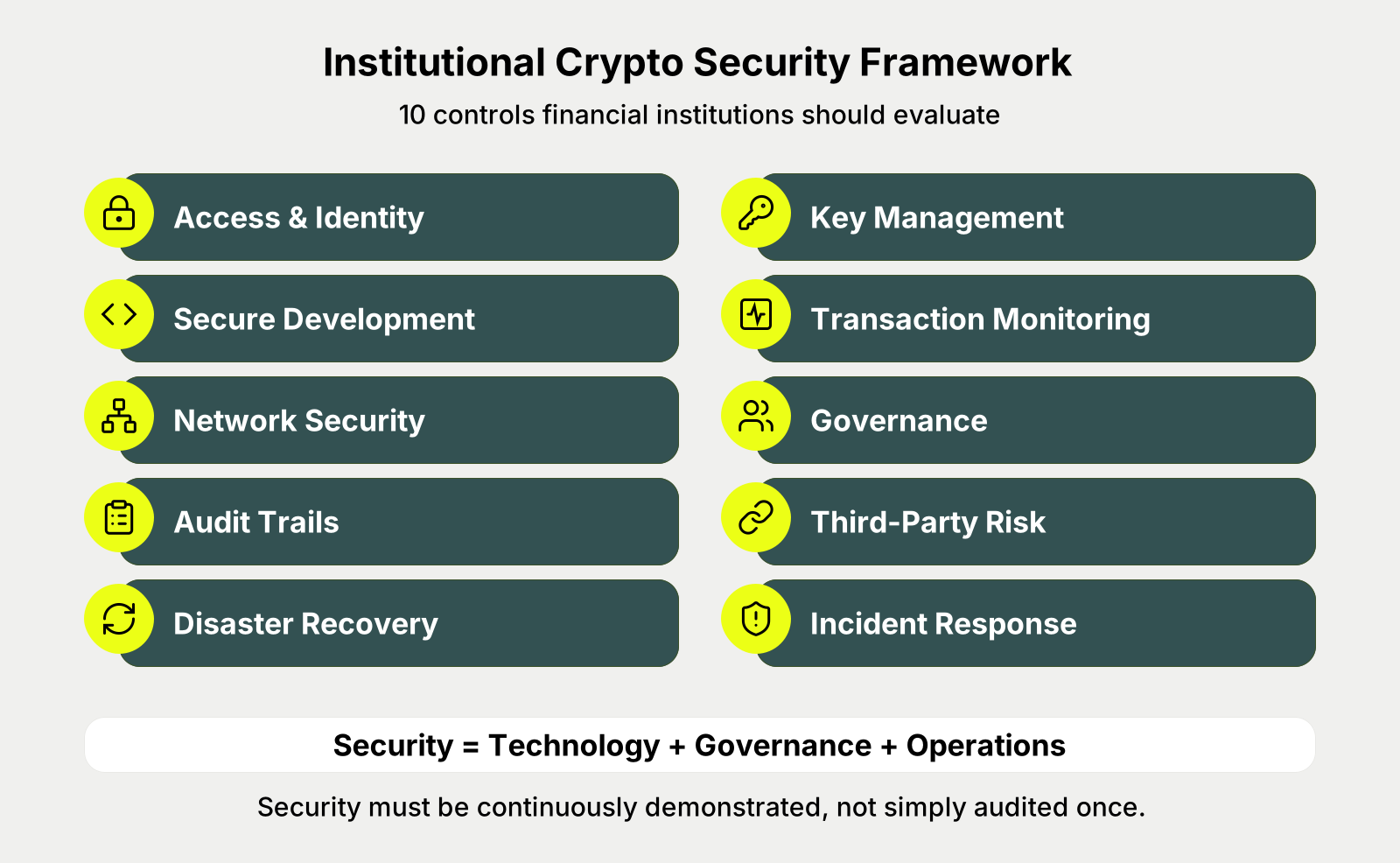
A due-diligence review should examine the following ten areas.
1. Access and identity management
Access controls determine who can enter critical systems and what each person or service can do.
Financial institutions should expect multi-factor authentication, role-based permissions, privileged-access controls and least-privilege policies. NIST’s zero-trust guidance similarly recommends granting only the access required for a particular task.
Ask: How is privileged access granted, reviewed and revoked, and which actions require additional authorization?
2. Key management and transaction signing
Private keys ultimately determine control over many digital assets. Their generation, storage, use, backup and recovery deserve particular scrutiny.
Institutions should understand whether the provider uses HSMs, MPC, multisignature arrangements, cold storage or another architecture, alongside the authorization policies governing transaction signing.
Crypto-specific frameworks such as the Cryptocurrency Security Standard place particular emphasis on key generation, signing, governance and operational security.
Ask: Who can authorize a transaction, where is key material protected and how is a compromised signing component contained?
3. Secure development and testing
Applications, APIs and smart contracts should pass through controlled development, testing and deployment processes.
Code review, vulnerability scanning, penetration testing and independent audits can uncover different classes of weakness. Providers should also demonstrate how vulnerabilities are prioritized and remediated.
Ask: How frequently are applications and critical components tested, and how are findings tracked through remediation?
4. Transaction monitoring
Payment security requires visibility into unusual activity.
Monitoring can include abnormal transaction size or velocity, unusual destinations, suspicious wallet activity, repeated authorization failures and behaviour that deviates from established patterns. Blockchain analytics can also support sanctions and financial-crime controls.
Ask: What activity is monitored continuously, what generates an alert and who investigates it?
5. Infrastructure and network security
The payment application sits within a larger technical environment.
Providers should be able to explain encryption, network segmentation, vulnerability management, endpoint controls, cloud security and protections around production environments.
Ask: How are production systems isolated and protected from unauthorized access?
6. Governance and separation of responsibilities
Critical decisions should have named owners and appropriate separation between roles.
A single individual should ideally be unable to alter sensitive settings and independently authorize high-risk transfers without additional controls.
Ask: Which teams own security, treasury and transaction authorization, and where is dual approval required?
7. Audit trails and logging
Investigators need to reconstruct what happened before and during an incident.
Logs should capture important administrative actions, access attempts, configuration changes and transaction events while protecting records against unauthorized alteration.
Ask: How long are security logs retained, who can access them and can privileged activity be reconstructed?
8. Third-party risk management
A provider’s security also depends on the companies supporting its service.
DORA specifically addresses ICT third-party dependencies for regulated financial entities, making this a procurement issue as well as a technical one.
Ask: Which critical services are outsourced and how are those providers assessed and monitored?
9. Business continuity and disaster recovery
A secure service also needs to remain recoverable during cloud failures, cyberattacks and other disruptions.
Institutions should assess redundancy, backups, failover, recovery objectives and testing rather than relying solely on an advertised uptime percentage.
Ask: When was disaster recovery last tested and what were the results?
10. Incident detection and response
Providers need predefined procedures for identifying, escalating, containing and investigating security events.
DORA requires financial entities to maintain incident-management processes that include detection, classification, roles, communication and recovery procedures.
Ask: Who takes control during a critical incident, how quickly are clients informed and how are affected systems isolated?
Why security certifications matter and what they prove
Certifications give procurement and risk teams independent evidence that documented controls exist.
- ISO/IEC 27001:2022 establishes requirements for an information security management system covering the ongoing management of information-security risks.
- SOC 2 examinations can evaluate controls relevant to security, availability, processing integrity, confidentiality and privacy.
- For digital assets, CCSS adds cryptocurrency-specific requirements around areas such as key management, access, operations and governance. Its publisher describes it as complementary to standards such as ISO/IEC 27001 rather than a replacement for them.
Institutions should examine the scope, date and issuing body behind any certification or audit. A certificate covering an information security management system does not automatically prove that every wallet architecture, integration or operational process is secure.
How should a crypto infrastructure provider respond to a security incident?
Security incident response lifecycle: from detection to recovery
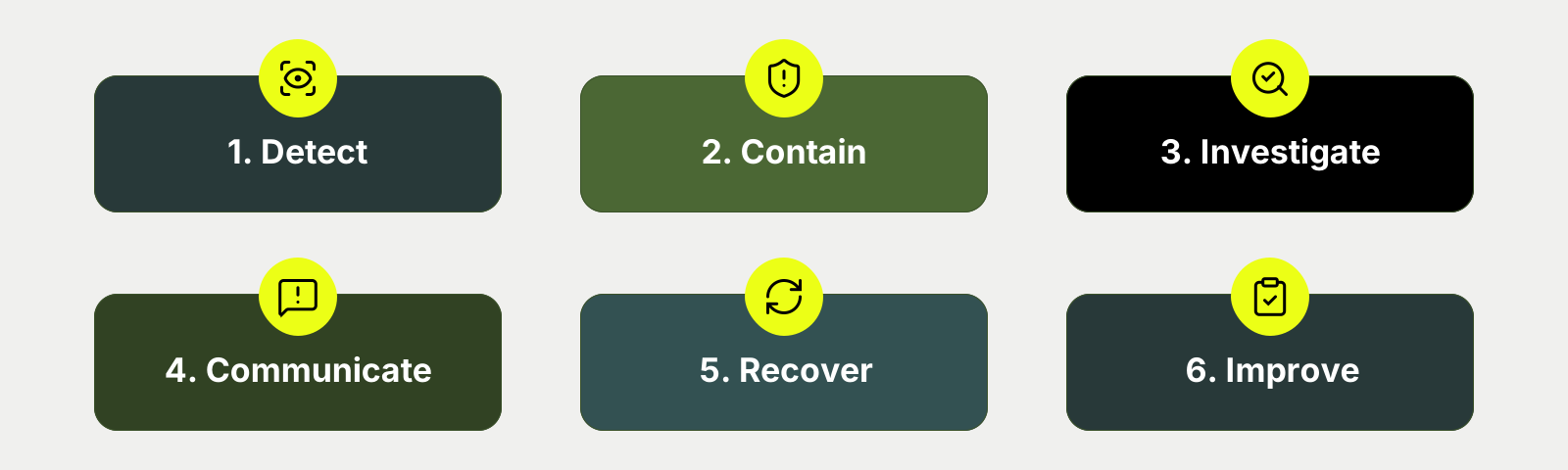
A mature response starts with detection and containment.
The provider should be capable of restricting compromised access, suspending affected transaction paths, isolating systems or credentials and protecting unaffected assets. Investigation should establish the attack route and determine the extent of exposure.
Communication follows. Relevant internal teams, clients and regulators need accurate information according to predefined escalation procedures.
Recovery should then restore services through controlled processes rather than simply returning systems to production as quickly as possible.
Finally, the provider should complete root-cause analysis, document the event and introduce controls designed around what the investigation discovered.
The quality of incident response is therefore measurable through preparation, speed, transparency and demonstrated improvement.
Security due diligence checklist for crypto infrastructure providers
| Area | What to evaluate | Questions to ask |
|---|---|---|
| Key management | Signing architecture | Who controls keys and signing authority? |
| Access | Privileged permissions | How is critical access granted and reviewed? |
| Monitoring | Continuous detection | What activity is monitored 24/7? |
| Certifications | Independent validation | Which standards and systems are in scope? |
| Incident response | Containment and recovery | What happens immediately after detection? |
| Resilience | Continuity and failover | How often is disaster recovery tested? |
| Auditability | Logs and records | Can privileged activity be reconstructed? |
| Third parties | Critical dependencies | How are external providers assessed? |
Security controls in practice
Building payment infrastructure requires an understanding of how software behaves once institutions depend on it.
The control model is demonstrated in Coinspaid Console, which is designed for businesses operating digital-asset infrastructure in their own environment and under their own licence. Its scope includes keeping keys, signing and assets in that environment, with permissions and transaction approvals. Businesses can adopt modules as their requirements develop.
This provides any security review a list of specific questions to work through with the technical team: where signing authority resides, how permissions are configured and which responsibilities the institution retains. The value of industry expertise is in resolving those design questions before they turn into operational problems.
For licensed institutions building services under their own brand, Coinspaid Enterprise provides infrastructure for digital-asset processing, custody connectivity, liquidity routing and compliance execution. The institution retains its licensing and commercial responsibilities. In this structure, any deployment should make the division of technical, legal, and operational duties explicit.
Coinspaid’s development experience provides a starting point for security assessments; bringing reliable infrastructure and blockchain expertise at every stage. Those commitments make service reliability something institutions can evaluate and prove before adopting digital assets.
Final thoughts
Crypto payment infrastructure security should be evaluated as an ongoing operating discipline.
Code quality remains relevant, but institutional due diligence reaches much further into key management, access, governance, monitoring, resilience, third-party dependencies and incident response.
The strongest provider assessment therefore asks for evidence across the entire lifecycle of a payment, from access and transaction authorization through monitoring, record keeping and recovery.
For financial institutions, this is much more telling than knowing a system has simply been audited.
It asks whether the provider can securely operate a critical financial service every day and demonstrate that control when auditors, clients or regulators require evidence.
FAQ – blockchain payment security
There is no universal security level. Assess the specific architecture and the controls around it, including key protection, access, monitoring, governance, third-party dependencies and recovery. Ask for evidence that those controls work in the proposed deployment.
Major risks include key compromise, credential theft, unauthorized access, infrastructure vulnerabilities, phishing, human error, third-party failures, monitoring failures and smart contract vulnerabilities where contracts are involved.
ISO/IEC 27001 certification covers an information security management system. SOC 2 reports assess controls within a defined scope, while CCSS addresses cryptocurrency-specific security. Check the entity, systems, dates and findings covered by each assessment.
Depending on the architecture, protections may include isolated key environments, HSMs, MPC, multisignature authorization, cold storage and transaction limits. Review how these work with access policies, separation of duties and monitoring; no single technology establishes that assets are protected.
The required availability should reflect the service’s role and the institution’s tolerance for disruption. Review the service-level agreement (SLA), exclusions, historical performance and recovery tests. An uptime percentage alone does not show how the provider will restore a critical service.
A status page helps clients understand which services are affected and follow recovery updates. Its incident history can support a review of availability and communication, alongside contractual reports and other evidence.
Cover key management, access, development, monitoring, network security, governance, logs, third parties, continuity and incident response. Record the evidence received, any gaps, the owner of each action and its deadline.
Activate the response plan, contain the threat and protect unaffected systems and assets. Communicate while the investigation proceeds, validate systems before restoring service, and track corrective actions through to completion.