Quick answer
Stablecoins vs SWIFT is a comparison between two different models for moving value across borders. SWIFT is the established bank messaging network used to coordinate international transfers, while stablecoin payments use blockchain infrastructure to transfer tokenized fiat value between digital wallets. For international businesses, the strongest model may involve both systems, with SWIFT supporting bank-based settlement and stablecoins supporting faster, programmable, 24/7 digital asset payments.
What is SWIFT?
SWIFT, the Society for Worldwide Interbank Financial Telecommunication, is one of the core systems behind international banking. It does not move money directly. Instead, SWIFT provides a secure messaging network that financial institutions use to send payment instructions, confirmations, and related financial data across borders.
A SWIFT payment usually depends on a lot: banks, correspondent banking relationships, local payment systems, and more.
SWIFT GPI has improved transparency and speed by giving banks and corporates payment tracking, fee visibility, and confirmation of delivery. According to SWIFT, nearly 60% of GPI payments are credited to beneficiaries within 30 minutes and almost all are credited within 24 hours.
What are stablecoin payments?
Stablecoin payments use digital tokens designed to track the value of fiat currencies, most commonly the U.S. dollar. A business can send stablecoins from one wallet to another through blockchain payment infrastructure, with settlement recorded on a blockchain rather than coordinated only through correspondent banking messages.
Stablecoins became important in crypto trading first, but they are now increasingly discussed as cross-border payments infrastructure for businesses, fintech platforms, marketplaces, payment providers, and global digital services.
Visa’s stablecoin analytics dashboard showed more than $272 billion in global circulating stablecoin supply and $10.2 trillion in adjusted global stablecoin transaction volume over the previous 12 months, showcasing the size of the market already operating on-chain.
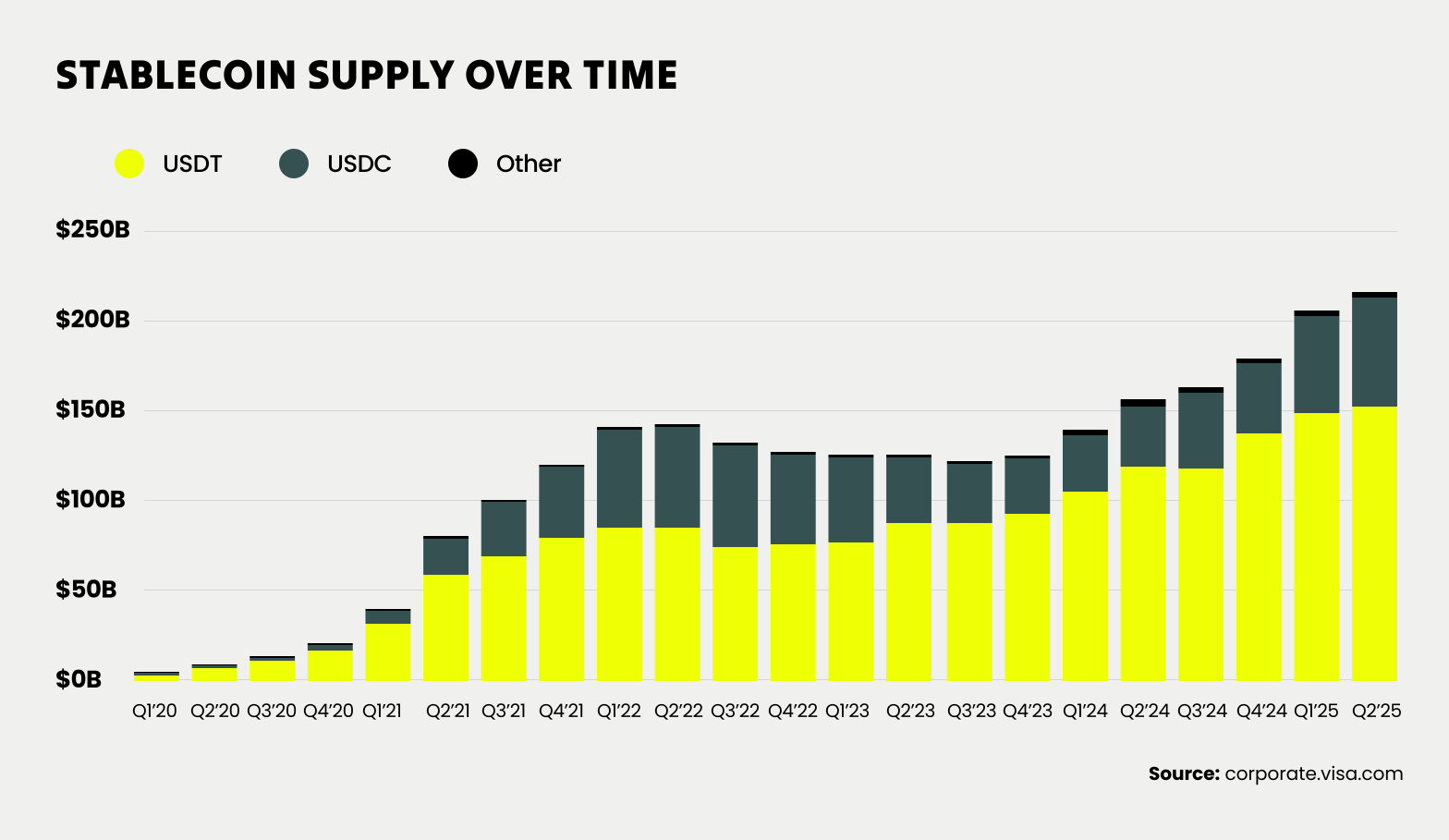
Stablecoin payments can support treasury transfers, merchant settlement, supplier payments, creator payouts, marketplace balances, wallet funding, and business-to-business transfers. Their usefulness depends on liquidity, blockchain network choice, custody setup, compliance controls, accounting processes, and conversion between stablecoins and fiat currencies.
Stablecoins vs SWIFT: key differences
| Category | SWIFT | Stablecoin Payments |
|---|---|---|
| Core function | Secure financial messaging between institutions | Digital value transfer through blockchain networks |
| Settlement model | Funds move through banks and correspondent accounts | Tokens move between blockchain addresses or managed wallets |
| Operating hours | Influenced by banking hours, cut-off times, holidays, and local systems | Blockchain networks usually operate 24/7 |
| Speed | Often fast with SWIFT GPI, but depends on banks and local processing | Can settle within minutes or less, depending on the network and confirmation policy |
| Transparency | Improved through GPI tracking and payment confirmations | On-chain visibility plus provider-level reporting and reconciliation |
| Intermediaries | Banks, correspondent banks, recipient banks, domestic systems | Blockchain infrastructure provider, wallet/custody setup, liquidity and compliance partners |
| Compliance | Bank-led AML, sanctions, KYC, correspondent banking controls | KYT, AML screening, wallet risk scoring, sanctions checks, transaction monitoring |
| Currency coverage | Strong fiat currency coverage through banking partners | Mostly USD-denominated stablecoins, with growing but smaller non-USD supply |
| Best fit | Bank transfers, regulated treasury, fiat settlement, institutional banking | 24/7 digital settlement, high-frequency payouts, on-chain businesses, fintech products |
| Main limitations | Cost, transparency, intermediaries, local bank delays | Regulation, issuer risk, wallet operations, compliance design, liquidity fragmentation |
Where SWIFT still performs best
SWIFT remains highly important for regulated international banking, large corporate treasury, trade finance, institutional transfers, and fiat settlement between bank accounts.
Businesses that already operate through bank accounts, credit facilities, audited treasury policies, and regulated financial reporting often rely on SWIFT because it connects directly with the banking system they already use.
SWIFT also has a strong advantage in fiat currency breadth. Global companies may need to pay suppliers in dozens of currencies, manage bank mandates, satisfy auditors, document payment trails, and coordinate with financial institutions in multiple jurisdictions. SWIFT’s role as a common messaging layer gives banks a standardized way to communicate across borders.
The system has also become faster and more transparent than older perceptions suggest. SWIFT GPI, as previously mentioned, allows payment tracking, confirmation, routing information, and fee visibility, which helps businesses reduce investigations and improve reconciliation.
Where stablecoins offer advantages
Stablecoins offer advantages where businesses need faster digital settlement, 24/7 availability, programmable payment flows, and fewer dependencies across long correspondent banking chains.
The Federal Reserve has described cross-border payments as generally slower, more expensive, and less transparent than domestic payments, with frictions linked to payment chains, correspondent banking, compliance checks, and intermediary costs.
For international businesses and fintech companies, stablecoins can improve several payment functions:
- Faster settlement: Stablecoin transfers can settle in minutes or less, depending on the blockchain network and provider setup.
- 24/7 availability: Payments can be sent outside banking hours, weekends, and public holidays.
- Shorter payment flow: Instead of Business → Bank → Correspondent Banks → Recipient Bank, a stablecoin payment can follow Business → Blockchain Infrastructure → Recipient.
- Programmable operations: APIs, smart contracts, wallet permissions, and automated rules can support recurring payouts, marketplace settlement, and treasury movement.
- Better fit for digital platforms: Stablecoins can support crypto-native balances, merchant settlement in digital assets, supplier payments, and high-frequency international payouts.
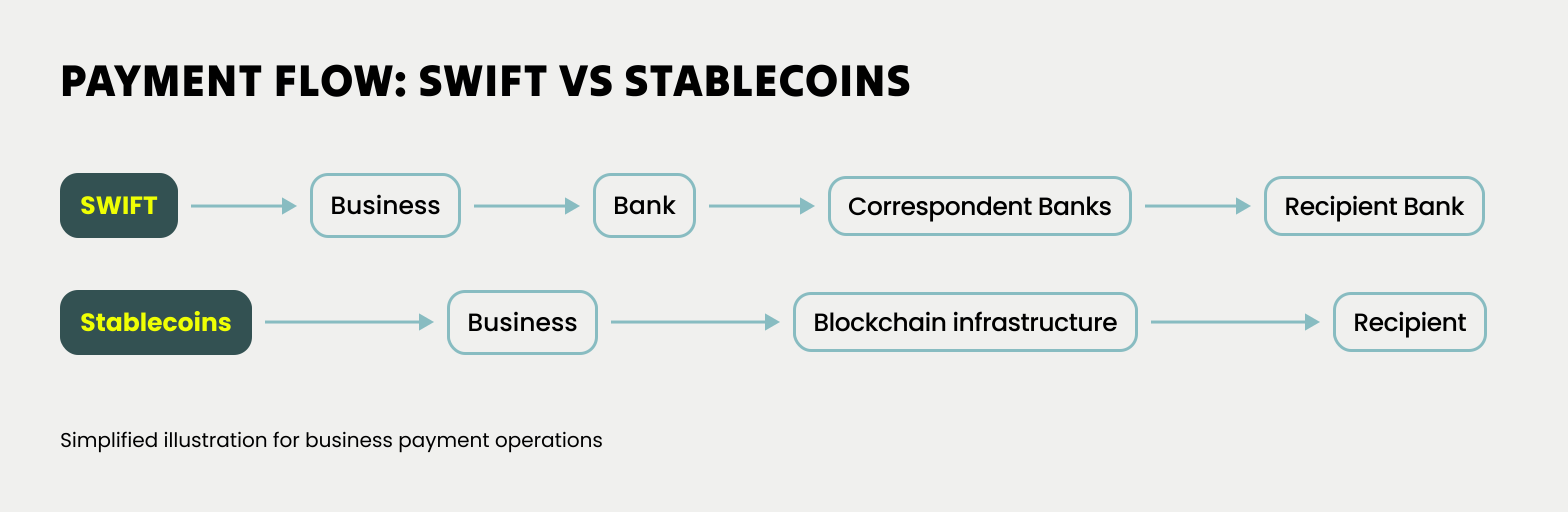
Businesses still need compliance, custody, liquidity, accounting, and reporting systems around stablecoin flows. Indeed, current designs carry risks around trust in money, financial integrity, reserves, and adoption. This makes infrastructure design critical for business use.
Can stablecoins and SWIFT coexist?
Stablecoins and SWIFT can coexist because they solve different parts of global payment infrastructure. SWIFT connects banks and supports fiat payment instructions, while stablecoins enable blockchain-based movement of tokenized value.
Many businesses will, in fact, use both: SWIFT for bank settlement, fiat treasury, and regulated account-to-account transfers; stablecoins for digital asset settlement, high-frequency payouts, and blockchain-native business models.
The future may involve interoperability between bank money, tokenized deposits, stablecoins, fiat accounts, card systems, and blockchain wallets. Businesses rarely choose payment systems based only on speed. They also evaluate compliance, accounting, counterparty risk, liquidity, cost, customer preferences, jurisdiction, reporting, and operational control.
The importance of payment infrastructure
The stablecoins vs SWIFT debate rarely touches upon the need for payment infrastructure that connects treasury, compliance, liquidity, reconciliation, custody, reporting, user experience, and risk controls.
For fintech companies, stablecoin payments require several operational layers:
- Wallet and network setup: wallet architecture, supported blockchains, private key management, and user permissions.
- Compliance controls: transaction monitoring, automated AML screening, sanctions checks, and wallet risk scoring.
- Financial operations: conversion tools, settlement reporting, accounting exports, and reconciliation data.
A global merchant has a different set of needs. It may require:
- Payment matching: invoice tracking, order reconciliation, and refund processes.
- Settlement control: fiat conversion, volatility management, and treasury reporting.
- Operational reliability: support for failed or delayed transactions, uptime, API stability, and blockchain fee management.
This is where blockchain payment infrastructure becomes more important than the individual payment network being used.
Coinspaid develops blockchain solutions for the global economy, helping businesses integrate digital asset payment infrastructure into existing financial operations. Its infrastructure approach covers areas such as payment processing, custody, settlements, liquidity management, compliance operations, APIs, reporting, and reconciliation for businesses and financial institutions.
For international businesses, the goal is to add blockchain solutions for business in a way that supports real payment needs, internal controls, and global growth.
The future of cross-border payments
The future of cross-border payments will likely be hybrid. The Financial Stability Board says cross-border payments have long faced four main challenges: high costs, low speed, limited access, and insufficient transparency. Its G20 roadmap targets improvements in speed, cost, access, and transparency across wholesale payments, retail payments, and remittances.
Stablecoins are part of this modernization, but they are not the only answer. Banks are upgrading messaging standards, real-time payment systems are expanding, central banks are studying tokenized money, and payment companies are building bridges between fiat accounts, cards, wallets, and blockchains.
International businesses should treat stablecoins as a new component of global payment infrastructure rather than a universal replacement for bank payments. Use cases are likely to appear where digital settlement solves a real operational problem: slow supplier payments, expensive payouts, limited banking hours, fragmented international collections, complex marketplace balances, or delayed treasury movement between entities.
As regulation matures, stablecoin payment infrastructure will need to look more like enterprise financial infrastructure. That means stronger compliance, clearer reserve standards, audited processes, reliable redemption, better accounting, network risk management, and secure custody.
Businesses that prepare early can build payment systems that connect traditional banking with blockchain-based settlement.
FAQ – blockchain solutions for global payments
SWIFT is not being fully replaced by stablecoins. SWIFT remains deeply embedded in global banking and corporate treasury, while stablecoins are becoming an additional option for blockchain-based cross-border payments, digital settlement, and fintech infrastructure.
Stablecoins can be better for certain cross-border payments, especially when a business needs 24/7 settlement, fast digital transfers, programmable payment logic, or wallet-based payouts. SWIFT can be better for bank account transfers, regulated fiat treasury, institutional banking, and payments that require established banking channels.
Yes. Many businesses can use SWIFT for fiat bank transfers and stablecoins for digital asset payments, international payouts, marketplace settlement, or blockchain-based treasury operations. The right setup depends on jurisdiction, counterparty needs, compliance requirements, liquidity, and accounting processes.
Businesses integrate stablecoin payments through blockchain payment infrastructure. This can include APIs, wallet systems, custody tools, payment pages, merchant dashboards, transaction monitoring, stablecoin-to-fiat conversion, settlement reporting, and reconciliation tools.
Blockchain payments require wallet infrastructure, supported blockchain networks, custody or key management, transaction signing, fee management, liquidity access, compliance screening, monitoring, reporting, and customer-facing payment interfaces. Businesses also need clear internal processes for refunds, failed payments, accounting, and regulatory checks.
Blockchain payment solutions support global businesses by enabling faster digital settlement, wider access to stablecoin payments, programmable payment operations, automated reconciliation, wallet-based payouts, and alternative cross-border payment flows. They can help fintech companies, merchants, marketplaces, and payment providers connect digital assets with real financial operations.