
About the expert
Hanna Drabysheuskaya is Chief Financial Officer at Coinspaid, where her responsibilities span finance, accounting, legal affairs and operational processes. Her career includes international accounting, financial analysis and enterprise finance, followed by several years working inside a blockchain payments business.
At Coinspaid, she has worked across financial reporting, audits, licensing, business analysis and the financial requirements of payment software. This gives her experience at the point where financial operations, technology and regulated payment services meet.
Key takeaways
- Banks can use blockchain for payments, settlement, digital assets, custody, treasury and tokenization.
- The business case depends on customer demand and the financial product built around the technology.
- Banks can build internally, integrate specialist systems or deploy a ready-to-launch platform.
- Customer relationships, branding, licences and selected financial controls can remain under bank control while providers supply the underlying technology.
Quick answer
Banks can use blockchain technology for payments, cross-border settlement, stablecoins, digital asset accounts, custody, treasury services, tokenized assets and programmable financial services.
The opportunity lies in turning these capabilities into financial products that existing and new customers can access through the bank. A bank can build the underlying technology internally, integrate specialist components, or adopt a ready-to-launch blockchain banking platform under its own brand.
Where blockchain creates business value for banks
Customer demand is one starting point. EY surveyed 100 financial institutions and 250 corporates in 2025 and found that 15% of financial institutions already offered stablecoin services, while another 15% planned to launch them within two years. Among corporates, 56% preferred stablecoin access through APIs embedded within existing treasury systems and around 70% said ERP integration would increase their willingness to adopt stablecoins.
Banks are also exploring blockchain because financial activity has outgrown traditional operating hours. Tokenized money can support continuous transfers, automated conditions and cross-border settlement. In July 2026, Swift announced that 17 banks across six continents were preparing to pilot live transactions using tokenized deposits through its blockchain-based ledger, with 24/7 payment availability among the intended capabilities.
BIS Project Agorá is a good institutional example. The project brings together eight central banks and more than 40 financial institutions to explore tokenized commercial bank deposits and central bank reserves for wholesale cross-border payments. Real-value testing conducted in July 2026 covered 17 scenarios and transactions totalling about CHF 800,000.
For banks, these developments create several possible product categories. Some strengthen existing services such as payments and treasury. Others create digital asset businesses that can produce transaction fees, custody fees, conversion income or other forms of service revenue.
What blockchain services can banks offer?
1. Digital asset payments
A bank can let corporate or merchant customers receive and send digital assets through accounts, payment APIs or business dashboards. The customer may use cryptocurrency or stablecoins while the bank manages the financial workflow around acceptance, conversion, reporting and settlement.
This can serve merchants, payment companies, marketplaces and international businesses. Commercial income can come from payment processing, account services, conversion and settlement. The technical requirements include wallet systems, blockchain connectivity, transaction monitoring, compliance checks and financial reporting.
2. Stablecoin payments and settlement
Stablecoin payments for banks can give corporate customers another way to transfer fiat-denominated value across blockchain networks. Applications include supplier payments, treasury movements, merchant settlement and institutional transfers.
The service can generate transaction income while helping the bank deepen treasury and payments relationships with existing clients. Supporting systems need to manage wallets, blockchain transactions, compliance, liquidity, conversion and reconciliation.
EY found that 79% of financial institutions surveyed planned to use third-party providers when developing stablecoin capabilities, showing the significant role specialist technology providers may have in bank deployments.
3. Cross-border payments
Blockchain can support cross-border transfers through stablecoins, tokenized deposits or other digital forms of value. The bank remains responsible for customer onboarding, risk policy and the customer-facing product while blockchain handles part of the transfer and settlement process.
Corporate clients with international suppliers, subsidiaries or customers may gain particular value from extended operating hours and programmable settlement.
Citi Token Services already uses blockchain to provide institutional customers with near-real-time cross-border payments and liquidity transfers across participating Citi branches. Customers initiate transactions through Citi’s existing digital banking channels or APIs.
4. Digital asset accounts and wallets
Banks can add digital asset balances and wallets alongside existing fiat accounts. Customers can then hold supported assets, receive funds, transfer them and potentially convert between digital assets and fiat currencies.
The customer group may include corporates, fintechs, professional investors and digital-asset businesses. Revenue can come through account packages, transactions, conversion and related treasury services.
The bank needs wallet provisioning, key management, transaction permissions, monitoring, asset support and integration with its existing customer and accounting systems.
5. Digital asset custody
Custody gives customers a regulated provider for safeguarding digital assets and managing the cryptographic keys used to control them. Banks can combine custody with transfers, trading access, treasury and asset servicing.
Deutsche Bank announced in September 2026 that it planned to launch digital asset custody for institutional and corporate clients in Europe, subject to completion of the applicable regulatory process. The service is designed to support selected digital assets, stablecoins and eventually tokenized financial instruments. Deutsche Bank also said selected external technology providers would supply defined technical components.
Custody can create recurring service revenue while giving banks another product for asset managers, hedge funds, corporates, brokers and other institutional clients.
6. Exchange and conversion
A bank offering digital assets often needs conversion between fiat currencies, stablecoins and other supported assets.
The commercial product may include customer exchange, automated conversion after incoming payments or treasury conversion for businesses holding several asset types. Revenue can come from exchange fees or spreads, subject to the bank’s pricing policies and applicable regulation.
7. Treasury services
Blockchain can extend corporate treasury services into digital assets. Banks can support transfers between entities, stablecoin settlement, conversion, automated payments and liquidity management.
Citi states that its Token Services product allows institutional clients to transfer liquidity between participating branches on a 24/7 basis. Siemens has described the service as supporting its real-time treasury transformation and enabling cross-border movements beyond local cut-off times.
This gives banks an opportunity to extend existing cash-management relationships into digital money while keeping treasury activity within the institution’s product environment.
8. Tokenized assets
Tokenization records a financial claim on a programmable platform. Potential bank products include tokenized bonds, funds, deposits, collateral and other regulated financial assets.
The Bank for International Settlements has examined tokenized commercial bank money, central bank reserves and government bonds as components of future financial systems. BIS research describes tokenization as a way to bring messaging, reconciliation and asset transfer into the same programmable environment.
For banks, tokenized assets can support issuance, custody, settlement, distribution and asset servicing. McKinsey has also identified new revenue opportunities for financial institutions across parts of the tokenized asset value chain.
How can blockchain services generate revenue for banks?
Blockchain is especially good at supporting a customer-facing financial product:
- A bank offering digital asset payments can earn transaction fees;
- Conversion between assets can support exchange income;
- Custody can create recurring account or safekeeping fees;
- Treasury and cross-border services can form part of premium corporate banking packages.
Tokenized assets are of special importance. Banks may provide issuance services, custody, settlement, distribution or administration, depending on licensing and the product involved.
The technology can also deepen existing relationships. A corporate customer already using a bank for accounts, FX and treasury may prefer to source stablecoin settlement through the same institution. An asset manager may value access to digital and traditional assets through an established banking relationship.
J.P. Morgan demonstrates how proprietary blockchain technology can become a commercial service. Its Kinexys business processes more than $5 billion in average daily transaction volume, according to the bank’s April 2026 update, and includes blockchain-based payments and programmable payment services for institutional clients.
The revenue approach therefore depends on the service. A bank can charge for transactions, custody, conversion, account access or asset services. It can also use blockchain capabilities to strengthen existing payments and treasury relationships.
What technology does a bank need?
A bank needs a number of connected components between the customer and the underlying blockchain networks.
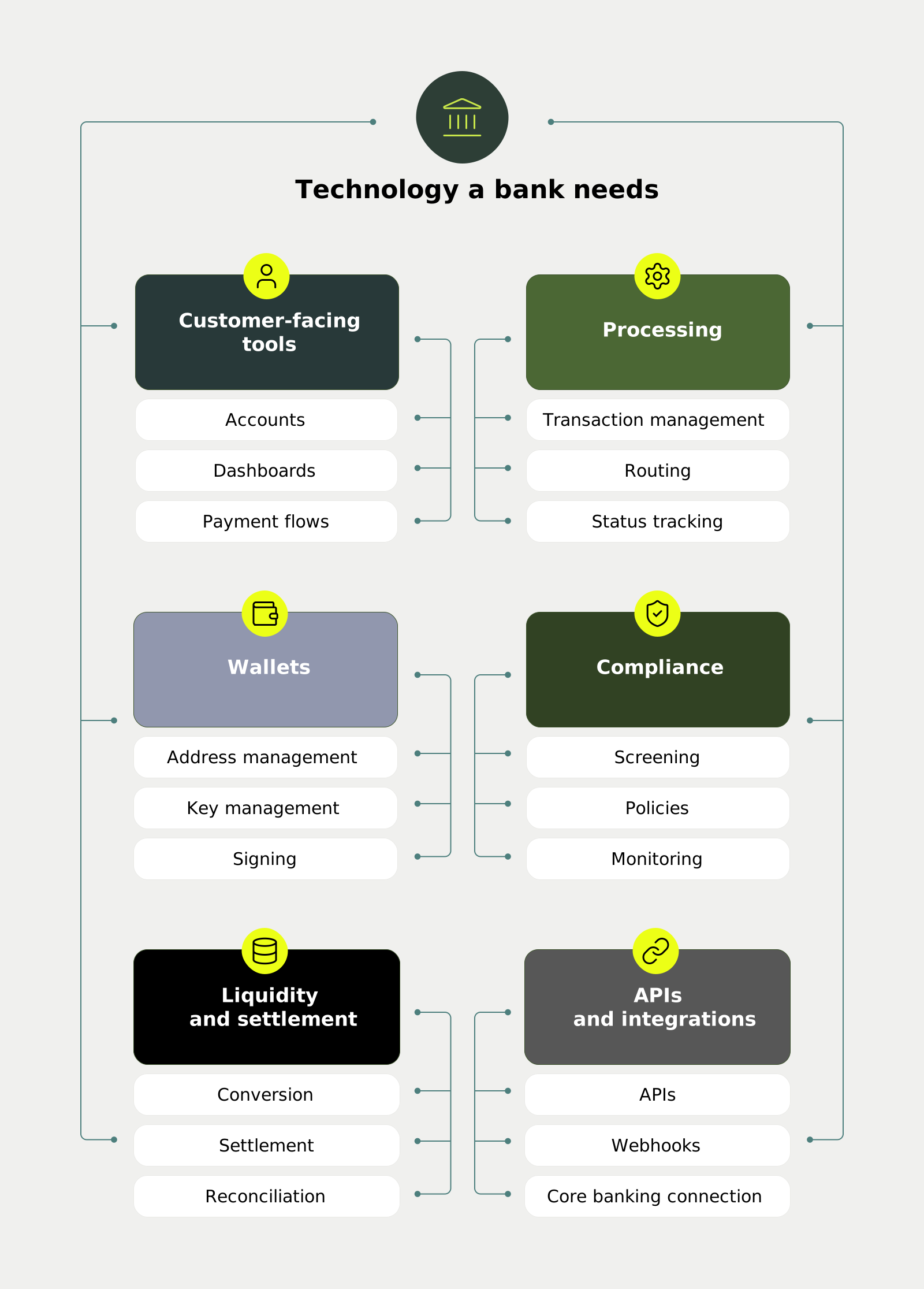
The customer-facing section covers accounts, dashboards, payment flows, pricing and service configuration. Processing technology manages transactions and communicates with the systems underneath it.
Wallet technology creates and manages addresses and signing processes. Compliance systems screen transactions and apply policies. Liquidity connections support conversion. Settlement and reconciliation connect digital asset activity with the bank’s financial records.
APIs and webhooks then connect these functions with existing banking systems. This allows a bank to introduce digital asset services alongside its established systems while retaining its customer records, treasury arrangements and internal financial processes.
Build vs integrate vs ready-to-launch platform
Banks have three main implementation approaches.
| Decision factor | Build in-house | Integrate specialist systems | Hybrid approach |
|---|---|---|---|
| Time to market | Usually longest | Usually shortest | Moderate |
| Upfront investment | High | Lower | Moderate |
| Ongoing maintenance | Primarily internal | Primarily provider-led | Shared |
| Control | Highest | Depends on architecture | High over selected systems |
| Security responsibility | Primarily internal | Shared | Divided by component |
| Multi-chain expansion | Requires further engineering | Usually easier | Selective |
| Compliance integration | Highly customizable | Depends on APIs | Bank policy with integrated tools |
| Provider dependency | Low | Highest | Reduced through modular design |
| Internal expertise | Extensive | Lower | Targeted |
| Suitable for | Proprietary technology with strategic value | Faster deployment of established capabilities | Institutions balancing control with specialist support |
Internal development can suit banks where blockchain engineering itself creates competitive value. Large transaction volumes, highly specialized requirements or existing cryptographic engineering teams can strengthen the case.
Integration can shorten implementation and give the bank access to specialist technology that is maintained continuously by an external provider.
A hybrid approach allows a bank to divide responsibilities. Customer relationships, governance, risk policies and commercially sensitive systems can remain internal while blockchain connectivity, wallet software or network maintenance comes from specialist providers.
External technology still requires governance. The Basel Committee’s current principles for third-party risk cover due diligence, contracting, monitoring, resilience and exit planning across bank relationships with external providers.
Banks evaluating digital asset services can compare internal development, modular software and ready-to-launch platforms against their licensing, customer, control and product requirements.
Can banks launch digital asset services under their own brand?
A white-label or blockchain SaaS approach allows a specialist provider to supply part of the technology while the financial institution operates the commercial service. Depending on the arrangement, the bank can retain its brand, customer relationships, distribution, commercial policy, applicable licences and treasury relationships.
This approach is a viable one for banks asking how to launch digital asset services without creating every blockchain component internally.
Coinspaid Enterprise is a great example. Coinspaid describes it as a ready-to-launch platform for financial institutions offering digital asset transactions, payments and exchange under their own brand. The current product includes merchant management, settlement, reconciliation, liquidity, compliance and transaction-monitoring capabilities.
Banks seeking more technical ownership can choose a more modular arrangement. Coinspaid Core is an enterprise backend for wallets, multi-chain transaction processing, monitoring and settlement. There’s also Coinspaid Console for organizations that want keys, signing and assets to remain within their own environment.
Which platforms can help banks launch digital asset services?
Platforms for banks to launch digital asset services generally fall into three categories.
1. Developer platforms
These give engineering teams APIs, blockchain connectivity and backend capabilities that they can use to create their own customer products.
They suit banks that already have strong internal product and engineering teams and want substantial freedom over the customer experience.
The bank still needs to determine how custody, compliance, liquidity, reconciliation and operational support will work.
2. Modular digital asset systems
A modular digital asset platform for financial institutions provides selected components while allowing the bank to retain control over other areas.
A bank may source wallet technology and blockchain connectivity while retaining key signing internally. Another institution may integrate transaction processing while using its own custody provider, liquidity partners and compliance systems.
Coinspaid describes arrangements where clients can retain keys, assets and transaction signing within their own environment while using external technology for blockchain operations and transaction management.
3. Ready-to-launch enterprise platforms
A ready-to-launch blockchain banking platform brings several core capabilities into one environment.
The provider may handle transaction processing, wallets, payments, settlement, reconciliation, liquidity and compliance integrations, while the bank keeps control of its brand and commercial setup.
Coinspaid Enterprise is designed for financial institutions that want to launch digital asset processing and custody services without building every component internally.
When assessing providers, banks should look at branding, key control, APIs, custody, compliance, liquidity, settlement, supported networks, scalability and exit planning.
The main decision is how much technology the bank wants to own. Some banks may keep customer experience, commercial rules and signing authority in-house while using specialist software underneath. Others may use a more complete enterprise platform and focus internal teams on distribution and customer service.
What should banks launch first?
The first product should follow the bank’s customers, commercial goals, regulatory readiness and implementation capacity.
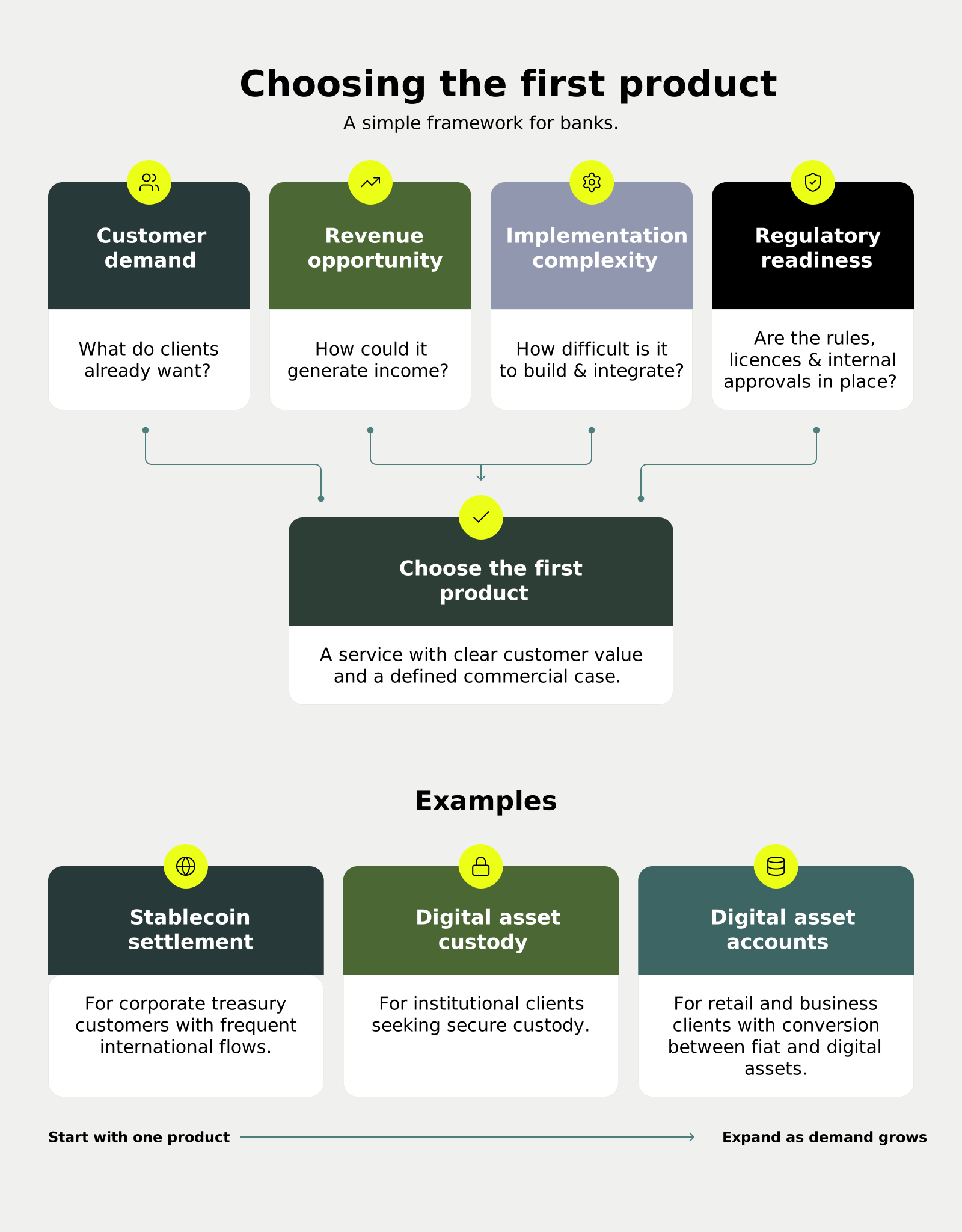
Customer demand identifies the service clients already want. Revenue opportunity assesses how the product could support transaction income, account fees, conversion, custody or other banking services.
Implementation complexity covers technology, security, operations and integration. Regulatory readiness considers licensing, asset eligibility, custody requirements, compliance procedures and internal approvals.
For one bank, stablecoin settlement may fit corporate treasury customers with frequent international flows. Another institution may have institutional clients asking for digital asset custody. A fintech-focused bank might begin with digital asset accounts and conversion.
The first launch should create a measurable customer service with a defined commercial case. Additional assets, networks and products can then follow as demand develops.
Coinspaid Enterprise and Coinspaid Core (Console) provide different paths for institutions assessing how much technology they want to operate themselves.
Final thoughts
Banks can use blockchain technology across payments, cross-border settlement, stablecoins, wallets, custody, treasury and tokenized assets.
The opportunity comes from turning those capabilities into financial products. A bank can add new services for existing clients, create transaction-based income, enter digital asset markets and serve customer groups whose financial activity already extends into blockchain-based assets.
Implementation can range from full internal development to modular integration and ready-to-launch enterprise software. The appropriate approach depends on where the bank wants control and where specialist providers can reduce engineering and operational work.
Moreover, banks can keep their brand, customer relationships, commercial strategy and selected financial controls while integrating the blockchain technology required underneath.
FAQ
Banks can use blockchain for payments, stablecoin settlement, cross-border transfers, digital asset accounts, custody, exchange, treasury services, tokenized assets and programmable transactions.
Common use cases include digital asset payments, stablecoin transfers, international settlement, custody, wallets, conversion, treasury operations and tokenization of financial assets.
Yes, where the relevant jurisdiction, licence and internal approvals permit them. Current banking examples include blockchain payments, tokenized deposits and digital asset custody.
Yes. White-label and SaaS arrangements can let banks provide customer-facing digital asset services under their own brand while specialist providers supply selected technology underneath.
Potential income sources include transaction fees, custody fees, conversion spreads, account charges and asset servicing. The available revenue mechanisms depend on the service, jurisdiction and bank’s commercial setup.
Banks can build internally, integrate individual components or use a ready-to-launch platform. A hybrid architecture can also keep selected capabilities internal while specialist providers handle blockchain-specific technology.
APIs and webhooks can connect blockchain transaction processing, wallets, compliance, liquidity and settlement systems with existing banking applications, ledgers, treasury systems and customer channels.
Banks can use developer platforms, modular digital asset systems or ready-to-launch enterprise platforms. Coinspaid Core (Console) is a great example, made for institutions seeking greater technical control, while Coinspaid Enterprise provides an example of a more complete platform for launching digital asset payments, processing and exchange under the institution’s own brand.