Blockchain applications in Fintech
The L5 layer represents the final business-facing stage of blockchain architecture, where infrastructure becomes usable financial products and services. The four layers beneath it handle raw blockchain access (L1), infrastructure and tools (L2), developer platforms (L3), and fintech abstraction (L4). Each layer hides more complexity, until L5 packages everything into a product that can be run by a business or end user. This is how fintech companies use blockchain in practice: their applications consume infrastructure through APIs, while customers see only payment flows, wallets, and dashboards.
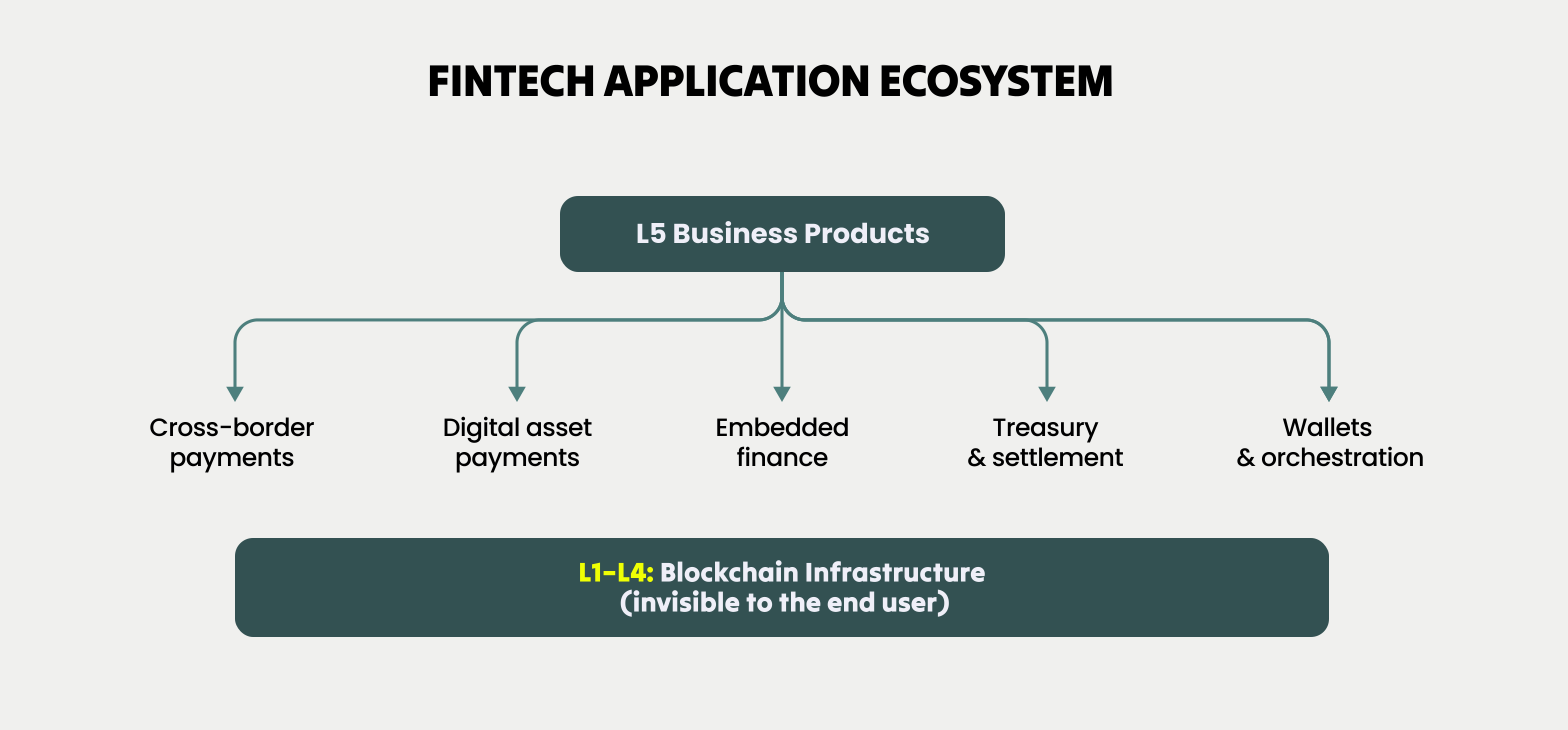
The L5 Business Product layer transforms blockchain infrastructure into usable fintech products, such as payment platforms, embedded finance applications, and cross-border financial services. At this layer, the blockchain itself becomes invisible. Users never see nodes, private keys, or transaction broadcasting. That is why most people interact with blockchain in fintech every day without knowing it.
The five layers at a glance:
| Layer | Name | What it provides | Who uses it |
|---|---|---|---|
| L1 | Raw blockchain access | Nodes, consensus, raw transactions | Protocol engineers |
| L2 | Infrastructure + tools | Node management, indexing, monitoring | Infrastructure teams |
| L3 | Developer platform | APIs, SDKs, key management | Developers |
| L4 | Fintech abstraction | Payment logic, compliance, orchestration | Fintech builders |
| L5 | Business product | Ready-to-use financial applications | Businesses and end users |
How blockchain infrastructure becomes a financial product
A financial product is an application that solves a business problem without exposing the technology underneath. Blockchain reaches this stage through abstraction. Every layer strips away the complexity of the one below it, leaving a simple interface: an API call, a checkout button, a balance screen.
The transformation follows a clear path:
- Infrastructure abstraction. Nodes, chains, and protocols are wrapped in managed services. Nobody at the product level thinks about block confirmations.
- APIs and orchestration. Standardized APIs route transactions across multiple blockchains. The product decides what to do, while orchestration decides how.
- Payment workflows. Raw transactions become structured flows inside blockchain payment systems: invoicing, deposits, payouts, refunds, and settlement.
- Fintech integration. Blockchain payments plug into the systems businesses already run: accounting, ERP, banking, and reporting.
- Operational simplification. Monitoring, compliance checks, and treasury management run in the background as part of the product.
The key principle lies in users consuming products instead of blockchain infrastructure. A merchant accepting digital asset payments interacts with a dashboard and an API, and the blockchain does the work several layers down.
Types of blockchain applications in Fintech
Blockchain fintech applications fall into several distinct categories. Together, they cover the main blockchain business applications in fintech, and most production systems combine two or more of them.
Cross-border payments
Blockchain cross-border payment applications are products that move value between countries without correspondent banking chains. A transaction settles on-chain in minutes instead of days. Fees typically stay below 1.5%, compared to the much higher cost of traditional international transfers. For businesses paying suppliers or contractors abroad, this is often the first blockchain product they adopt.
Digital asset payments
Digital asset payment applications are products that let businesses accept digital assets at checkout. The customer pays in a digital asset. The merchant receives settlement in digital assets or fiat, depending on configuration. Conversion, address generation, and confirmation tracking happen automatically inside the product.
Embedded finance
Embedded finance is the integration of financial services directly into non-financial products. With blockchain underneath, a marketplace can offer built-in wallets, and a SaaS platform can pay out earnings in digital assets. A gaming company can run its own payment flows. Embedded finance blockchain solutions power the feature, but the host product owns the experience.
Treasury and settlement systems
Treasury systems are tools that manage how a business holds, converts, and moves its digital asset balances. They handle liquidity across currencies, automate conversion rules, and reconcile every transaction. Settlement systems define when and how funds reach their final destination, whether that is a digital asset wallet or a bank account.
Stablecoin payment products
Stablecoin payment products are applications that use fiat-pegged digital assets for pricing stability. Regulated options such as USDC and EURC allow businesses to get blockchain settlement speed without exposure to price swings. Stablecoins are becoming the default unit for B2B blockchain payments, payroll, and cross-border settlement.
Payment orchestration platforms
A payment orchestration platform is a system that routes transactions across multiple blockchains, currencies, and providers through a single integration. It selects the optimal network for each payment, manages failures, and consolidates reporting. For businesses operating at scale, orchestration replaces a patchwork of separate integrations.
Wallet and payment applications
Wallet and blockchain payment applications are end-user interfaces for holding and spending digital assets. In a business context, these are usually custodial or semi-custodial products where key management, security, and recovery are handled by the provider. Meanwhile, the user gets a familiar account experience.
Fintech application ecosystem:
Why businesses use blockchain-based financial products
Businesses adopt blockchain financial products for operational reasons, not for the technology itself per se. For enterprise blockchain payments, the main drivers are:
- Faster settlement. On-chain transactions settle in minutes. There are no banking hours, weekends, or holiday delays.
- Global operations. One integration covers payments to and from almost any country. No local banking partner is required in each market.
- Lower infrastructure burden. The provider runs the nodes, security, and monitoring. The business runs its product.
- Scalability. Transaction volume can grow without renegotiating banking relationships or rebuilding payment systems.
- Operational efficiency. Automated reconciliation and real-time transaction data reduce manual finance work.
- Compliance integration. AML screening, transaction monitoring, and reporting come built into mature platforms instead of being assembled separately.
Traditional vs blockchain-based financial products:
| Criterion | Traditional financial products | Blockchain-based financial products |
|---|---|---|
| Settlement speed | 1–5 business days for cross-border | Near-instant, minutes on-chain |
| Operating hours | Banking hours, business days | 24/7/365 |
| Cross-border fees | Often 3–7% with intermediaries | Around 1%, typically below 1.5% |
| Geographic reach | Limited by banking partnerships | Global by default |
| Reconciliation | Manual, batch-based | Automated, transaction-level |
| Transparency | Limited visibility in transit | Full on-chain traceability |
| New market entry | New banking setup per region | Same integration everywhere |
The role of blockchain infrastructure behind fintech products
Every blockchain fintech product depends on operational infrastructure running underneath it. The product is the visible 10%. The infrastructure is the other 90%.
What that infrastructure does:
- Infrastructure orchestration. Managing node clusters, chain upgrades, and network failovers across multiple blockchains.
- Transaction monitoring. Tracking every transaction from broadcast to final confirmation, detecting anomalies, and handling stuck or failed transfers.
- Multi-chain systems. Supporting Bitcoin, Ethereum, and other networks through one consistent internal interface, so the product does not care which chain a payment uses.
- Compliance tooling. Screening wallet addresses, scoring transaction risk, and generating the records regulators expect.
- Settlement infrastructure. Aggregating incoming funds, managing hot and cold wallet balances, and executing payouts and conversions reliably at scale.
When this layer fails, the product fails. A checkout that cannot confirm payments or a payout system that loses track of balances is a business problem, not a technical detail. This is why infrastructure quality determines product quality at L5, even though customers never see it.
Blockchain applications in practice
In production, blockchain’s layered architecture maps onto how providers package fintech blockchain solutions. Coinspaid is a useful example: it offers blockchain payment infrastructure for business at two different layers of the stack.
Coinspaid Core is a scalable blockchain infrastructure for digital assets. It operates at the infrastructure level: an operational blockchain backend for enterprise use, built on top of raw blockchain access. It handles multi-chain transaction processing, wallet management, monitoring, and settlement logic. Companies that want to build their own blockchain-powered fintech products use Core as the engine and keep full control of the product experience.
Coinspaid Enterprise is a ready-to-launch, enterprise-level blockchain payment platform. It is the business-facing abstraction layer: a complete L5 product. A business integrates once and gets payment acceptance, payouts, conversion, treasury tools, and reporting, without managing any blockchain infrastructure itself.
The merchant’s customers see a normal checkout, the finance team sees a normal dashboard, and the blockchain stays out of sight.
The same pattern repeats across the industry: an infrastructure product for companies that build, and a finished platform for companies that launch.
Build vs buy: why businesses prefer ready-made blockchain products
Building blockchain payment capability in-house means recreating the entire stack: node operations, multi-chain support, wallet security, compliance, and treasury logic. Buying means integrating a finished platform. For most businesses, the math favors buying.
These are the factors that drive the decision:
- Infrastructure costs. Running nodes across multiple chains, with redundancy and security, is a permanent expense before the first payment is processed.
- Engineering complexity. Blockchain payment engineering is a specialized field. Hiring and retaining that team is hard, and mistakes are expensive.
- Compliance overhead. AML programs, transaction monitoring, and licensing take years to build. A licensed provider already carries that weight.
- Speed to market. Integration with a ready-made platform takes weeks. Building takes 12–24 months, often more.
- Operational scalability. A mature platform has already solved high-volume processing. An in-house build discovers scaling problems in production.
- Maintenance burden. Chains fork, protocols upgrade, and threats evolve. An internal system needs a permanent team just to stand still.
Build vs buy comparison:
| Factor | Build in-house | Buy a ready-made platform |
|---|---|---|
| Time to launch | 12–24+ months | Weeks |
| Upfront cost | High: team, infrastructure, audits | Low: integration effort |
| Ongoing cost | Permanent engineering + ops team | Predictable fees, around 1% per transaction |
| Compliance | Built and licensed from scratch | Inherited from the licensed provider |
| Multi-chain support | Each chain added manually | Included and maintained |
| Security responsibility | Fully internal | Shared with a specialized provider |
| Focus | Split between product and infrastructure | Stays on the core product |
Building makes sense for companies whose core business is blockchain infrastructure. For everyone else, the product layer is where the value is, and the infrastructure layer is better rented than rebuilt.
The future of blockchain applications in Fintech
The direction is clear: blockchain applications for financial services keep multiplying while the technology itself disappears from view. The next generation of fintech products will use blockchain settlement the way today’s apps use cloud computing. Nobody will mention it, simply because nobody will need to.
Several trends are shaping this stage:
- Stablecoin settlement as default. Regulated stablecoins are becoming standard for B2B payments and cross-border settlement, with clearer rules arriving in major markets.
- Deeper embedded finance. Wallets, payouts, and digital asset features will appear inside platforms whose core business has nothing to do with crypto.
- Convergence with traditional finance. Banks and payment companies are adding blockchain settlement next to existing systems, not instead of them.
- Consolidation at the product layer. Businesses will increasingly choose full platforms over assembling their own stack from separate tools.
- Regulation as a feature. Licensed, compliant infrastructure becomes a selling point rather than a checkbox, as enterprises demand audited providers.
The L5 layer is where this future gets delivered. Infrastructure matures below, while products multiply above.
FAQ
Building directly on blockchain networks means operating nodes, managing keys, and handling every protocol change manually. Infrastructure providers abstract all of that behind stable APIs. Fintech companies get reliability and multi-chain coverage without running the underlying systems themselves.
A production payment product needs node access across supported chains, secure wallet management, transaction monitoring, compliance screening, and settlement logic. Most businesses obtain this as a packaged platform rather than assembling each piece independently.
They remove correspondent banking chains from the transfer. Value moves directly on-chain and settles in minutes, with fees typically below 1.5%. One integration works across countries, so expanding to a new market does not require new banking relationships.
Speed and focus. A ready-made platform launches in weeks, includes compliance and security, and is maintained by the provider. The business spends its engineering effort on its own product instead of on blockchain plumbing.
When payment volume, compliance requirements, or operational complexity outgrow basic tools. Enterprise platforms such as Coinspaid Enterprise add treasury management, multi-currency settlement, dedicated support, and reporting built for finance teams.
Infrastructure, such as Coinspaid Core, provides the operational backend: chains, wallets, monitoring, and settlement systems. A business-facing platform packages that backend into a finished product with dashboards, checkout flows, and APIs designed for commercial use. Infrastructure is what builders use; platforms are what businesses launch with.
They consolidate acceptance, payouts, conversion, and reporting into one system. Reconciliation is automated at the transaction level, compliance checks run inside the platform, and finance teams work from a single dashboard instead of stitching together multiple tools.
By integrating an existing platform instead of building. A single API integration replaces months of infrastructure work, and licensing and compliance come with the provider. Typical time to launch drops from over a year to a few weeks.
Volume growth without re-architecture. Scalable infrastructure handles peak loads, adds new chains and assets without rebuilds, and keeps settlement fast as transaction counts rise. Fintech companies can grow their product without their payment layer becoming the bottleneck.