
About the expert
Murat Prokopov is Strategic Partnerships Executive at Coinspaid, where he works with established businesses integrating blockchain infrastructure into existing payment operations. Active in the digital assets industry since 2016, he has led teams building and advising on blockchain products and payment systems, following an earlier career that included nearly a decade serving enterprise and Big Four clients at a large consulting and technology company.
What payment infrastructure is required for AI agents?
AI is beginning to acquire the authority to spend on behalf of a person or company. A conventional application can calculate an invoice, recommend a supplier or identify the cheapest flight, while an AI agent can potentially find the supplier, compare terms, select an offer and initiate payment within parameters established in advance by the person or business it represents.
Payment companies are already preparing:
- Visa has built agent-specific payment tokens and instruction controls into Visa Intelligent Commerce;
- Mastercard is developing Agent Pay for consumer and machine transactions;
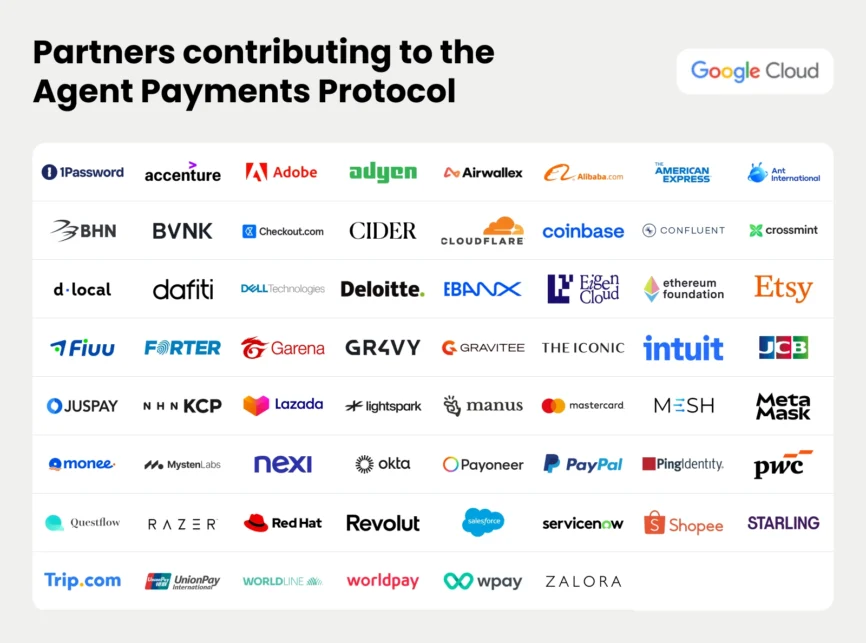
- Google’s Agent Payments Protocol provides a framework for proving the authority behind an agent-initiated purchase.
In the US, 24/7 bank settlement through FedNow and the RTP network sits alongside stablecoin payment systems, giving companies several settlement methods that an agent can potentially call through software.
Quick answer — what payment systems do AI agents need?
AI agents need payment systems they can use through software, while businesses keep control over what the agent is allowed to spend and where. This means combining APIs with secure credentials, spending rules, real-time approvals, fraud and compliance checks, settlement and clear transaction records.
The payment itself could use a card, bank account, instant-payment network, stablecoin or another blockchain-based asset. The important point is that the agent can make payment decisions without gaining unrestricted access to company funds.
An agent could, for example, be allowed to spend up to $500 with approved cloud-computing suppliers during one week. Larger purchases could require human approval, while every completed payment is recorded so the business can see which agent made it and under what authority.
AI agents should be able to make approved payments, while businesses keep control over what each agent is allowed to do.
What are AI agent payments?
AI agent payments are transactions initiated, managed or orchestrated by software acting under delegated authority from a person or organization, with the surrounding payment system responsible for verifying that authority before funds are released.
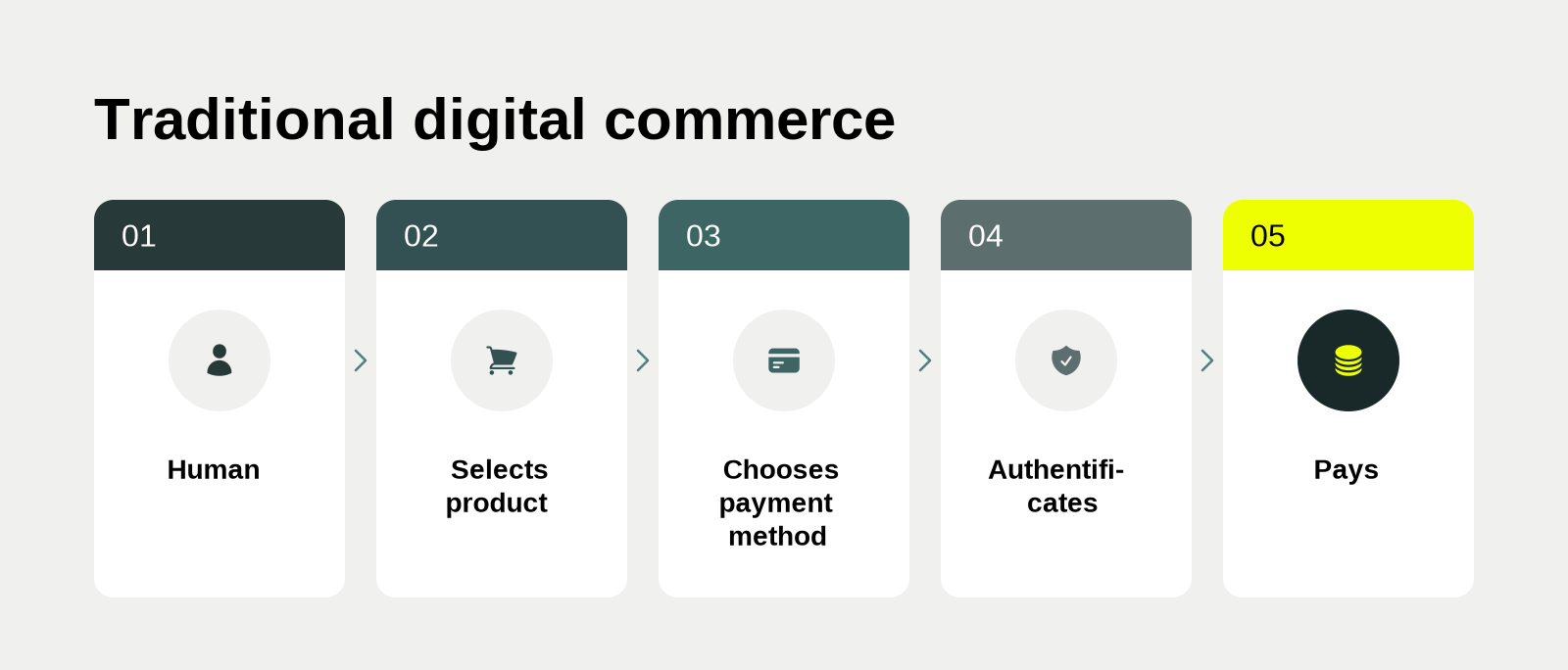
Traditional digital commerce usually follows a human-led sequence, as below:
Agentic commerce adds software as an active decision-maker:
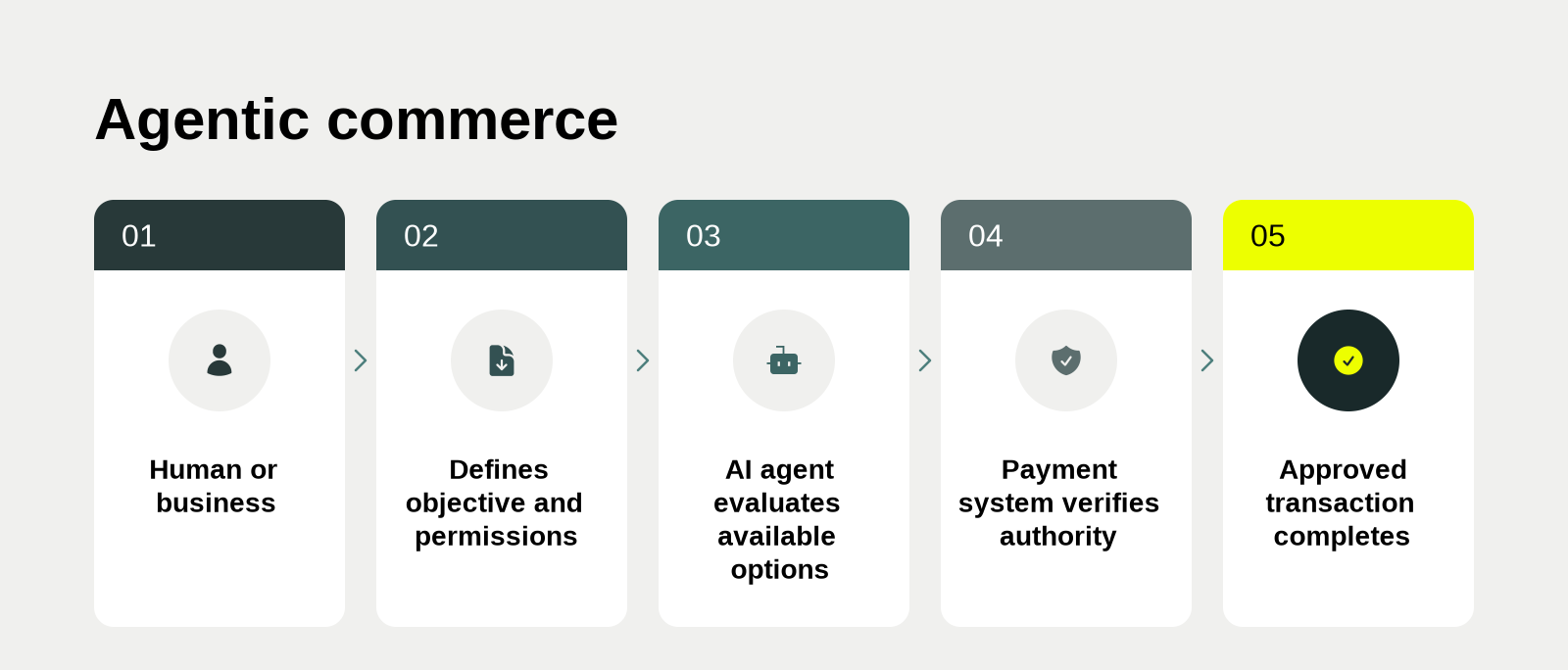
The agent may choose when and where to transact, while identity systems, payment policies and treasury controls establish the boundaries within which those decisions can become financial actions. That arrangement gives businesses a way to automate purchasing while preserving control over account access, transaction values and approved counterparties.
Google’s AP2 design demonstrates this through cryptographically signed mandates that record what the user authorized, while Visa and Mastercard are pursuing related models through agent-specific credentials, authenticated instructions and network-level controls.
💡 Did you know? Visa and Artemis found that the x402 machine-payment protocol processed around 109.6 million transactions worth just $15 million between May 2025 and mid-2026. That works out to an average payment of roughly 14 cents, showing why agentic payments may create demand for payment systems built to handle huge volumes of very small transactions.
How do AI agent payments work?
An enterprise-grade agentic payment follows a sequence in which authority is granted first, purchasing decisions are made within that authority, and payment systems verify every financial action before settlement.
- Authority is granted. A user or business defines what the agent may buy, how much it may spend and the conditions under which it can act.
- The agent finds and selects an option. It searches merchants or services, compares available choices and selects one based on factors such as price and availability.
- Identity, permissions and policies are checked. The payment system verifies the agent, confirms its authority and applies spending limits, merchant rules and approval requirements.
- The payment is authorized and settled. The system selects an appropriate payment method, issues the payment instruction and transfers funds across the chosen network.
- The transaction is recorded and reconciled. Payment data is matched with the order and account records, leaving the business with an auditable record of what the agent did and under what authority.
When software initiates thousands of transactions across many suppliers, recording becomes especially important. Ultimately, finance and compliance teams need a reliable account of the authority, payment route and commercial event behind each transfer.
Why current payment systems are not enough
Today’s online payment system has been designed around a human at checkout, where possession of a card credential, login session or authenticated device helps establish that the person submitting the transaction has authority to do so.
With agentic commerce, software can submit the payment instruction while the person or company responsible for the transaction sits elsewhere, which creates a need to connect the agent, the original mandate and the resulting payment in a way that can be verified later.
Google identified authorization, authenticity and accountability as three central problems when developing AP2. The payment system needs evidence that an agent received authority, that the transaction corresponds to the original instruction and that the parties can determine responsibility when a transaction is disputed or falls outside expected parameters.
Binary account access fits poorly here because software may require permission for a narrow set of actions rather than broad account control. A company could therefore set rules allowing up to $200 per transaction and $2,000 per day with approved vendors, while purchases above $500 require human approval and selected transactions settle in USDC.
Moreover, fraud detection becomes more demanding as automated traffic expands. After all, payment providers must distinguish authorized purchasing agents from malicious bots, account-takeover attempts and compromised software, which makes agent attribution and identity data valuable alongside established device, account and transaction information.
Every completed payment also needs enough metadata for finance teams to reconstruct the commercial event afterwards, including the agent identity, authorization, merchant, underlying order, payment method, fees, exchange rate and settlement result.
What payment systems do AI agents need?
1. API-first payment systems
Agents operate through software interfaces, making payment APIs fundamental because the system needs machine-readable methods for retrieving balances, requesting quotes, creating payment instructions, checking transaction status, initiating payouts and receiving responses through APIs and webhooks.
The payment function becomes a callable service that software can use inside a larger task, allowing the agent to connect purchasing decisions with authorization, treasury and settlement systems through machine-to-machine interactions alongside the wider purchasing process.
2. Agent identity and authentication
Businesses need to establish which agent is acting, whose authority it represents and which credential permits the requested financial action, especially when multiple agents operate across the same company account.
Identity can involve registered agents, cryptographic credentials, tokenized payment credentials and signed instructions. Mastercard’s Agent Pay model, for example, uses registered agents and agentic tokens, while Visa can bind payment tokens to a particular agent and purchasing context.
3. Programmable permissions
Authorization needs to support granular policies that convert business rules into payment controls, allowing a company to set maximum transaction values, daily budgets, approved merchants, permitted currencies and approval thresholds according to the role assigned to each agent.
A procurement agent could have authority to buy software subscriptions from approved vendors up to a monthly ceiling, while a treasury agent could receive permission to convert selected assets within predefined limits and route larger transfers to a second approver.
4. Payment routing
An agent may encounter several ways to complete the same purchase, such as cards or bank payments with a US supplier and stablecoins with an international software provider, so routing software needs to select a payment method according to cost, settlement time, liquidity, merchant acceptance, currency and compliance policy.
5. Real-time settlement
Software can operate continuously, which increases the value of payment systems that can authorize and settle transactions outside traditional banking hours.
The US already has two significant instant bank-payment options. FedNow allows participating institutions to send and receive payments within seconds, 24 hours a day and seven days a week, while The Clearing House’s RTP network also provides continuous instant account-to-account payments.
6. Risk, fraud and compliance controls
Every automated transaction still passes through financial crime, sanctions, fraud and internal risk requirements, so the payment system needs monitoring capable of evaluating the agent, payer, recipient and transaction alongside relevant behavioral patterns.
Exceptions can then trigger rejection, additional verification or human approval, while routine payments inside established parameters continue automatically.
7. Auditability and reconciliation
An agentic payment record should establish who authorized the agent, which agent acted, what it was allowed to do, what transaction occurred and how settlement completed, giving finance, compliance and internal audit teams a usable record of the full financial event.
Those records also need to flow automatically into treasury and accounting systems, because automation at the purchasing stage creates the most value when reconciliation and reporting can keep pace with the resulting transaction volume.
8. Programmable money and blockchain systems
Stablecoins and blockchain networks add another payment option because transactions can be initiated programmatically, operate continuously and settle through internet-native systems that software can call through APIs or smart contracts.
Coinbase’s x402 protocol provides a good example. A server can return an HTTP ‘402 Payment Required’ response containing payment instructions, allowing another machine or AI agent to submit a stablecoin payment and receive the requested API resource, which creates a model for pay-per-query data, compute and other digital services.
Traditional vs blockchain-based systems for agentic payment infrastructure
| Traditional payment systems | Blockchain and stablecoin systems | |
|---|---|---|
| Acceptance | Extensive card and bank acceptance | Depends on merchant and network support |
| Settlement | Cards vary, while US instant-payment systems can settle in seconds | Often continuous, with speed depending on the blockchain |
| Programmability | Available through APIs and provider controls | Native compatibility with programmable transactions |
| Stable unit of account | Fiat is native | Stablecoins can provide fiat-linked value |
| Consumer protection | Mature dispute and protection frameworks | Varies by provider, asset and jurisdiction |
| Cross-border use | Strong reach with established intermediaries | Global network access can reduce the number of intermediaries |
| Microtransactions | Cost varies by payment method | Some networks and protocols target very small payments |
| Compliance | Mature institutional processes | Requires wallet, transaction and asset-specific controls |
| Custody | Usually handled through banks and payment providers | Requires custody or wallet systems |
| Reversibility | Established mechanisms exist | On-chain transfers generally reach final settlement once confirmed |
💡 Blockchain is particularly useful where agentic commerce requires continuous settlement, programmable transfers or stablecoin-based value exchange, while bank and card systems bring extensive acceptance, mature consumer protections and established financial processes.
Security and giving an AI agent permission to spend
Agentic payments require programmable authorization with tightly defined access to company funds, allowing software to perform assigned financial tasks while payment systems enforce the boundaries around those tasks.
A strong model should feature delegated authority, under which a company creates a credential or mandate for a particular agent and limits that credential according to transaction value, approved merchants, time period, currency and required approvals.
High-value or unusual transactions can be routed to a human approver, while routine purchases inside established policies continue automatically, giving the business a way to automate frequent payments while treasury control remains with the business.
Revocation is equally important because businesses need the ability to disable an agent, withdraw a credential, freeze a payment route or reduce limits immediately when its role changes or suspicious activity appears.
What financial institutions need to prepare for agentic commerce
Banks and fintech companies can prepare for AI agent payments by treating software as an additional source of payment instructions and building controls that establish who the agent represents, what authority it holds and how each transaction should be processed.
That requires API-first access to payment functions, granular authorization, agent identity and credential management, real-time processing, multi-system routing, monitoring and automated reconciliation, while developer tools need to expose those capabilities in formats that agent platforms can integrate reliably.
Financial institutions also need a way to identify an agentic transaction when it enters their systems. In June 2026, Worldline, ING and Mastercard completed an end-to-end production agentic payment in Europe in which the transaction carried identifiers revealing its agentic nature to the issuing bank, following an earlier live transaction completed by Santander using Mastercard Agent Pay.
Several providers are already developing different parts of this market:
- Visa Intelligent Commerce focuses on agent credentials, authenticated instructions and commerce data;
- Mastercard Agent Pay adds agent credentialing and permissioning;
- Stripe supports agent wallets, issuing and machine payments;
- Coinbase’s x402 focuses on programmatic stablecoin payments over HTTP.
Blockchain payment providers also play a role, giving institutions the custody, compliance, liquidity and treasury tools needed for stablecoin settlement.
Build, integrate or use a hybrid model
| Capability | What to Look For | Why It Matters |
|---|---|---|
| API access | Easy integration with software agents | Lets agents initiate payments automatically |
| Spending controls | Programmable limits and approval rules | Keeps agent activity within set boundaries |
| Payment methods | Cards, bank transfers and crypto | Gives agents more ways to pay |
| Stablecoin support | Major stablecoins and networks | Enables 24/7 digital settlement |
| Monitoring | Real-time transaction checks | Helps detect unusual activity |
| Audit records | Clear record of each agent action | Shows who acted and under what authority |
| Reconciliation | Automatic matching of payments and records | Reduces manual finance work |
Where Coinspaid comes in
Coinspaid is a blockchain infrastructure provider, especially useful for businesses that need digital-asset custody, settlement, exchange, treasury and compliance services behind an AI-driven payment or treasury application.
Coinspaid Enterprise provides a ready-to-launch platform for digital asset transactions, payments and exchange. It includes merchant management, settlement, reconciliation, liquidity and compliance tools, giving institutions a way to add several of the functions an agentic payment system may need without building each one internally.
Coinspaid Console breaks these functions into separate products:
- Treasury Management supports asset flows and treasury operations;
- Core Custody handles the storage and management of digital assets;
- Core Exchange supports asset and currency conversion;
- Compliance adds screening, monitoring and approval controls.
The future of payments for AI agents
AI agents turn payments into a software function that can be invoked whenever a commercial decision reaches the point of settlement. That makes authorization, auditability and treasury control key to the systems that companies build around them.
Companies define who an agent represents, what it can buy, how much it can spend, which counterparties it can use and when human approval becomes necessary, while the payment system translates those rules into enforceable controls.
The settlement methods underneath that authority can remain diverse:
- Cards bring wide acceptance and established protections;
- Instant bank payments provide real-time account-to-account settlement;
- Stablecoins give software access to continuous blockchain-based value transfer.
Businesses that prepare early will be able to let AI systems initiate more financial actions while preserving control over permissions, security, treasury and settlement.
FAQ
AI agents need payment APIs, identity and authentication, programmable authorization, spending policies, payment routing, risk controls, real-time settlement, reconciliation and audit records, while blockchain and stablecoin connectivity can add continuous programmable settlement where the business use case requires it.
A person or company delegates authority to an agent, which finds a product or service and requests a transaction, after which the payment system verifies the agent and its permissions, applies spending and risk policies, selects a payment method, authorizes the transaction and records the resulting settlement.
Stablecoins combine digitally programmable transfer with a value designed to track a fiat currency such as the US dollar, which can support continuous machine-to-machine payments, API purchases and cross-border settlement through software-driven processes.
Yes. An agent can initiate an international card, bank or blockchain transaction when the underlying payment provider supports the parties, currencies and jurisdictions involved, while the same compliance and authorization requirements continue to govern the business.
Businesses can apply delegated credentials, per-transaction limits, daily budgets, merchant allowlists, asset restrictions, time limits, approval thresholds and emergency revocation, with those controls enforced by payment systems around the agent.
Programmable authorization turns financial authority into enforceable rules, allowing a company to give an agent permission for a defined set of transactions according to amount, merchant, currency, time period or other conditions.
The answer depends on which components provide strategic value. Large financial institutions may build agent identity and authorization internally while integrating external payment networks, custody or blockchain connectivity, while other businesses may use managed providers for most payment functions and retain proprietary control over agent policies and customer experience.