Crypto market in the US 2026
Ownership, payment use, stablecoins and autonomous commerce
The US crypto market in 2026 has a large base of cryptocurrency holders, but owning digital assets and using them to pay are different measures of adoption. For businesses evaluating crypto payments, the useful question is how much of that ownership translates into demand for their services.
Stablecoins are central to that question. They are designed to track a reference value, usually a currency such as the US dollar, while moving across blockchain networks. Their applications include checkout, remittances, supplier payments and treasury transfers.
This article examines the ownership estimates, payment data and regulatory developments available in 2026, with a focus on what they mean for business operations.

Around 67-70 million US adults hold cryptocurrency according to two major 2026 studies; among newer holders surveyed by the NCA, 42% are women, 18% are aged 18-24 and 28% are aged 55 or older.

40% of American crypto holders use digital assets to shop or pay, while 41% use them to send money to friends and family.

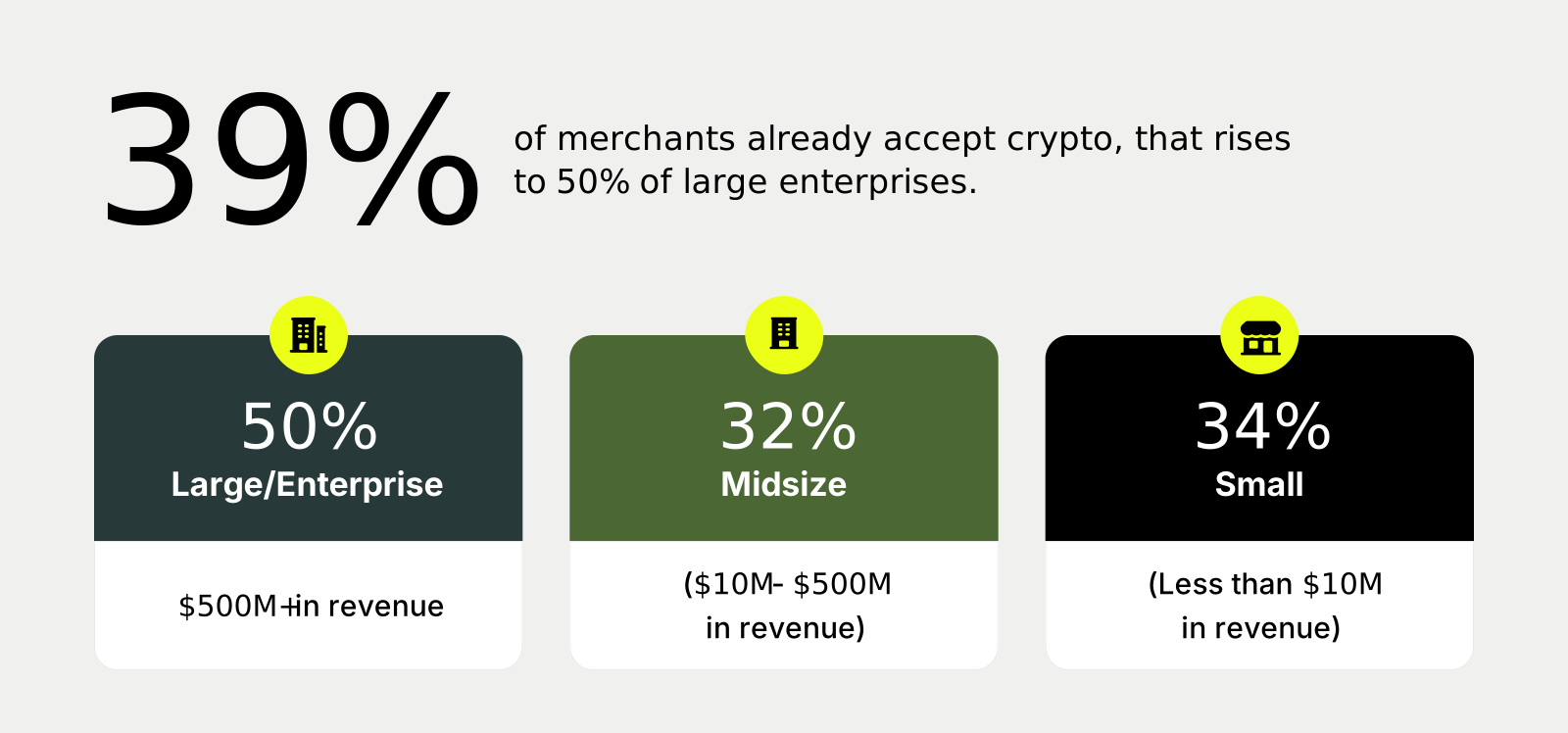
39% of surveyed US merchants already accept cryptocurrency at checkout, and 72% of those merchants reported an increase in crypto sales over the previous year.

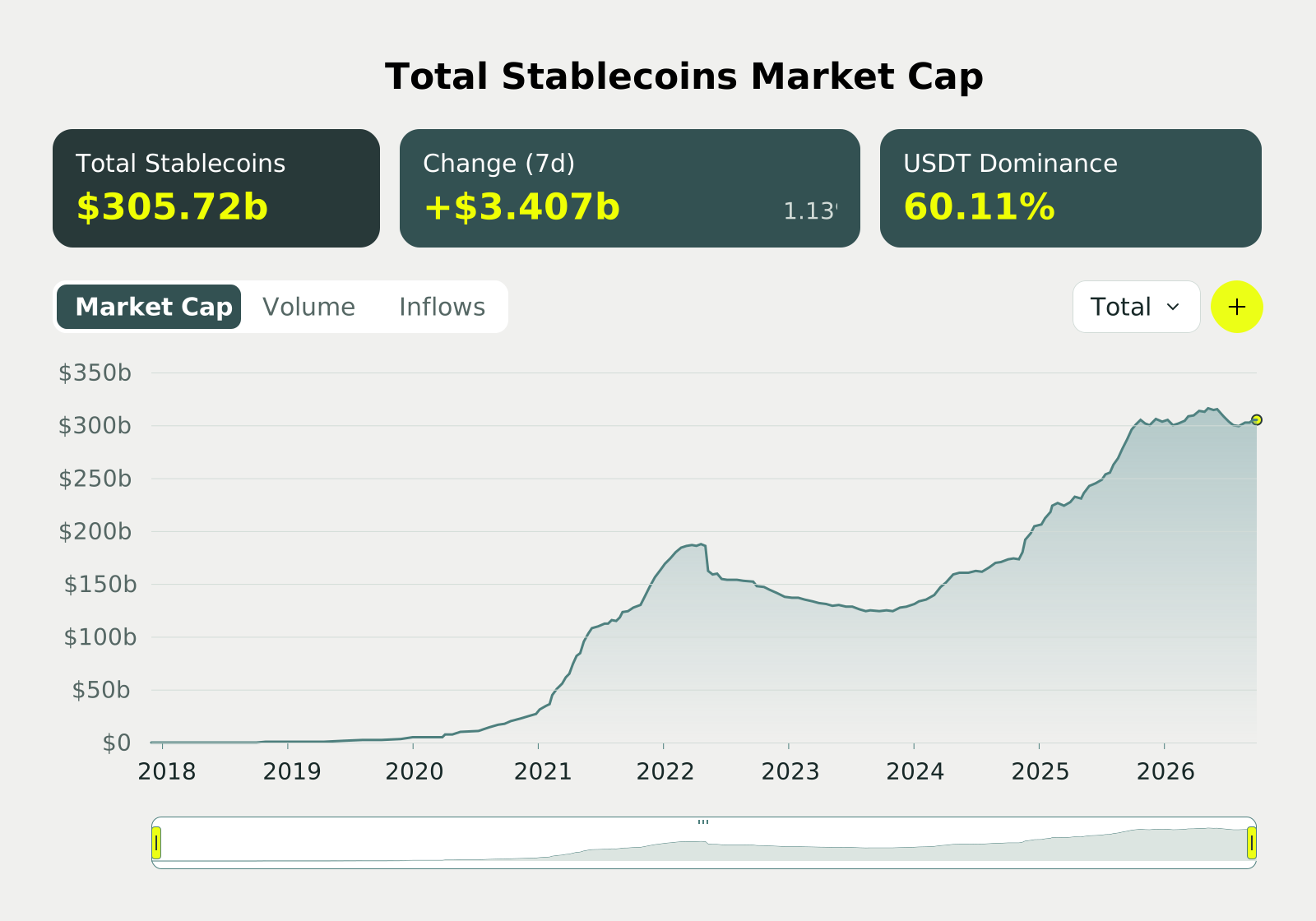
The stablecoin market stands at roughly $306 billion, with USDT and USDC accounting for around 84% of tracked supply at the time of writing.

McKinsey, using Artemis data, estimated $390 billion of stablecoin payments in 2025, including $226 billion in B2B payments.

The GENIUS Act has given US payment stablecoins a federal statutory framework, while regulators continue to develop the accompanying rules.
There is no single, directly comparable measure of US crypto ownership. Surveys differ in whom they reach, the period they cover and whether they count direct holdings, past-year use or exposure through exchange-traded funds (ETFs).
The National Cryptocurrency Association (NCA), launched with Ripple funding, estimates 67 million American adult holders in its 2026 report. The Harris Poll surveyed 10,000 holders for the study between 12 February and 3 March 2026. These are survey-based estimates rather than verified counts of individual owners.
Security.org’s 2026 survey found that 30% of its 992 adult respondents owned cryptocurrency, compared with 28% in its previous annual survey. The sample and self-reported responses matter when interpreting that figure.
Motley Fool Money’s May 2026 survey of 2,000 adults found that 22% held crypto directly or through an ETF: 16% reported direct ownership and 6% ETF exposure.
The Federal Reserve’s 2025 household survey, published in May 2026, reported a lower measure: 10% had used crypto in the preceding year. That includes buying or holding it as an investment and is not equivalent to the ownership questions above.
| Metric | Estimate |
|---|---|
| US crypto holders, NCA | 67 million |
| US crypto holders, Security.org | 70.4 million |
| Global crypto owners, a16z | 716 million |
| Global crypto owners, Crypto.com | 741 million |
| Monthly active on-chain addresses, a16z | 181 million |
| Active stablecoin wallets, Visa | 316 million |
Ownership and activity produce very different pictures. Hundreds of millions of people may hold digital assets, while a smaller group interacts with blockchains every month. For payments companies, transaction frequency, wallet activity and willingness to spend can therefore reveal more about commercial demand than ownership totals alone.
The NCA’s newer-holder cohort, covering first purchases in 2025–26, differs from earlier adopters. Women account for 42%, compared with 34% of earlier buyers. Adults aged 18–24 represent 18%, compared with 11%, while those aged 55 or older represent 28%, compared with 14%. These are shares within holder groups, not ownership rates for the wider population.
Motley Fool Money found a generational difference in current direct or ETF ownership: 30% of millennials and 24% of Gen Z respondents, compared with 16% of Gen X and 7% of baby boomers.
Stated interest in stablecoins follows a similar pattern. In The Motley Fool’s July 2025 survey, 71% of Gen Z and 60% of millennials said they would consider stablecoins for shopping, compared with 31% of Gen X and 18% of baby boomers. This measures willingness, not completed purchases.
For businesses, demographic reach is a starting point for customer research. It does not establish how often those customers will pay with crypto or which assets they will use.
The NCA’s state-level estimates place the largest absolute crypto populations in the country’s most populous states. Its figures combine national survey findings with demographic and congressional-district data.
| State | Average | % of adult population | |
|---|---|---|---|
| 1 | California | 9.5 M | 30 |
| 2 | Texas | 5.94 M | 25 |
| 3 | Florida | 4.71 M | 25 |
| 4 | New York | 4.66 M | 29 |
| 5 | Illinois | 2.64 M | 12 |
| 6 | Georgia | 2.45 M | 28 |
| 7 | Pennsylvania | 2.36 M | 23 |
| 8 | Washington | 2.07 M | 33 |
| 9 | North Carolina | 2.01 M | 23 |
| 10 | Ohio | 1.99 M | 21 |
| Total, all states | 67 M | 25 |
The South accounts for 38% of holders in the NCA sample, followed by the West with 27%. The Midwest and Northeast each account for approximately 18%, a distribution that broadly follows the geography of the US population.
Ownership gives only part of the commercial picture. Payment behaviour shows how digital assets are becoming part of day-to-day economic activity.
The NCA found that 40% of American crypto holders use crypto to shop or pay, while 41% use it to send money to friends or family. Those figures point to a sizeable population already familiar with using digital assets as transferable value rather than simply holding them as investments.
Stablecoins are key. Their value is generally linked to a reference asset such as the US dollar, while the token itself can move across blockchain networks. Such a combination has opened applications across consumer payments, supplier settlement, contractor payouts, marketplace transfers and corporate treasury.
In October 2026, DefiLlama showed global stablecoin market capitalization of approximately $307.8 billion. USDT accounted for $184.2 billion and USDC for $74.3 billion, or about 84% combined. These are global supply measures, not the size of the US payments market. The chart below shows an earlier snapshot of $305.72 billion.
Blockchain transfer totals reach far higher levels because they capture trading, treasury transfers and internal movements alongside commercial payments. Visa reported 316 million active stablecoin wallets and said adjusted stablecoin transaction volume was on course to exceed $10 trillion during 2025.
Payment-specific estimates provide a narrower view of commercial activity. McKinsey, drawing on Artemis data, estimated $390 billion in stablecoin payments during 2025. B2B transfers represented the largest category at $226 billion, followed by consumer-to-consumer transfers at $77 billion, consumer-to-business payments at $76 billion and business-to-consumer payments at $11 billion.
That distinction changes the commercial assessment. Stablecoin supply shows how much value is outstanding; payment volume shows one use of that value. Neither figure, by itself, establishes how many US merchants accept crypto.
Merchant adoption offers one of the clearest signs that crypto is entering ordinary commerce.
A January 2026 study from PayPal and the National Cryptocurrency Association surveyed 619 US payment decision-makers and found that 39% already accepted cryptocurrency at checkout. Adoption reached 50% among large enterprises, compared with 34% among small businesses and 32% among midsize companies.
Among merchants already accepting crypto, digital assets represented 26% of sales on average. 72% said their crypto sales had grown over the previous year, suggesting that adoption can deepen after the payment method is introduced.
Demand often begins with the customer. 88% of merchants said they receive enquiries about paying with crypto, while 69% said customers want to use it at least once a month. Among merchants yet to accept digital assets, 79% believed crypto could help them attract new customers.
The strongest reported interest appeared in sectors with international customers, digital products or higher-value discretionary purchases.
| Business category | Merchants reporting customer crypto interest |
|---|---|
| Hospitality and travel | 81% |
| Digital goods, gaming, luxury and specialty | 76% |
| Retail and e-commerce | 69% |
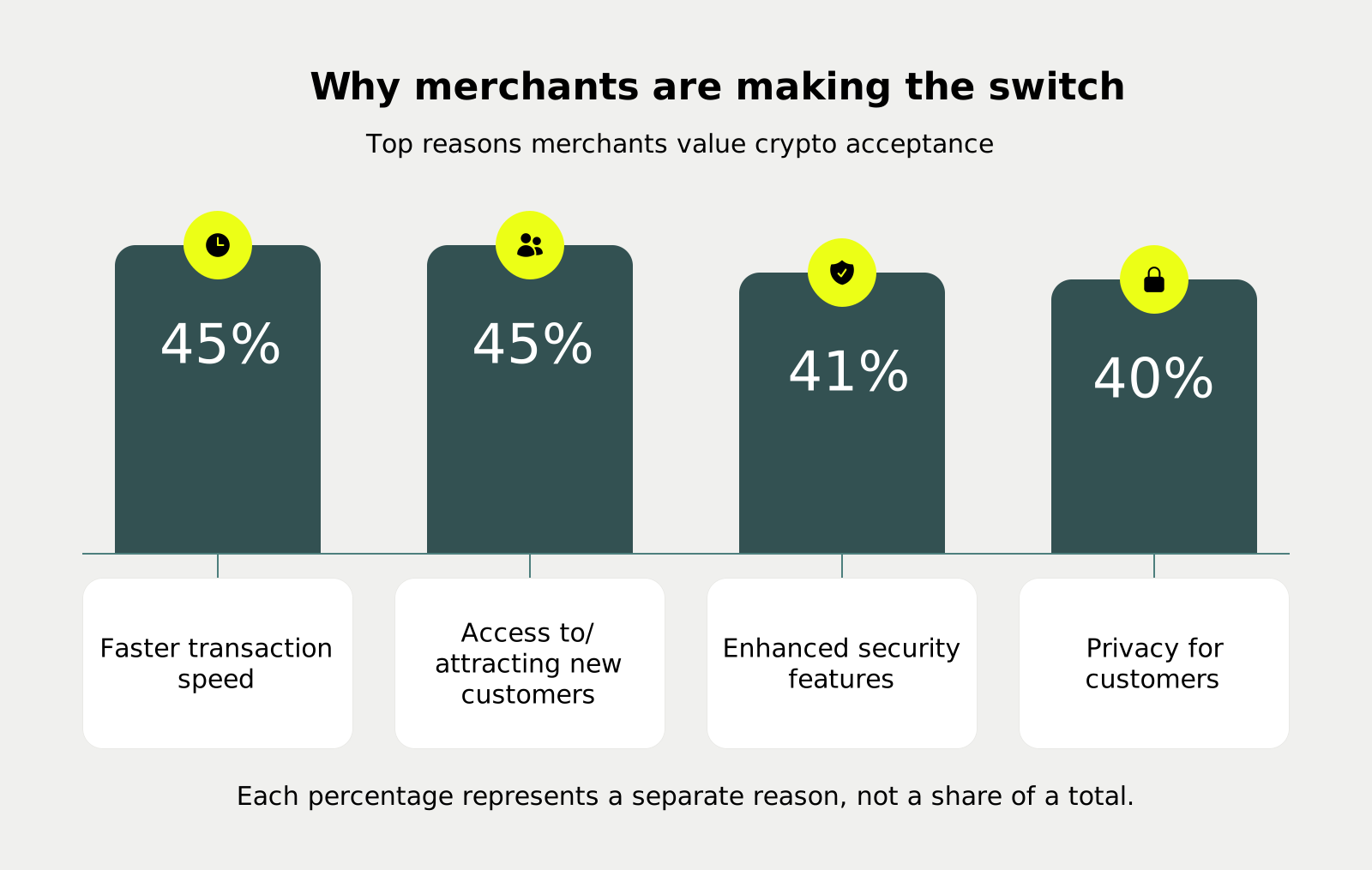
Implementation remains a decisive commercial factor. 90% of merchants said they would be likely to try accepting crypto if setup were as easy as accepting credit cards. That finding places considerable emphasis on checkout integration, conversion, refunds, accounting and reconciliation.
The expansion of crypto ownership and payments also raises the commercial stakes around security, custody and regulatory compliance.
| Risk | Explanation | Business implication |
|---|---|---|
| Regulatory implementation | The GENIUS Act created a federal framework for payment stablecoins, while regulators continue to develop detailed rules and wider crypto legislation remains under consideration. | Businesses need compliance systems that can adapt as supervisory requirements develop. |
| Cybersecurity | The FBI recorded 181,565 complaints involving cryptocurrency in 2025 with more than $11 billion in reported losses. | Wallet security, account controls and fraud detection require the same level of attention as payment functionality. |
| Stablecoin risk | Payment stablecoins depend on reserve quality, redemption arrangements, issuer operations and market confidence. | Companies need to assess issuers, reserves, redemption routes and network exposure. |
| Liquidity | A blockchain transaction can settle quickly while conversion into another currency depends on market liquidity and banking access. | Treasury teams need defined conversion and settlement procedures. |
| Custody | Private keys and account access create operational exposure. Security.org found that 16% of surveyed crypto owners had experienced an access problem such as lost keys, outages or frozen accounts. | Key management, recovery processes and segregation of assets require careful design. |
| Concentration | USDT and USDC together represent roughly 84% of the stablecoin market tracked by DefiLlama. | Heavy reliance on a small number of issuers creates issuer-specific exposure. |
| Market volatility | Security.org found unstable value was the most frequently cited concern about cryptocurrency, selected by 37% of respondents. | Businesses accepting volatile assets may choose rapid conversion, treasury limits or stablecoin settlement. |
The GENIUS Act was signed into law on 18 July 2025, establishing a framework for payment stablecoin issuers, including reserve and disclosure requirements. Enactment, implementing rules and effective dates are separate milestones; the law’s passage did not make every stablecoin or provider compliant.
On 24 September 2026, the Federal Reserve requested comment on two proposals covering Board-supervised issuers and related activities. The proposals address reserve assets, capital, risk management, safeguarding reserve assets and bank applications to issue payment stablecoins.
The OCC’s February 2026 proposal covers areas including reserves, redemption, custody and supervision. It expressly leaves Bank Secrecy Act, anti-money laundering and sanctions provisions to separate rulemaking. FinCEN and OFAC issued their joint AML and sanctions proposal on 8 April 2026.
On 30 September, Treasury’s interim final rule established forms and procedures for reviewing state regulatory certifications. The rule took effect that day, while acceptance of certifications remained conditional on approval of the information collection. This was a procedural step, not completion of the entire regulatory framework.
The SEC’s 17 March 2026 interpretation, joined by the CFTC, clarifies how federal securities laws apply to certain crypto assets and transactions, including when a crypto asset may become subject to an investment contract. This guidance is distinct from legislation or an issuer’s authorisation to operate.
Businesses therefore need to identify which rules apply to their role and counterparties, as well as expectations in the states they do business in. Issuing a stablecoin, safeguarding assets, providing payment services and accepting a customer payment create different responsibilities. Product design should account for due diligence, sanctions controls, record keeping and custody from the outset.
The GENIUS Act has established a federal foundation for payment stablecoins, while regulatory agencies continue to work through reserves, capital, safeguarding and supervision.
The next stage will centre on implementation. Issuers, banks, payment companies and corporate users will have to adapt products and compliance processes to the final rules.
Stablecoin payment data already shows a substantial corporate component. The $226 billion of estimated B2B activity during 2025 suggests that supplier settlement, treasury transfers and marketplace payments deserve as much attention as consumer checkout.
International companies have particular incentives to explore these systems where counterparties already use dollar-linked digital assets and where traditional banking processes create additional settlement steps.
Customer demand is already visible. The next phase of adoption will depend on how closely crypto payment operations can resemble the finance processes merchants already understand.
The PayPal and NCA finding that 90% of merchants would consider crypto if implementation were as easy as cards suggests that checkout, settlement, reporting and reconciliation will carry considerable influence over adoption.
Agentic commerce allows software to initiate commercial actions under authority granted by a person or company. The authority needs clear limits: what the agent may buy, how much it may spend and when a person must approve the transaction.
Payment systems need to enforce those permissions and retain an audit trail. Stablecoins may support some agent-initiated transactions, alongside cards, bank payments and tokenised deposits. The payment method does not remove the need to establish who is responsible for the action.
Digital-asset transactions already bring payment, treasury and compliance functions together.
A single transaction may involve customer screening, blockchain analytics, wallet management, conversion, settlement and accounting before the commercial process is complete. Companies evaluating crypto payments will therefore need to examine the entire operating process around the transaction, from checkout through to the finance ledger.
The US crypto market in 2026 is defined by scale, diversity and a growing range of commercial applications.
Ownership studies place the American holder population in the tens of millions, with some of the largest surveys estimating roughly one in four adults. Newer holders represent a wider mix of ages and demographics, while a substantial proportion of existing owners already use digital assets for shopping, payments and transfers.
Merchant adoption has developed alongside that audience. Nearly four in ten payment decision-makers surveyed by PayPal and the NCA said their businesses already accept cryptocurrency, and a large majority reported recurring customer interest.
Stablecoins provide the strongest bridge between crypto ownership and commercial payments. Their market value exceeds $300 billion, while payment-specific research shows hundreds of billions of dollars in annual activity and a particularly strong contribution from B2B transactions.
The US regulatory framework is also becoming more defined. Federal stablecoin legislation now sits alongside continuing work on reserves, supervision, custody and market oversight.
The next stage of the American crypto market will depend less on the number of wallets people hold and more on how effectively digital assets can fit into commerce. This means reliable settlement, deep liquidity, secure custody, strong compliance controls and clean reconciliation with existing finance systems.
Those capabilities will determine how much of today’s crypto ownership ultimately turns into lasting commercial activity.