The XRP Ledger (XRPL) is a public, open-source network that reaches agreement without mining.
Independent validators keep Unique Node Lists (UNLs); when roughly 80% of a node’s trusted validators approve a candidate ledger, it closes – giving deterministic finality in 3-5 seconds.
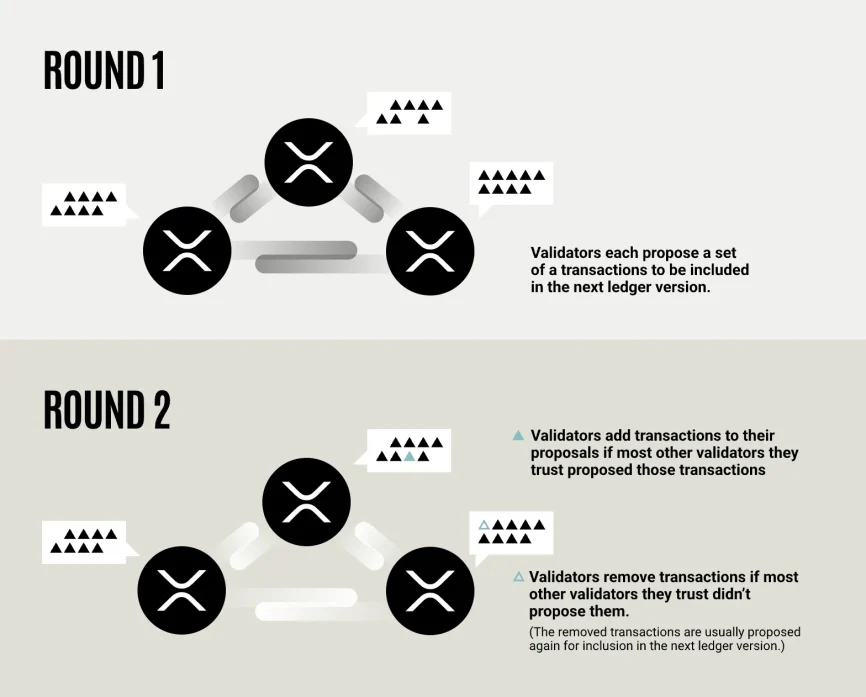
Fees are deliberately tiny and burned (anti-spam), so even high-frequency flows remain economical. Governance happens through “amendments”: features activate after sustained supermajority support.
Ripple vs XRP difference: Ripple is a company that develops payment-related solutions, while XRP is the digital asset that runs on the XRP Ledger (XRPL), an independent network not controlled by Ripple.
What is XRP used for?
- Cross-border payments & remittances: a leading cross-border payments crypto system where speed and cost matter.
- Liquidity bridge between fiat currencies: reduce pre-funding by converting into XRP, transferring on XRPL, and settling into the destination currency.
- Micropayments / on-demand liquidity (ODL): stream small payments, aggregate off-chain, settle on-chain within seconds.
- Exchange base currency on XRPL: XRPL’s native DEX lets you trade XRP and issued tokens (fiat IOUs, asset tokens).
Characteristics of XRP in business contexts
- Speed: XRP transaction speed averages 3-5 seconds with deterministic finality.
- Low Fees: fractions of a cent per transaction – attractive for payout and marketplace models.
- Scalability: designed for 1,500+ TPS on commodity hardware.
- Sustainability: consensus uses minimal energy – stable and fast crypto for business operations.
- Liquidity: effective bridge asset between fiat and crypto, especially for multi-corridor flows.
What businesses should know about XRP
When it comes to XRP, businesses should first understand the regulatory landscape.
U.S. courts haven’t classified XRP itself as a security; only Ripple’s institutional sales violated Section 5 – ending with a $125M penalty (final judgment Aug 7, 2024; case closed Aug 8, 2025).
Next, XRP’s decentralisation model differs from Bitcoin and Ethereum, using a UNL-based consensus often viewed as more curated.
In treasury contexts, XRP competes with stablecoins and CBDCs, which may offer greater accounting stability.
Also, because XRP remains a free-floating asset, many companies choose to auto-convert holdings into fiat or stablecoins to minimise exposure to market volatility.
| Feature | XRP | Bitcoin | SWIFT (bank transfers) |
|---|---|---|---|
| Transaction speed | 3-5 seconds | 10 minutes | 1-5 business days |
| Fees | Fractions of a cent | Several USD (variable) | High (intermediaries, 2-7%) |
| Scalability | 1,500+ TPS | 7 TPS | Limited by banking hours |
| Energy use | Very low (eco-friendly) | High (PoW mining) | N/A |
| Best use case | Cross-border payments, liquidity | Store of value, investment | International banking settlements |
What is XRP (Ripple)? (Video)
Real-world applications of XRP
- Banks & fintechs: remittances and on-demand liquidity corridors where pre-funding is costly.
- E-commerce: fast international checkout with lower operational costs.
- SaaS: global subscriptions, refunds, and regional pricing.
- Payroll & affiliates: cross-border salary and partner payouts at scale.
FAQ: What is XRP?
No. This is the classic Ripple vs XRP difference: Ripple is a fintech company that builds payment products (formerly RippleNet, now Ripple Payments). XRP is the digital asset that runs on the open-source XRP Ledger (XRPL). Ripple builds on XRPL but doesn’t own or control it.
XRPL reaches deterministic finality in about 3-5 seconds. Network fees are extremely low (the base cost is 10 drops = 0.00001 XRP), which supports high-frequency XRP payments at scale.
In August 2025, the SEC-Ripple case formally concluded. The court left in place a $125,035,150 civil penalty and an injunction related to institutional sales; it confirmed that programmatic sales on public exchanges were not securities. Regulation still varies by context and jurisdiction, so always check the latest guidance and seek counsel.
In cross-border transaction scenarios, XRP is associated with fast settlement (3–5 seconds) and relatively low fees, which can influence how transactions are processed across different currencies. Some payment systems built on XRPL use XRP as a bridge asset to facilitate value transfer between different currencies.