How to Increase Cross‑Border Sales

Table of Contents:
If you are someone dealing with cross-border commerce, you know firsthand how it often eats into your profit margins and many times you end up with frustrated customers. Luckily, cryptocurrency payments are emerging as a powerful remedy to these challenges.
This might come as a surprise to many, however blockchain payments are already the reality of modern finance. Increasing use of cryptocurrency payment gateways is reshaping the global financial landscape. With digital assets becoming more widely used, businesses are adding crypto payment options to their platforms for secure transactions and reduced costs.
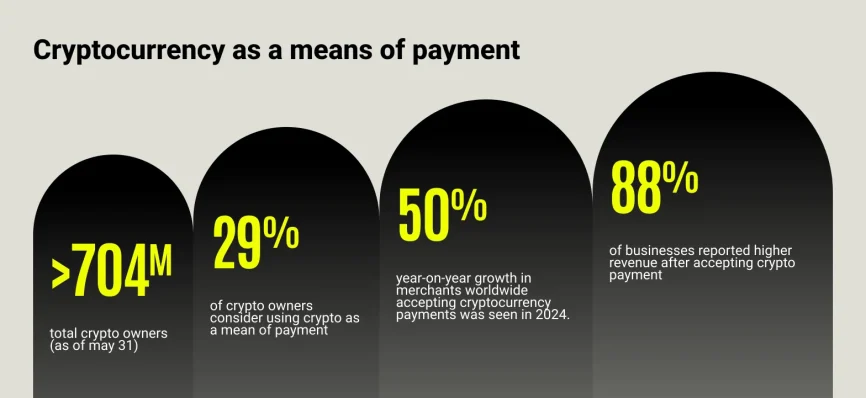
In fact, stats suggest that in 2023, the global market for crypto payment gateways was valued at USD1.2 billion and is projected to grow at a compound annual growth rate (CAGR) of over 15% from 2024 to 2032. Most importantly, in 2024, over 12,800 merchants worldwide were offering crypto checkouts – up 50% year over year – and 88% of them reported increased revenue after integrating crypto payments.
How to Increase Cross-Border Sales with Crypto (Video)
Why crypto payments enable global growth
In today’s connected economy, much of your business sales depends on fixing the inefficiencies of international transactions. Traditional banking systems involve high fees, long settlement times, and complicated compliance, especially for cross-border business payments. But crypto is a game changer because it offers a faster, cheaper, and more inclusive solution.
- Cost reduction. Cross-border crypto payments cut costs because they involve no intermediaries, allowing businesses to transact directly with customers, vendors, or partners. With low fees, which are often under 1.5%, and no bank charges, businesses save money on supplier payments or doing their payroll in crypto.
- Speed & efficiency. Thanks to 24/7 availability, businesses can send and receive money across time zones without delays. Smart contracts automate payments and minimize manual errors. Faster settlement times and reduced transaction fees impact the liquidity management and improve resource utilization, allowing companies to become financially agile.
- Borderless access. International crypto payments help companies reach new markets posing less financial obstacles. From paying overseas partners to accepting payments in stablecoins or a digital dollar, crypto supports financial inclusion by offering services where traditional banking isn’t great enough.
- Enhanced security & transparency. Features supporting KYC & AML compliance are available to help businesses meet regulatory obligations. This can enhance security and build trust, aspects especially crucial in blockchain-based digital payments.
| Payment Type | Transaction Fee | Time to Settle | Notes |
|---|---|---|---|
| Credit Card Payment | 2–3% + $0.30 | Instant to Merchant | High fees for Merchant. Chargeback risk. |
| Debit Card Payment (Regulated) | Regulated: 0.05% + $0.21 Durbin Amendment: 0.9% + $0.15 | Instant to Merchant | Low fees, subject to Durbin Amendment caps |
| ACH Transfer | $0.20 – $1.50 | 3–5 Business Days | Limited to domestic transfers. Funding risk. |
| International Wire Transfer | $30 – $50 | 1–5 Business Days | High fees, exchange rate markups. |
| Remittance Service | 6.65% (for $200) | Minutes to Days | Varies by service and destination country. |
| Peer-to-Peer Payment App | Free (p2p) 1–3% (Business) | Instant to 1 Day | Fees apply for instant transfers, credit card use, and payments. |
| Stablecoin Transfer | <$0.01 | Seconds to Minutes | Global availability, minimal fees. |
If you’re exploring how to increase your sales or expand, crypto adoption isn’t just a trendy choice, it’s a tool for scalable, regulated, and reliable growth.
What are the real-world benefits
Unlike traditional fiat payments, which often involve high fees and delays, crypto offers a modern, borderless solution for settling business deals, paying suppliers, sending stablecoin remittances, and serving international customers efficiently.
eCommerce
Online retailers are increasingly turning to crypto payments to expand and reduce checkout friction. With instant settlement, low transaction fees, and no need for currency conversion, merchants can reach international customers who prefer to pay in crypto or stablecoins.
Popular platforms now offer crypto integrations, making it easier than ever to accept international crypto payments and increase cross-border conversions.
| Platform | How Crypto is Integrated |
|---|---|
| Shopify | Store owners can accept crypto through built-in integrations. It’s easy to enable crypto as a payment option. |
| WooCommerce | Supports crypto via plugins. Merchants can quickly add crypto checkout features. |
| Magento | Offers crypto support through enterprise-level extensions. Ideal for larger merchants. |
B2B & vendor payments
By using B2B crypto transfers, businesses can simplify vendor payments, improve liquidity management, and minimize delays. Many companies turn to payroll in crypto, particularly for remote or international contractors, for faster and cheaper cross-border payments.
Gartner research points out that a rising trend among B2B buyers is opting for digital interactions and self-service over the traditional modes of interactions. This reinforces the urgency for businesses to adopt agile, digital-first solutions to meet buyer expectations and stay competitive in the B2B landscape.
Luxury & travel sectors
High-end industries like luxury goods, private aviation, and international travel are on the rise as cryptocurrencies help create a new class of high-net-worth individuals. Crypto millionaires surged by 95% in just one year, with 172,300 individuals now holding over USD 1 million in digital assets.
Meanwhile, a related global study by CellPoint Digital revealed that airlines face persistent payment challenges, ranging from the availability of alternative payment methods to struggles with dynamic currency conversion.

Conclusion
Accepting payments in crypto reduces costs by eliminating intermediaries and streamlining fast transactions, making cross-border payments faster and cheaper. Digital currency transactions help companies accelerate growth by providing instant access to decentralized finance tools and global liquidity. Crypto opens up new markets by reaching people that traditional banking services cannot, and eventually enables seamless international commerce.
Millions of people worldwide already own cryptocurrency, and are looking for businesses that accept this method of payment.
Disclaimer
This article is for informational purposes only and does not constitute financial, investment, or legal advice. Nothing in this article should be interpreted as a recommendation to buy or sell digital assets. Cryptocurrencies and blockchain technologies are subject to regulatory requirements that vary by jurisdiction. Businesses and individuals should consult qualified legal and financial professionals before engaging in cryptocurrency-related activities.